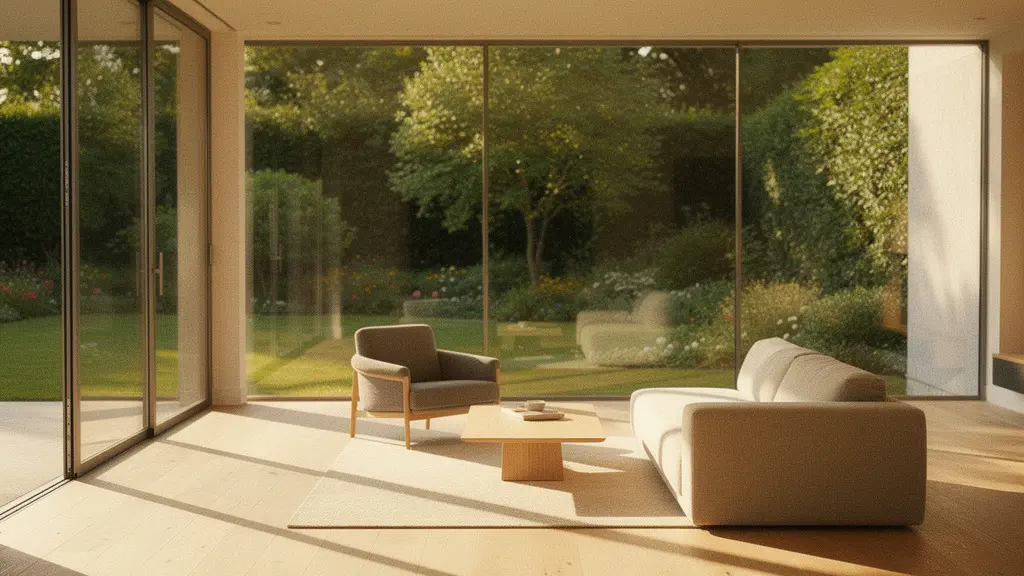
The transformative effect of floor-to-ceiling glass on small spaces is not an aesthetic illusion but a direct outcome of applied structural and optical engineering.
- Maximizing glazing height directly increases the physical depth of daylight penetration, illuminating areas far from the window.
- Slimmer, high-strength frames like steel are not just a design choice; they are structurally necessary to support larger, uninterrupted glass panes for panoramic views.
- Properly engineered systems mitigate inherent challenges like thermal distortion and heat loss, ensuring long-term performance and comfort.
Recommendation: Move beyond viewing glass walls as simple windows and analyze them as integrated systems where material choice, thermal breaks, and structural integrity dictate the success of the spatial expansion.
The desire to make a small property feel larger is a universal challenge for property owners. Conventional wisdom suggests using mirrors, light paint colors, and clever furniture placement. These are valid tactics, but they operate on the level of interior decoration, creating an illusion of space rather than fundamentally altering its perception. When the goal is a profound transformation, the conversation must shift from decoration to architecture, specifically to the engineering of light and structure through floor-to-ceiling glass walls.
Many discussions about large glass installations remain superficial, focusing on the obvious benefits of “more light” and “a connection to the outdoors.” While true, these statements fail to address the underlying physics and material science that make these transformations possible. The real power of a glass wall lies not just in its transparency, but in its engineered ability to manipulate daylight, bear structural loads with minimal visible support, and manage complex thermal dynamics. A successful installation is a testament to engineering precision, not just a bold design choice.
This article moves beyond the platitudes. We will deconstruct the structural and environmental engineering principles that allow floor-to-ceiling glass to genuinely expand a small space. We will not be discussing aesthetics, but rather the hard science of daylight penetration, the comparative tensile strengths of frame materials, the critical importance of thermal performance measured in U-values, and the mechanical solutions to problems like operational friction and bird safety. This is a technical examination of how to engineer openness, providing you with the knowledge to assess these systems not as a designer, but as an engineer would.
This guide delves into the specific technical questions that determine the success and longevity of a floor-to-ceiling glass installation. By understanding these core engineering concepts, you can make informed decisions that ensure your investment results in a truly expansive, functional, and enduring space.
Summary: Why Floor-to-Ceiling Glass Walls Transform Small Rooms into Open Spaces?
- Why Maximizing Glazing Height Increases Daylight Penetration Depth?
- How to Clean Recessed Tracks to Keep Heavy Doors Sliding Smoothly?
- Slim Aluminum vs Steel: Which Supports Larger Glass Panes?
- The Glass Safety Measure to Prevent Birds Flying into Your Wall
- How to Clean 3-Meter High Glass Without a Ladder?
- U-Value 1.4 vs 1.8: Is the Difference Worth the Extra Cost?
- Sliding vs Bifold Doors: Which Creates a Better Indoor-Outdoor Connection?
- The Distortion Problem That Jams Doors in Direct Sunlight
Why Maximizing Glazing Height Increases Daylight Penetration Depth?
The statement that tall windows “let in more light” is an oversimplification. The critical engineering benefit is the increase in daylight penetration depth—the distance natural light travels into a room to provide useful illumination. The physical principle is straightforward: the higher the head of a window, the steeper the angle of incoming sunlight, allowing it to reach further across the floor and ceiling. A common architectural rule of thumb suggests that daylight can effectively penetrate a distance of up to 2.5 times the window head height. Therefore, a 3-meter-high, floor-to-ceiling window can push useful light 7.5 meters into a space, whereas a standard 1.5-meter window in the same wall might only reach 3.75 meters.
The geometry of the window also plays a crucial role. A 2025 study published in Scientific Reports demonstrated that for a given area, rectangular windows deliver deeper daylight penetration than square ones. The research found that a vertical orientation maintained illuminance above the 500 lx threshold for 80% of office hours at a depth of 1.3 meters, a significant improvement over the 70% achieved by square windows. This confirms that maximizing the vertical axis is key.
To fully leverage this deepened light, the room’s interior surfaces must be engineered to act as secondary light sources. High reflectivity is paramount. Ceilings should have a reflectance of over 80% and walls over 50% to effectively bounce this deep light throughout the space. By using the entire vertical plane of a wall for glazing, you are not just opening a view; you are fundamentally re-engineering the light distribution system of the entire room, turning distant corners from dimly lit zones into functional, day-lit areas.
How to Clean Recessed Tracks to Keep Heavy Doors Sliding Smoothly?
A floor-to-ceiling sliding glass door’s effortless glide is a function of precision engineering within its recessed track. However, this flush, minimalist aesthetic creates a vulnerability: the track acts as a natural collection point for dust, grit, and debris. This accumulation is not merely an aesthetic issue; it can impede roller mechanisms, increase operational friction, and ultimately damage the system, turning a smooth slide into a strenuous effort. Maintaining these tracks is a non-negotiable aspect of long-term performance.
Effective maintenance requires a systematic, multi-tiered approach that addresses different types of debris over time. A simple wipe-down is insufficient. Professionals follow a schedule that escalates in intensity, ensuring all parts of the track, including the often-overlooked drainage channels and weep holes, remain clear and functional. This prevents both mechanical jamming and water-logging issues that can lead to more significant structural damage.
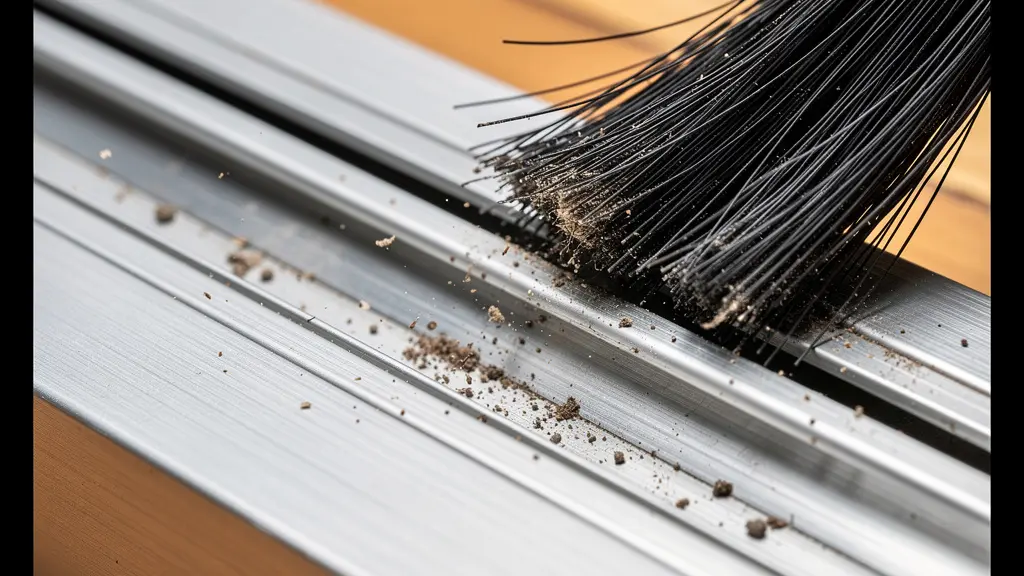
The choice of cleaning agents is as critical as the mechanical cleaning itself. A common mistake is using oil-based lubricants like WD-40. While they may provide temporary relief, their sticky residue actively attracts and traps more dirt and grit, exacerbating the problem over time. Instead, a silicone-based or dry PTFE lubricant is the correct engineering choice, as it provides a slick, non-sticky surface that repels debris. A disciplined cleaning regimen is the only way to preserve the door’s intended function.
- Weekly: Remove all visible surface debris using a stiff-bristled brush. Follow up with a vacuum cleaner using a crevice tool to extract all loose particles from the main channels.
- Monthly: Use a can of compressed air to dislodge fine dust and grit from tight corners, roller assemblies, and hard-to-reach areas that a brush or vacuum cannot access.
- Quarterly: After a thorough cleaning, apply a dedicated silicone-based or dry PTFE lubricant specifically designed for sliding doors to the moving parts, ensuring a smooth, low-friction glide.
- Biannually: Conduct a deep clean of all drainage channels within the track system. Carefully inspect and clear the weep holes to ensure water can escape, preventing pooling and potential water damage.
Slim Aluminum vs Steel: Which Supports Larger Glass Panes?
When designing an all-glass aesthetic, the primary structural challenge is supporting the immense weight of the glass and resisting wind loads with the most minimal frame possible. The choice between aluminum and steel is therefore not an aesthetic one, but a fundamental engineering decision dictated by material properties. As the experts at NanaWall Systems state, the core difference lies in their inherent strength:
Steel’s higher tensile strength and modulus of elasticity allow for significantly slimmer profiles to support the same glass weight and wind load, creating a more ‘all-glass’ look.
– NanaWall Systems, Floor-to-Ceiling Glass Walls Guide
This superior strength-to-volume ratio is the key. Steel’s tensile strength can be up to three times that of aluminum (250-2000 MPa for steel vs. 70-700 MPa for aluminum). This means a steel profile can be significantly narrower—often 20-40mm—while providing the same or greater structural support as a much wider aluminum profile of 60-80mm. This directly translates into the ability to design with larger, uninterrupted panes of glass. While a large aluminum frame might support a pane up to 3m x 2m, a high-strength steel system can accommodate monumental sizes, sometimes reaching up to 6m x 3m.
However, this structural advantage comes with trade-offs in cost and maintenance that must be factored into the engineering equation. The initial outlay for steel systems can be 50-100% higher than for aluminum, and they require diligent rust protection, whereas aluminum is naturally corrosion-resistant. Both materials require a thermal break—a non-conductive material separating the interior and exterior frame profiles—to achieve acceptable thermal performance. The decision ultimately rests on a project’s primary goal: if the objective is the absolute maximum glazed area with the minimum visible frame, steel is the superior engineering choice, despite its higher cost.
| Feature | Aluminum Frames | Steel Frames |
|---|---|---|
| Profile Width | 60-80mm typical | 20-40mm possible |
| Tensile Strength | 70-700 MPa | 250-2000 MPa |
| Maximum Glass Size | Up to 3m x 2m | Up to 6m x 3m |
| Thermal Performance | Good with thermal break | Requires thermal break |
| Cost (Initial) | Lower | 50-100% higher |
| Durability | 25-30 years | 50+ years |
| Maintenance | Minimal | Requires rust protection |
The Glass Safety Measure to Prevent Birds Flying into Your Wall
Large expanses of glass, particularly those that reflect surrounding vegetation or sky, pose a significant and often fatal threat to birds. From an engineering perspective, the problem is one of visual perception. Birds do not perceive clear or reflective glass as a solid barrier. Solving this requires modifying the glass surface to be visible to the avian eye without unacceptably compromising the human view. The most effective solutions are based on the biological differences between avian and human vision.
One of the most advanced and aesthetically unobtrusive solutions is UV-patterned glass. Birds can see light in the ultraviolet (UV) spectrum, whereas humans cannot. This allows for the application of a patterned UV-reflective coating that is clearly visible to birds as a barrier, but remains virtually invisible to the human eye under most conditions. This technology, such as Guardian’s Bird1st™ solution, builds on the differences in vision to protect wildlife while preserving the clarity and expansive views that the glass wall was designed to provide. This approach is far superior to simple decals, which obstruct views and offer less comprehensive coverage.
When UV-patterned glass is not feasible, other effective methods include fritted or acid-etched glass. A frit pattern consists of ceramic dots or lines baked onto the glass surface during manufacturing. To be effective, these patterns must follow the “2×4 rule”: horizontal elements should be no more than 2 inches apart, and vertical elements no more than 4 inches apart. While more visible to humans than UV coatings, these patterns can be integrated as a deliberate design element. The effectiveness of such treatments is significant; the application of a dot-pattern film at McCormick Place in Chicago led to a 95% reduction in bird collisions, demonstrating the profound impact of making glass visible to birds.
Action Plan: Implementing Bird-Safe Glass Solutions
- Assess New Builds: Specify UV-patterned glass (e.g., Bird1st™) at the design stage for the most effective and aesthetically pleasing solution. It is visible to birds in the UV spectrum but largely invisible to humans.
- Evaluate Fritted or Etched Options: For a permanent, integrated solution, consider fritted (ceramic dots) or acid-etched patterns that follow the 2-inch by 4-inch rule for bird visibility.
- Retrofit Existing Glass: For existing installations, apply a high-quality external film with a 2-inch grid or dot pattern. This is a cost-effective retrofit solution.
- Manage Environmental Factors: Reduce or eliminate exterior and interior nighttime lighting, especially during the spring and fall migration seasons, as artificial light disorients migrating birds.
- Confirm Efficacy: Ensure any chosen pattern or treatment is on the exterior surface (surface #1) of the glass, as reflections on inner surfaces can obscure the pattern and render it ineffective.
How to Clean 3-Meter High Glass Without a Ladder?
Cleaning expansive floor-to-ceiling glass presents a significant logistical and safety challenge. Using a ladder for heights of 3 meters or more is inefficient, hazardous, and often results in streaky, inconsistent finishes. The professional solution involves systems that allow for thorough cleaning from the ground, leveraging technology to ensure both safety and a perfect, spot-free result. The gold standard in this field is the water-fed pole system.
This system uses a telescopic pole, often made of lightweight carbon fiber, that can extend several meters. A specialized brush at the end agitates dirt on the glass surface while jets spray highly purified, de-ionized water. Because this water is stripped of all minerals and impurities, it evaporates without leaving any spots or streaks. This eliminates the need for a final squeegee pass and a second round of work, drastically improving efficiency and delivering a flawless finish. The operator remains safely on the ground throughout the entire process.
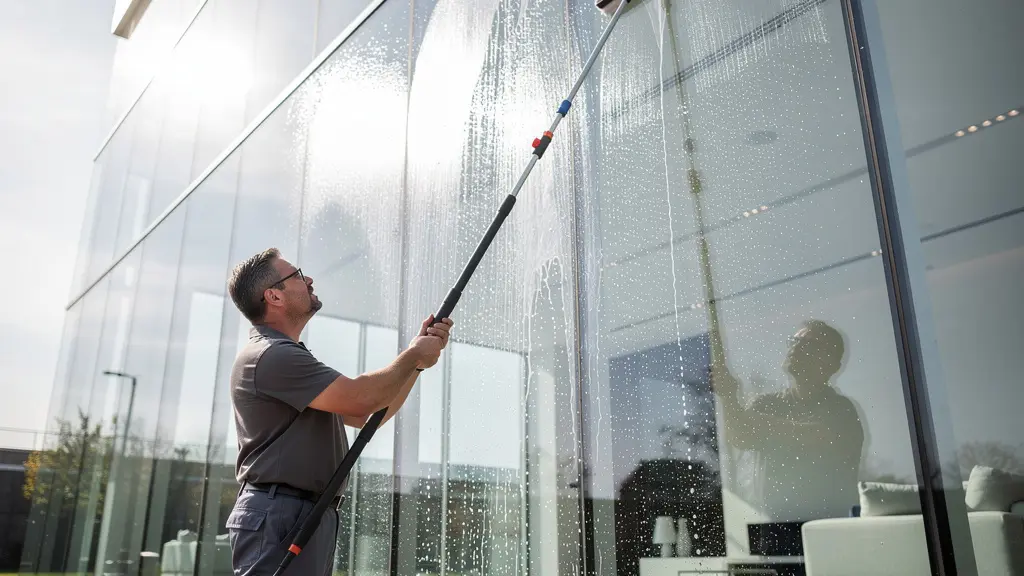
For those seeking to reduce cleaning frequency altogether, the application of a hydrophobic coating is a proactive engineering solution. These nano-coatings create a super-slick surface that causes water to bead up and roll off, taking dirt and grime with it (the “lotus effect”). While not eliminating the need for cleaning entirely, they can reduce the required frequency by up to 90%. Other technologies include robotic window cleaners, which are best suited for large, simple, and easily accessible panels, and advanced telescopic squeegee systems for manual cleaning where a water-fed pole is not practical. For heights consistently above 3 meters, investing in one of these professional-grade systems or engaging a service that uses them is the only way to maintain the clarity of the glass safely and effectively.
U-Value 1.4 vs 1.8: Is the Difference Worth the Extra Cost?
In the context of large glass walls, the U-value is the single most important metric for thermal performance. It measures the rate of heat transfer through the glazing unit, expressed in W/m²K (Watts per square meter per Kelvin). A lower U-value signifies better insulation and less energy loss. When comparing two high-performance units, such as one with a U-value of 1.8 and a superior one at 1.4, the question is not just about performance, but about the long-term return on the initial investment.
The difference of 0.4 W/m²K may seem small, but on a large glazed area, it has a significant cumulative impact on energy consumption. The calculation is straightforward: for every degree of temperature difference between inside and outside, a 1.8 U-value window loses 1.8 watts of energy per square meter, while a 1.4 U-value window loses only 1.4 watts. This 22% improvement in thermal resistance directly translates into lower heating and cooling costs year after year.
A cost-benefit analysis makes the financial case clear. As demonstrated by a comparative analysis from Vetrinawindows, the long-term savings often justify the higher upfront cost of the lower U-value unit. Over a decade, the accumulated energy savings can substantially offset or even exceed the initial price difference. Choosing the lower U-value is an investment in the building’s long-term operational efficiency, comfort, and sustainability.
| U-Value | Annual Energy Loss (20m² wall) | Annual Cost | 10-Year Total |
|---|---|---|---|
| 1.8 W/m²K | 1,800 kWh | $270 | $2,700 |
| 1.4 W/m²K | 1,400 kWh | $210 | $2,100 |
| Savings | 400 kWh/year | $60/year | $600 saved |
Sliding vs Bifold Doors: Which Creates a Better Indoor-Outdoor Connection?
The ultimate goal of a glass wall is often to create a seamless connection between indoor and outdoor living spaces. While both large-panel sliding doors and bifold doors can open up a wall, they achieve this through fundamentally different mechanical operations, which have a profound impact on the view, usability, and spatial planning. From a purely visual standpoint when closed, the choice is clear. As Vetrina Windows notes:
Large-panel sliding doors offer a superior, less-obstructed panoramic view due to fewer and slimmer vertical mullions compared to a folded set of bifolds.
– Vetrina Windows, Floor-to-Ceiling Windows Guide
This is the critical distinction for maximizing a view. A bifold system, by its nature, is a series of smaller hinged panels, resulting in multiple vertical frames that interrupt the panorama. A sliding system can be engineered with massive individual panels (3 meters wide or more), drastically reducing the number of vertical sightlines and creating a truly cinematic, uninterrupted vista.
The trade-off occurs when the doors are open. A bifold system can fold away to create a 90-95% clear opening, effectively removing the wall entirely. A standard sliding system, however, typically only opens up to 50% of the total width, as one panel slides behind another. While pocket sliding systems that disappear into the wall can achieve a 100% opening, they require significant structural work and wall depth. Furthermore, the daily operation and spatial impact differ significantly. A single sliding panel is effortless to open for quick access, whereas opening a bifold system is a multi-step process. Bifolds also require a large, clear “stacking zone” either inside or outside for the folded panels, which impacts furniture placement. Sliding doors have zero impact on furniture, as they move within their own plane.
| Feature | Sliding Doors | Bifold Doors |
|---|---|---|
| View When Closed | Minimal obstruction | Multiple vertical frames |
| Opening Width | 50% maximum | 90-95% possible |
| Furniture Impact | Zero – slides along wall | Requires clear stacking zone |
| Daily Operation | Single panel, effortless | Multi-step process |
| Wind Resistance | Excellent | Vulnerable when open |
| Cost | Lower | 20-40% higher |
Key Takeaways
- Structural Integrity Dictates Design: The ability to use vast, uninterrupted glass panes is a direct function of the frame material’s tensile strength, with steel offering slimmer profiles for larger panes than aluminum.
- Thermal Performance is Non-Negotiable: A low U-value and a quality thermal break are not optional upgrades but essential engineering components to prevent massive energy loss and ensure occupant comfort.
- Maintenance is a Design Consideration: Systems like recessed tracks and expansive glass surfaces require planned, specialized maintenance protocols (e.g., water-fed poles, silicone lubricants) to ensure long-term functionality.
The Distortion Problem That Jams Doors in Direct Sunlight
One of the most critical and often overlooked engineering challenges with large glass door systems, particularly those with dark-colored metal frames, is thermal distortion, or bowing. On a hot, sunny day, a dark frame exposed to direct sunlight can absorb a significant amount of solar radiation, causing its temperature to rise far above the ambient air temperature. This heating is rarely uniform. The exterior face of the frame gets much hotter than the interior face, causing the metal to expand differentially. This uneven expansion can cause the entire frame to bow or warp, sometimes by several millimeters.
This distortion is a serious mechanical problem. In a tightly toleranced sliding or bifold door system, even a few millimeters of bowing can be enough to cause the door to bind, jam, or become difficult to operate. It can compromise the weather seals, leading to drafts and water ingress. The primary engineering solution to this problem is the integration of a high-quality polyamide thermal break. This strip of low-conductivity plastic physically separates the inner and outer profiles of the metal frame. It acts as an insulator, preventing the heat absorbed by the exterior profile from transferring to the interior profile, thus dramatically reducing the temperature differential and the resulting distortion.
Several other strategies must be employed in tandem. Choosing lighter frame colors (white, silver) can significantly reduce solar heat absorption compared to black or dark bronze. During installation, ensuring there are proper expansion tolerances (typically 3-5mm) allows the frame to expand and contract naturally without binding. For south and west-facing elevations that receive the most intense solar radiation, incorporating exterior shading devices like overhangs or louvers can provide the most effective protection by preventing direct sunlight from hitting the frame in the first place. Addressing thermal distortion at the design phase is crucial for ensuring the door operates smoothly and reliably throughout its lifespan.
By dissecting the engineering principles behind floor-to-ceiling glass, it becomes clear that creating a truly expansive space is a matter of technical precision. From specifying the correct U-value for your climate to choosing a frame material based on its tensile strength, every decision has a cascading effect on performance, durability, and comfort. To apply these concepts effectively, the next logical step is to secure a detailed structural and thermal analysis for your specific property. This will transform these theoretical principles into an actionable blueprint for your project.