Bioclimatic design is not an expense; it’s a high-return investment in your home’s financial performance and your family’s health.
- It transforms your home’s structure into a dynamic thermal asset, actively harvesting and conserving energy to drastically reduce utility costs.
- It systematically engineers superior indoor air quality and natural light, creating a healthier living environment with demonstrable well-being benefits.
Recommendation: Evaluate your home project not by its initial cost, but by its 30-year lifecycle value—factoring in energy savings, maintenance, and occupant wellness.
For most homeowners, the battle against rising energy bills feels like a constant, losing struggle. You invest in better insulation, consider new windows, and meticulously manage the thermostat, yet comfort remains elusive and costs continue to climb. This reactive approach treats the home as a passive, leaking box that must be constantly force-fed energy. We are told to plug the gaps, but we are rarely shown how to redesign the system itself.
What if the house itself—its orientation, its materials, its very form—could become an active, intelligent system for managing energy? This is the core premise of bioclimatic design. It moves beyond the patchwork of individual “eco” solutions to a holistic philosophy where the building’s envelope becomes a high-performance thermal asset. This isn’t merely about being “green”; it’s about applying data-driven architectural principles to achieve a radical improvement in efficiency, comfort, and occupant health. It’s a strategic shift from spending on energy to investing in architectural performance.
This article will deconstruct the financial and wellness case for bioclimatic architecture. We will move beyond the platitudes and dive into the hard data, examining how specific design choices translate into measurable returns. From the science of ventilation and its impact on respiratory health to the long-term ROI of passive systems, you will discover how to turn your home into a model of sustainability and a sanctuary for well-being.
To fully grasp the interconnected strategies that make bioclimatic design so effective, this guide is structured to walk you through each critical component. The following summary outlines the key areas we will explore, from foundational principles to advanced material science.
Summary: The Core Pillars of a High-Performance Bioclimatic Home
- Why Living in a Poorly Ventilated Home Increases Respiratory Risks by 30%?
- How to Orient Your Extension to Capture 6 Hours of Winter Sun Daily?
- Active Systems vs Passive Design: Which Yields a Better ROI over 15 Years?
- The Common Glazing Mistake That Turns Summer Conservatories into Ovens
- How to Reduce Artificial Lighting Needs by 50% Through Structural Layout?
- Why S-Shaped Blades Seal Better Against Rain Than Flat Blades?
- Why Your Conservatory Loses Heat 4x Faster Than Your Living Room?
- Why High-Grade Aluminum Structures Outlast Wood in Coastal Environments?
Why Living in a Poorly Ventilated Home Increases Respiratory Risks by 30%?
We tend to think of pollution as an outdoor problem, but the air inside our tightly sealed modern homes can be significantly more hazardous. Without adequate air exchange, a cocktail of volatile organic compounds (VOCs) from furniture and paints, along with CO2 from our own breath and moisture from daily activities, accumulates. This creates a breeding ground for mold and dust mites, directly impacting respiratory health. This isn’t speculation; it’s a critical aspect of wellness engineering, where architectural choices have direct health consequences.
The link between poor ventilation and respiratory illness is well-documented. Stagnant, humid air is a primary trigger for asthma and allergies. By implementing a dynamic ventilation strategy, we can actively manage indoor air quality. In fact, well-designed passive homes that incorporate balanced ventilation demonstrate remarkable health benefits. For instance, studies from 2018 show a 40% drop in asthma flare-ups for occupants living in homes with controlled, fresh air circulation. This highlights that ventilation is not just about comfort; it’s a fundamental pillar of preventative healthcare built into the home’s design.
A bioclimatic approach doesn’t just rely on opening a window. It employs a systematic strategy, combining passive cross-ventilation with mechanical systems that recover heat. The goal is to achieve a complete air change at regular intervals without losing the thermal energy you’ve worked so hard to gain. This ensures a constant supply of fresh, filtered air, maintaining indoor humidity in the optimal 40-60% range and significantly reducing the concentration of airborne pathogens and allergens. The home transforms from a static container into a living, breathing system that supports occupant health.
Action Plan: Dynamic Air Quality Management
- Implement a morning ‘fresh air flush’ by opening windows for 15 minutes daily to expel overnight CO2 buildup.
- Use cross-ventilation during mid-day to actively expel VOCs from furniture and paints.
- Install a mechanical ventilation with heat recovery (MVHR) system for a constant, filtered air supply without significant heat loss.
- Position exhaust extraction points in high-moisture areas like kitchens and bathrooms, while supplying fresh air to living spaces and bedrooms.
- Monitor indoor humidity levels with a hygrometer, aiming to maintain a 40-60% range for optimal respiratory health.
How to Orient Your Extension to Capture 6 Hours of Winter Sun Daily?
The sun is the most powerful and free energy source available to a home. In a conventional building, it’s often treated as a nuisance—a source of glare and overheating to be blocked with blinds. In bioclimatic design, the sun is a primary utility to be harvested, stored, and deployed with precision. The orientation of your home or extension is the single most important decision in determining its energy performance. It’s not about simply facing south; it’s about understanding the sun’s path throughout the year and aligning the home’s functions with its rhythm.
The ideal orientation is a strategic compromise between maximizing winter heat gain and minimizing summer overheating. A purely south-facing orientation captures the most winter sun, as the low-angle rays penetrate deep into the building. However, a south-east orientation often provides a superior living experience. As European bioclimatic case studies show, this captures valuable morning sun, which is perfect for kitchens and breakfast areas, warming the house after a cool night and reducing lighting needs. It cleverly avoids the intense, low-angle afternoon sun in summer, which is harder to shade.
Choosing the right orientation is a data-driven process that directly impacts your architectural ROI. Each direction offers a different profile of light and heat, making it suitable for different purposes. Utility rooms and garages can be placed on the north side, acting as a thermal buffer, while primary living spaces benefit from the southern exposure. The following table breaks down these trade-offs, providing a clear framework for strategic placement.
This comparative analysis, based on solar path data, provides a clear decision-making framework for optimizing your home’s layout for both energy efficiency and comfort. As this strategic breakdown of solar strategies illustrates, the right orientation is a fundamental asset.
| Orientation | Winter Heat Gain | Summer Protection | Best Use Case | Daily Sun Hours |
|---|---|---|---|---|
| South (Pure) | Maximum (100%) | Good with overhangs | Living spaces needing heat | 6-8 hours |
| South-East | High (85%) | Excellent (avoids afternoon sun) | Morning activity areas | 5-6 hours |
| South-West | High (85%) | Poor (captures hot afternoon sun) | Evening use spaces | 5-6 hours |
| East | Moderate (40%) | Good (morning sun only) | Bedrooms, kitchens | 3-4 hours |
| West | Low (30%) | Very Poor (maximum heat gain) | Storage, utility | 3-4 hours |
Active Systems vs Passive Design: Which Yields a Better ROI over 15 Years?
The conventional approach to home comfort is active: when it’s cold, a boiler burns fuel to generate heat; when it’s hot, an air conditioner consumes electricity to cool the air. These are complex, expensive systems that require constant energy input and maintenance. Passive design flips this paradigm on its head. It invests upfront in the building’s “chassis”—its insulation, airtightness, and glazing—to dramatically reduce the need for active systems in the first place. The question for any homeowner is: which approach delivers a better return?
The data is overwhelmingly in favor of the passive approach. By creating a super-insulated and airtight building envelope, a passive house minimizes heat loss to such an extent that a conventional heating system becomes redundant. The minimal heat required can be provided by a small, simplified system, often integrated with the ventilation. The performance results are staggering, with measurement data from passive house projects confirming 72% heating energy savings on average compared to standard new builds. This isn’t a marginal improvement; it’s a fundamental re-engineering of a home’s energy consumption.
This is where the concepts of Lifecycle Value and Architectural ROI become tangible. While the initial investment in the building envelope may be higher, the savings on eliminated or downsized mechanical systems, coupled with decades of near-zero heating bills, create an undeniable financial case. A high-performance structure is a long-term asset that pays dividends every year.

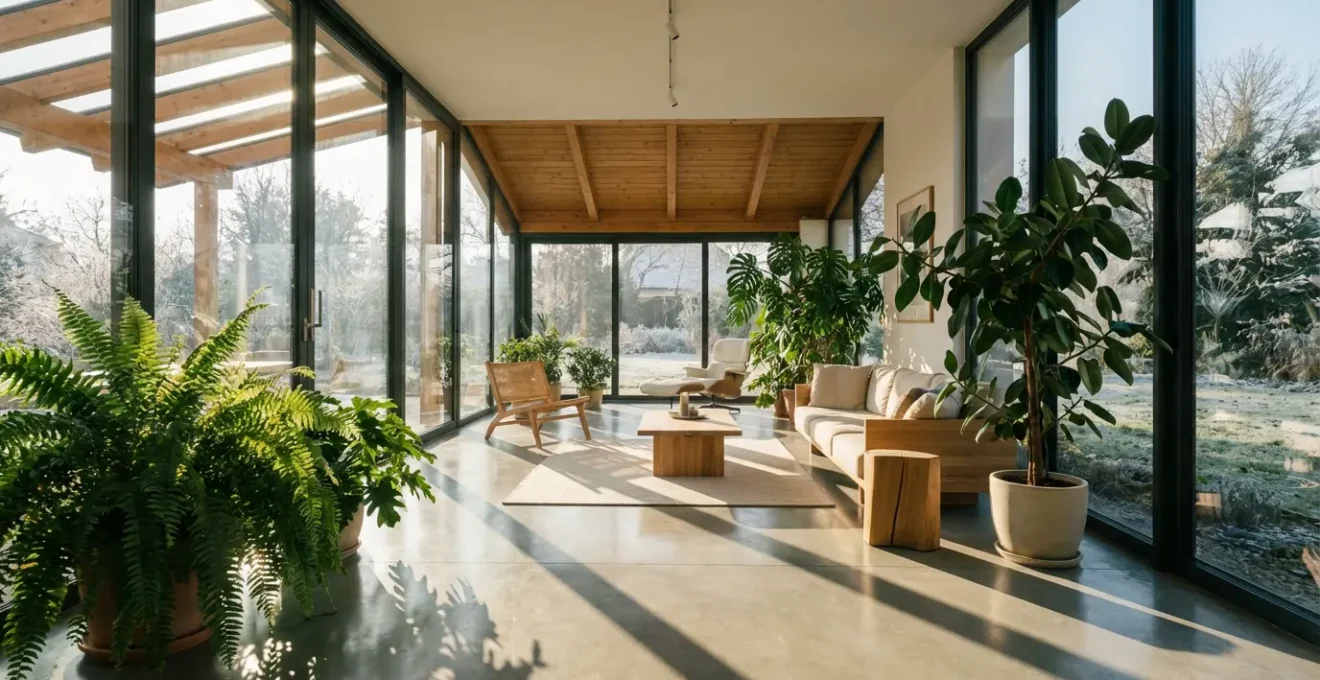
This principle is perfectly demonstrated by thermal mass floors, like the polished concrete seen here. The structure itself becomes an active part of the heating system, absorbing free solar energy during the day and slowly releasing it at night. This is the essence of passive design: turning the building’s static elements into dynamic, energy-managing components.
Case Study: 30-Year Lifecycle Cost Comparison
A comprehensive lifecycle analysis comparing a passive house design with standard construction reveals profound long-term savings. The passive design required an initial $30,000 in shell improvements (insulation, windows) but eliminated the need for a $15,000 traditional boiler system, resulting in a net upfront increase of just $15,000. However, over a 30-year period, this initial investment yielded a staggering $170,000 in energy savings. The total return represented 70% of the original construction cost, proving that investing in the building envelope offers a far superior ROI than relying on expensive, energy-intensive active systems.
The Common Glazing Mistake That Turns Summer Conservatories into Ovens
A conservatory should be a bridge between your home and the garden, a light-filled space usable year-round. Too often, it becomes an uninhabitable greenhouse in summer and a frigid icebox in winter. This failure is almost always due to a single, critical misunderstanding: selecting glass based on insulation value alone. Homeowners and even some builders focus exclusively on the U-value, a measure of how well the glass prevents heat from escaping. But in a structure made almost entirely of glass, preventing the sun’s heat from *entering* is equally, if not more, important.
This is where the Solar Heat Gain Coefficient (SHGC) comes in. SHGC is a rating from 0 to 1 that measures how much of the sun’s heat radiation is transmitted through the glass. A low SHGC means the glass blocks a significant amount of solar heat, keeping the interior cool. A high SHGC allows more heat to pass through, which is beneficial for winter passive heating. The common mistake is using high-SHGC glass on all surfaces, especially the roof, which receives the most intense summer sun. This effectively turns the conservatory into a solar oven.
A strategic bioclimatic approach uses different types of glazing for different orientations. Low-SHGC glass is essential for the roof and any west-facing panes that receive harsh afternoon sun. Higher-SHGC glass can be used on vertical, south-facing windows to maximize passive solar gain in winter. This nuanced approach is part of designing a dynamic envelope that intelligently filters the sun’s energy depending on the season.
U-value is the coat that keeps you warm in winter, but SHGC is the umbrella that keeps you from getting sunburnt in summer. For a conservatory, the umbrella is often more important.
– Building Science Expert, Bioclimatic Design Principles
This simple analogy perfectly captures the dual role of modern glazing. To create a truly comfortable, four-season space, you must consider both properties. The optimal solution is a “system of three”: spectrally selective glazing with a low SHGC, effective external shading to stop the sun before it hits the glass, and well-designed cross-ventilation to exhaust any accumulated heat.
How to Reduce Artificial Lighting Needs by 50% Through Structural Layout?
Daylight is more than just free illumination; it’s a critical component of human health and well-being. It regulates our circadian rhythms, improves mood, and enhances productivity. A core tenet of bioclimatic design is to maximize the penetration of high-quality, diffuse natural light deep into the building, thereby reducing the reliance on artificial lighting. This isn’t just about adding more windows; it’s about using the building’s structure to guide and distribute light intelligently.
Achieving a 50% reduction in artificial lighting use requires moving beyond simple windows and employing advanced daylighting techniques. These strategies work by capturing sunlight at high levels and reflecting it deep into the floor plan. For example, light shelves, which are horizontal surfaces placed above eye-level, shade the area near the window from direct glare while bouncing diffuse light onto the ceiling, illuminating the room evenly. Similarly, clerestory windows—short, wide windows set high up on a wall—provide excellent, balanced light without compromising privacy or creating unwanted solar gain at low levels.
The integration of these features creates a superior “wellness engineering” environment. As demonstrated in studies on spaces with enhanced daylighting, there are tangible health benefits, including reduced allergy symptoms and improved occupant mood, which translate into thousands of dollars saved in health expenses over the long term. The right daylighting strategy is a powerful tool for both energy savings and creating a healthier home. The following table compares some of the most effective techniques.
Each technique offers a different way to sculpt light within a space, and a comprehensive bioclimatic design often combines several to achieve optimal results. This data from an analysis of bioclimatic house components shows the variety of tools available.
| Technique | Light Distribution | Glare Control | Installation Cost | Depth of Penetration |
|---|---|---|---|---|
| Light Shelves | Bounces light to ceiling | Excellent | Moderate | 2.5x window height |
| Clerestory Windows | High-level diffuse light | Very Good | High | Full floor plan |
| Tubular Skylights | Concentrated spots | Good with diffuser | Low | Single room |
| Transom Windows | Room-to-room transfer | Good | Low | Adjacent spaces |
| Reflective Surfaces | Amplifies existing light | Variable | Very Low | Depends on placement |
Why S-Shaped Blades Seal Better Against Rain Than Flat Blades?
In the design of a dynamic building envelope, particularly for extensions like bioclimatic pergolas, the devil is in the details. The ability to control sun and shade with adjustable blades is a key feature, but their performance during rainfall is what truly separates a high-quality system from a liability. While flat blades may seem simpler, the geometry of an S-shaped blade provides a fundamentally superior seal against water ingress, relying on principles of physics rather than simple compression.
When S-shaped blades interlock, they don’t just meet edge-to-edge. They create a multi-turn “labyrinth seal.” This forces any penetrating water to travel a complex path, overcoming multiple barriers, changing direction, and fighting gravity and surface tension at each turn. It’s an exponentially more effective water barrier than the single point of contact offered by a flat blade overlap, which can easily be compromised by wind-driven rain or slight misalignments. Rigorous testing, like that performed at the CSTB (Scientific and Technical Centre for Building) on high-end pergola systems, confirms the superior wind and rain resistance of this interlocking geometry.
Beyond the pure mechanics of water resistance, the S-shaped profile delivers an often-overlooked benefit that contributes directly to occupant wellness: acoustic performance. The robust, interlocking fit and the curved profile of the blades change how they react to the impact of heavy rain, resulting in a more serene indoor environment.
The snug fit and curved shape of S-blades dampen the drumming sound of heavy rain, creating a more serene and peaceful indoor environment compared to the noise generated on flat-bladed roofs.
– Acoustic Engineering Study, Bioclimatic Pergola Design Analysis
This is a perfect example of how sophisticated engineering in bioclimatic design delivers benefits on multiple levels. A design choice made for superior weatherproofing also results in a quieter, more comfortable, and therefore healthier living space. It’s a testament to a holistic approach where every component is optimized for performance and well-being.
Why Your Conservatory Loses Heat 4x Faster Than Your Living Room?
Many homeowners who add a conservatory are shocked by how quickly it becomes cold the moment the sun sets, and how much it costs to keep it warm. The reason is rooted in fundamental building physics. A conservatory is mostly glass, and even the best double or triple glazing has a much higher rate of heat transfer (a higher U-value) than a well-insulated wall. Furthermore, the metal frames used in construction can act as “thermal bridges,” creating super-highways for heat to escape your home.
The result is a space with a drastically different thermal performance from the rest of the house. An analysis of construction characteristics reveals that a typical conservatory can have an 8 times faster heat dispersion rate compared to a standard living room. This means that for every degree of heat you pump into the space, it escapes eight times faster. This is why a simple radiator, perfectly adequate for a bedroom, can feel completely ineffective in a conservatory. It’s like trying to fill a bucket with a massive hole in the bottom.
This is where bioclimatic principles become essential. To combat this rapid heat loss, a modern conservatory must be designed as a complete thermal system. This involves using high-performance glazing with low U-values, but more importantly, it requires frames with a “thermal break.” This is a layer of non-conductive material, typically a polyamide, that is placed inside the aluminum frame to separate the inner and outer surfaces. This simple-sounding innovation dramatically reduces the thermal bridging effect, keeping the indoor frame warm and preventing massive heat loss.
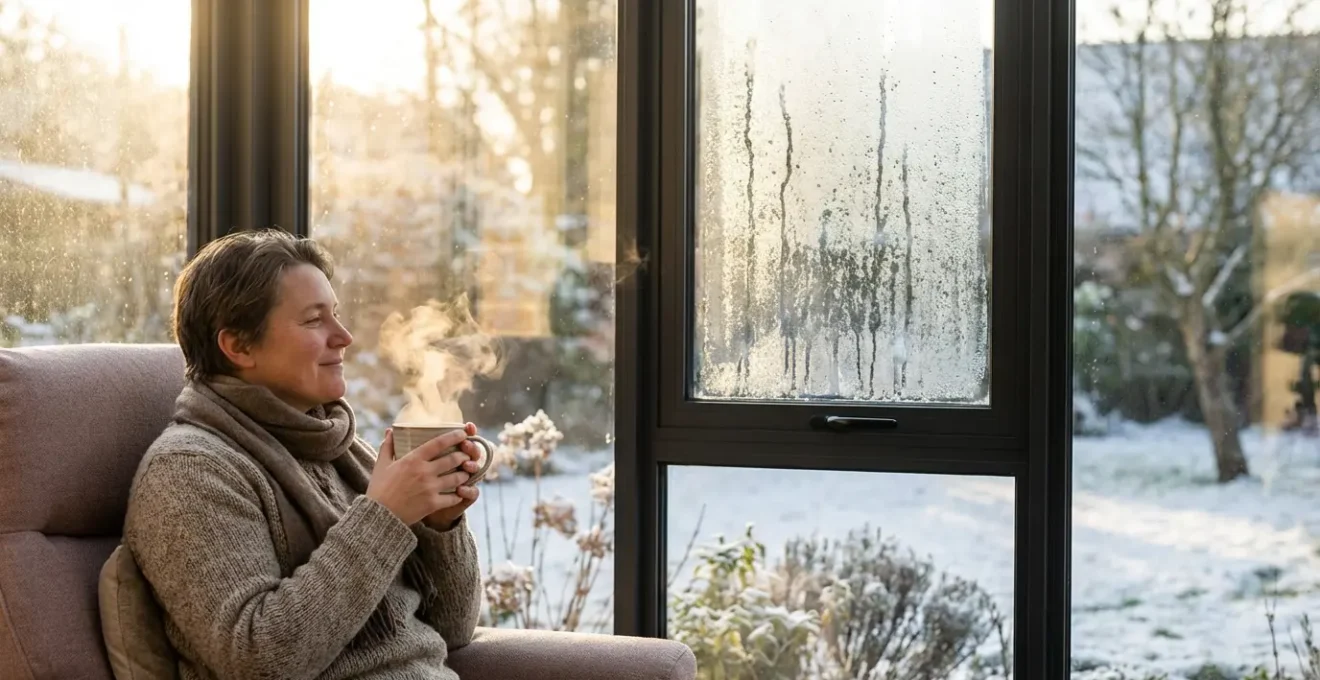
The image of someone enjoying a warm drink in a conservatory on a cold day is the ultimate goal. This level of comfort is not accidental; it is engineered. It is the direct result of a well-designed thermal envelope—with high-performance glass and thermal-break frames—that allows for comfort and connection to the outdoors without paying a severe energy penalty.
Key Takeaways
- Bioclimatic design is a financial strategy: It prioritizes upfront investment in the building envelope to generate decades of energy savings, yielding a higher lifecycle ROI than conventional construction.
- Your home’s design is a health intervention: By systematically managing air quality, humidity, and daylight, bioclimatic principles directly contribute to a healthier indoor environment and occupant well-being.
- Performance is in the details: From the SHGC of the glass to the shape of a pergola blade, long-term durability and comfort are determined by a data-driven approach to material science and engineering.
Why High-Grade Aluminum Structures Outlast Wood in Coastal Environments?
When building near the coast, the environment itself becomes a primary adversary. The combination of high humidity, salt spray, and intense UV radiation relentlessly attacks building materials. While the rustic appeal of wood is undeniable, its performance in a marine environment is notoriously poor. Wood is hygroscopic, meaning it absorbs moisture from the air, leading to swelling, warping, and rot. It requires constant, costly maintenance—staining, sealing, and replacing—to fight a battle it will eventually lose.
In contrast, high-grade, powder-coated aluminum offers a vastly superior solution for long-term durability and lifecycle value. The key lies in its material science. When exposed to air, aluminum instantly forms a passive, inert oxide layer that protects it from further corrosion. When this is combined with a factory-applied electrostatic powder coating, such as those certified by Qualicoat® and Qualimarine®, the structure becomes virtually impervious to salt spray. Leading manufacturers are so confident in this technology that they offer 25-year warranties even in the harshest coastal settings.
This long-term performance completely reframes the cost equation. While the initial material cost of a marine-grade aluminum structure may be higher than treated wood, the total cost of ownership over 25 years is dramatically lower. By eliminating the need for regular, labor-intensive maintenance, the aluminum structure proves to be the superior financial investment, as the following comparison demonstrates.
The data from this long-term material performance analysis is clear: when considering the total cost of ownership, aluminum’s resilience makes it the most cost-effective choice for coastal construction.
| Material | Initial Cost | Maintenance Frequency | 25-Year Total Cost | Warranty Period | Salt Resistance |
|---|---|---|---|---|---|
| Marine-Grade Aluminum | 100% (baseline) | None required | 100% | 25 years | Excellent (inert oxide layer) |
| Treated Wood | 70% | Every 3-5 years | 220% | 5-10 years | Poor (hygroscopic swelling) |
| Standard Aluminum | 85% | Every 10 years | 120% | 10-15 years | Good |
| Composite Materials | 90% | Every 7 years | 140% | 15 years | Moderate |
| Vinyl/PVC | 60% | Every 5 years | 180% | 10 years | Moderate (UV degradation) |
Modern sublimation processes even allow for hyper-realistic wood grain finishes on aluminum, offering the aesthetic of wood without its inherent vulnerabilities. This allows homeowners to achieve their desired look without compromising on the decades of maintenance-free performance that define a true bioclimatic investment.
By embracing bioclimatic principles, you are not just building or renovating a house; you are commissioning a high-performance system designed for financial resilience and optimal well-being. Begin evaluating your next project not by its initial price tag, but by its 30-year lifecycle value. This is the shift in mindset that unlocks true, lasting sustainability.