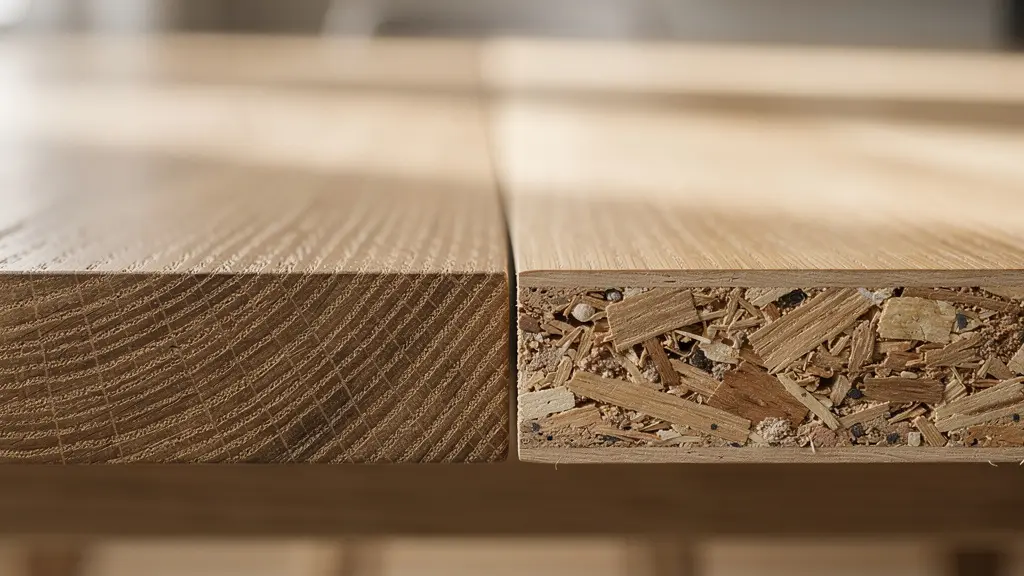
A solid oak table is not an expense; it is a multi-generational investment in your family’s story, gaining character and value where veneer simply depreciates.
- Its structure, from the dense grain to traditional dovetail joints, is engineered for a century of use, not just a decade.
- It can be sanded and refinished repeatedly to erase damage or adapt to new decor, making it economically and stylistically timeless.
Recommendation: Look beyond the price tag to assess the joinery, the type of oak (white vs. red), and the finish—these are the true indicators of a future heirloom.
When you stand in a showroom, the choice between a solid oak dining table and its veneered counterpart can seem like a simple matter of budget. One has a higher price tag; the other seems to offer the same look for less. This is the first and most common misunderstanding. As an appraiser, I don’t see two similar tables—I see two entirely different futures. One is a disposable good, designed to look its best the day it arrives and decline from there. The other is the beginning of a legacy, a piece of ‘Heirloom Equity’ that will absorb the story of your family, its value measured in decades of shared meals and celebrations.
Most advice focuses on the superficial: “solid wood is more durable,” “veneer can chip.” While true, this misses the fundamental point. A solid oak table possesses a living character. It responds to its environment, it bears the marks of a life well-lived, and most importantly, it can be reborn time and time again. Veneer, which is merely a paper-thin layer of wood glued to a core of composite board or lesser timber, offers no such promise. Any significant scratch, water ring, or peeling edge is a fatal wound. It cannot be sanded, it cannot be truly repaired; its fate is the landfill.
This guide is not about comparing two products. It is about shifting your perspective from that of a consumer to that of a custodian. We will explore why the ability to refinish a table is its greatest economic advantage, how to care for it through simple rituals, and what to look for in its construction to ensure it outlasts us all. We will value it not for its flawless surface today, but for its capacity to hold the beautiful, imperfect patina of your family’s life for generations to come.
To truly understand the lasting value of solid oak, we will examine the key aspects that define its longevity and adaptability. The following sections break down everything from its capacity for renewal to the secrets of its enduring structural integrity.
Summary: Why a Solid Oak Dining Table Is the Definitive Choice for a Family Heirloom
- Why Solid Oak Can Be Sanded and Refinished 10 Times Over?
- How to Re-Oil Your Oak Table to Prevent Water Stains?
- White Oak vs Red Oak: Which Grain Pattern Suits Modern Decor?
- The Humidity Mistake That Cracks Solid Wood Tables in Winter
- When to Tighten the Bolts: Adjusting Your Table After Delivery?
- Green Oak vs Glulam: Which Is More Stable for Large Spans?
- Why Dovetail Drawers Last 50 Years Longer Than Glued Joints?
- How to Achieve a “Driftwood” Look That Actually Protects the Timber?
Why Solid Oak Can Be Sanded and Refinished 10 Times Over?
The single greatest value proposition of a solid oak table is its capacity for renewal. A veneer table is a static photograph, but a solid oak table is a living canvas. Over 50 years, a family might change their home’s decor three or four times. A deep cherry stain that suited a traditional dining room can be sanded away and replaced with a light, natural finish for a modern, Scandinavian aesthetic. This adaptability is impossible with veneer, where the surface is the only thing of value.
This isn’t just about aesthetics; it’s about profound economic sense. When a veneered table is damaged or falls out of fashion, your only option is costly replacement. A solid oak table, however, can be professionally restored to its former glory. Studies show that refinishing costs are typically 30-50% less expensive than buying a new table of comparable quality. Each refinishing cycle doesn’t just restore the table; it adds to its story. The minor imperfections that remain become part of its character, a concept I call the “patina of life.”
Consider a deep scratch from a child’s art project or a water ring from a memorable holiday dinner. On a veneer piece, these are permanent blemishes that signal the end. On solid oak, they are temporary marks. A skilled hand can sand the surface down, erasing the damage completely without ever reaching the end of the material. This process can be repeated for over a century, ensuring the table not only serves your family but is ready to be passed on to the next generation, fresh and ready for their own stories.
How to Re-Oil Your Oak Table to Prevent Water Stains?
Caring for a solid oak table is not a chore; it is a ritual. It is the simple act of stewardship that connects you to the piece and preserves its vitality. While lacquers and polyurethanes create a plastic-like barrier on the surface, an oil finish penetrates deep into the wood’s pores. This maintains the timber’s natural texture and feel, allowing you to connect directly with the grain your family has gathered around for years. This connection is something no veneer can offer.
The process of re-oiling is your primary defense against water stains and daily wear. As the experts at Grain & Frame note in their guide, this method is superior for maintaining the wood’s inherent beauty. As they put it:
Wood oils do a great job of protecting your table, whilst still maintaining the natural feel and texture of the wood. Wood oils are also great at enhancing the natural colour of the wood whilst protecting against spillages and general use.
– Grain & Frame Experts, Wood Table Maintenance Guide
This simple act of wiping on a new coat of conditioning oil every six to twelve months is akin to feeding the wood. It replenishes the moisture, deepens the color, and creates a hydrophobic barrier that causes water to bead up on the surface rather than soak in. It’s a five-minute task that ensures your table’s surface remains resilient and beautiful.
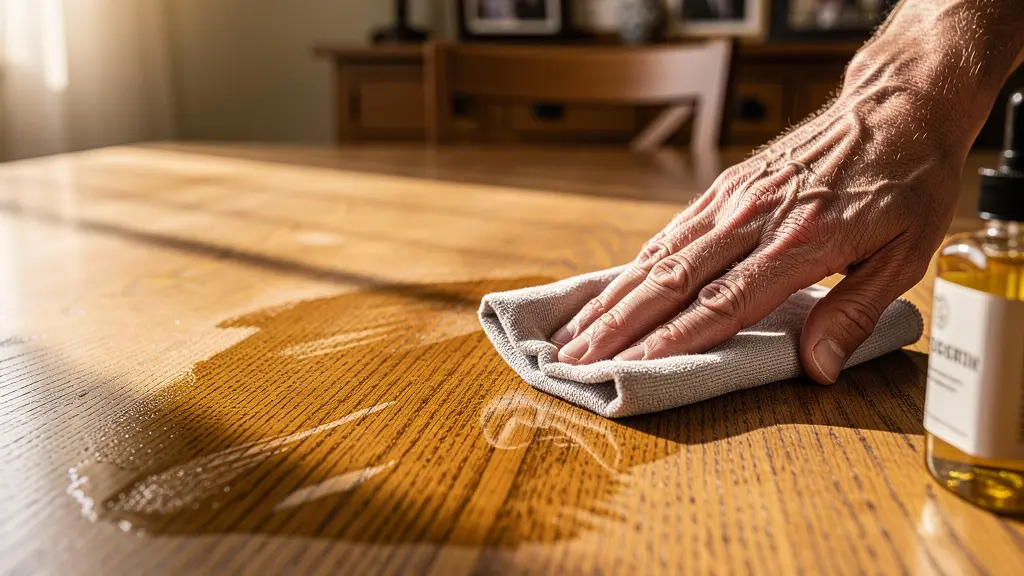
As you can see, this is an intimate process. It is this hands-on care that transforms a piece of furniture from a mere object into a cherished member of the home. You are not just cleaning a surface; you are preserving a legacy, ensuring the living character of the wood endures for decades of service.
White Oak vs Red Oak: Which Grain Pattern Suits Modern Decor?
Choosing between White Oak and Red Oak is one of the first and most important decisions in commissioning a “forever table.” This choice goes far beyond color; it defines the table’s character, its durability, and how it will complement your home’s style over the long term. From an appraiser’s viewpoint, both are excellent hardwoods, but they have distinct personalities. The grain of Red Oak is more porous and dramatic, with wide, swirling patterns that lend themselves beautifully to rustic, traditional, or farmhouse aesthetics. Its warmer, reddish-blonde tones create an immediate sense of welcome.
White Oak, conversely, has a finer, straighter, and more subtle grain pattern. Its cooler, light brown-to-yellowish tones make it the preferred choice for modern, contemporary, and minimalist interiors. But its advantages are not purely aesthetic. White Oak scores higher on the Janka hardness test, a professional measure of a wood’s resistance to denting and wear. It also contains microscopic, balloon-like structures called tyloses within its grain, making it naturally more resistant to water and rot—the very reason it has been the wood of choice for boat builders and barrel makers for centuries.
This table outlines the key differences to help guide your decision, ensuring your investment aligns with both your home’s design language and your family’s lifestyle.
| Characteristic | White Oak | Red Oak |
|---|---|---|
| Janka Hardness | 1360 | 1290 |
| Water Resistance | Superior (tyloses present) | Moderate |
| Grain Pattern | Subtle, straight | Pronounced, open |
| Natural Color | Light, cooler tones | Warm, blonde |
| Best For | Modern/Contemporary | Rustic/Traditional |
Ultimately, selecting the right species is about foresight. By matching the oak’s inherent character to your long-term vision for your home, you ensure the table will never feel dated, but will instead become a perfectly integrated centerpiece of your family’s life.
The Humidity Mistake That Cracks Solid Wood Tables in Winter
One of the most essential concepts to grasp as the custodian of a solid wood table is that the material is still “alive.” It breathes. Wood is a hygroscopic material, meaning it absorbs and releases moisture from the air to stay in equilibrium with its environment. This is its natural state, and a sign of its authenticity. A veneer table, sealed in plastic and adhesives, is inert and lifeless. An oak table, by contrast, will subtly expand in the humid summer months and contract in the dry air of winter.
The most common and damaging mistake a new owner can make is ignoring this “living character,” particularly during winter. Central heating systems create an artificially arid environment, rapidly pulling moisture from the wood. If this process happens too quickly or the humidity drops too low, the wood shrinks and builds up internal stress. This stress is what can lead to fine cracks or checks, especially near the ends of the boards. This is not a defect in the wood; it is a predictable reaction to an imbalanced environment.
Understanding this behavior is the key to prevention. The goal is to maintain a stable indoor environment, avoiding drastic swings in temperature and humidity. Placing the table away from direct heat sources like radiators or vents is the first critical step. Furthermore, being mindful of the room’s relative humidity and taking simple steps to stabilize it will protect your investment for a lifetime, ensuring the wood ages gracefully rather than reacting stressfully.
When to Tighten the Bolts: Adjusting Your Table After Delivery?
When your solid oak table is delivered, its journey is not over; it is just beginning a new chapter. The first few weeks in your home are a critical acclimation period. The table has moved from a workshop to a delivery truck to your dining room, each with a different temperature and humidity level. During this time, the wood will “settle” as it adjusts to its new permanent environment. This is a normal and expected process.
As the wood acclimates, you may notice a very slight movement. This is why high-quality tables are constructed with hardware that allows for this natural expansion and contraction. After about four to six weeks, it is wise to perform a simple check. This involves inspecting the bolts that attach the legs or trestle base to the tabletop. They should be snug, but never over-tightened to the point of cracking the wood. A gentle quarter-turn with a wrench is often all that is needed to account for any initial settling.
Many tables use special hardware, often called Z-clips or table top fasteners, which sit in a groove on the apron and are screwed to the underside of the top. These clever devices hold the top securely while allowing it to slide ever so slightly with seasonal humidity changes. Overtightening bolts defeats their purpose and can lead to damage. This initial adjustment is a simple act of stewardship, acknowledging the table’s living nature and ensuring its structural integrity from the very beginning of its long life in your home.
Green Oak vs Glulam: Which Is More Stable for Large Spans?
To truly appreciate the value of an oak table, one must understand where its legendary strength originates. The term “stability” is often discussed, but what does it mean for furniture? While materials like Glulam (glued laminated timber) are engineered for stability in large architectural spans, their strength comes from adhesives and industrial processes. The stability of a solid oak plank is inherent, a testament to the slow, patient work of nature.
This inherent stability is a direct result of the tree’s life cycle, a fact beautifully explained by the artisans at The Bespoke Carpentry Co. This insight into the wood’s origins is key to valuing the final product:
Oaks are slow-growing trees which can grow for decades upon decades before being ready to harvest for timber. This slow growth rate means oaks are dense and tightly grained, which makes the wood stronger and more resistant to stretching and denting. It also means that the wood is more stable and less likely to warp or bend than the wood of faster-growing trees.
– The Bespoke Carpentry Co., Oak Furniture Construction Guide
This dense, tight grain is the signature of strength. When you run your hand over a solid oak table, you are feeling the physical record of decades of slow, steady growth. This is what gives it the heft, the resilience against dents, and the structural integrity to last for generations. Unlike faster-growing softwoods or composite materials, which can warp or sag under their own weight over time, a properly constructed oak table possesses a natural resistance to these forces. It is this foundational quality that makes it the perfect timber for a “forever table”—a piece intended to be passed down to children and grandchildren.
Why Dovetail Drawers Last 50 Years Longer Than Glued Joints?
When I appraise antique furniture, I look for tell-tale signs of quality that separate true craftsmanship from mass-produced goods. The single most important indicator is the joinery. While the broad expanse of the tabletop is what you see, the joints are the skeleton that holds it all together. A table with an extension leaf or drawers provides the perfect opportunity to inspect this critical detail. The gold standard, a hallmark of enduring quality, is the dovetail joint.
This ancient technique involves interlocking a series of “pins” and “tails” cut into the ends of two boards. When joined, they form an incredibly strong mechanical bond that resists being pulled apart. It requires skill, precision, and time—qualities you will not find in most modern, mass-market furniture, which relies on glue, staples, or screws. These shortcuts are faster and cheaper, but they create weak points that are destined to fail over time as the glue dries out or the screws loosen. In fact, studies of furniture construction show that traditional dovetail joints create stronger, longer-lasting furniture, often by a margin of 50 years or more.
The satisfaction of owning such a piece is palpable, as this experience from a customer of Amish Outlet Store attests:
We are thrilled with our furniture from the craftsmen at AOS! We placed a large order, several tables were custom sized for us along with a dining table and loveseat. All arrived in pristine condition. Beautifully made from Quarter Sawn Oak and perfectly finished all over, every nook and cranny, underneath too.
– Customer, Amish Outlet Store
This testimony highlights the pride of ownership that comes from true craftsmanship. When you invest in a table with proper joinery, you are not just buying a place to eat; you are acquiring a piece of functional art built with a structural integrity designed to last a century.
Key Takeaways
- A solid oak table is an appreciating asset whose value is measured in generations, while veneer is a depreciating good with a limited lifespan.
- The ability to be sanded and refinished makes solid oak economically and stylistically timeless, adapting to changing decor and erasing signs of wear.
- True quality lies in the details: the slow-grown density of the timber, the use of traditional joinery like dovetails, and a finish that protects while preserving the wood’s natural feel.
How to Achieve a “Driftwood” Look That Actually Protects the Timber?
A common concern I hear is whether a solid oak table can fit into a more contemporary or coastal aesthetic. Many associate oak with a heavy, traditional look. However, one of the wood’s greatest strengths is its versatility. With the right techniques, it can be finished to achieve a light, airy, “driftwood” grey that is very much in vogue. The crucial difference is how this is achieved. Hasty, DIY methods often involve harsh chemicals or paints that damage the wood or simply cover its beautiful grain.
A professional approach, however, achieves this look by working *with* the wood’s natural properties, enhancing its beauty while ensuring its protection. This involves a multi-step process that alters the color of the tannins within the oak itself, rather than just painting a color on top. The result is a finish that is both beautiful and durable, protecting the timber for years to come. It’s the perfect way to have a trendy look without sacrificing the heirloom quality of the piece.
Action Plan: Achieving a Professional Driftwood Finish
- Ammonia Fuming: This traditional technique safely uses ammonia vapor (not liquid) to react with the natural tannins in oak, turning the wood a beautiful, soft grey without obscuring the grain.
- Liming Wax or Bleaching Oil: After fuming or on its own, a liming wax or a specialized bleaching oil can be applied to lighten the grain and add subtle white highlights, mimicking the sun-bleached effect of real driftwood.
- Matte Hardwax Oil Finish: The final and most important step is to seal and protect the wood. As noted by the experts at Hardman Design, using a high-quality product like Osmo’s hardwax oil in a matte or “raw” effect provides robust water and stain protection that is virtually invisible, preserving the natural, untreated look.
By using these professional methods, you can perfectly align your solid oak table with a modern aesthetic. It proves that investing in a timeless material does not mean you are locked into a single style. Instead, you have a foundation of quality that can be adapted to reflect your taste now and for decades to come.
Frequently Asked Questions about Solid Oak Dining Tables
What humidity range is safe for solid oak tables?
To prevent cracking and warping in solid wood furniture, it’s best to maintain the indoor humidity in a stable range between 35% and 55% relative humidity (RH). This consistency is more important than hitting a specific number.
Why does wood crack more in winter?
The dry air produced by indoor heating systems in winter pulls moisture out of the wood, causing it to shrink. This shrinkage creates immense internal stress across the wood grain, which can result in fine cracks or checks if the humidity drops too low or too quickly.
How can I protect my table without a humidifier?
While a humidifier is the most effective tool, you can help stabilize moisture by placing the table away from direct heat sources like radiators or vents, introducing leafy houseplants into the room (which release moisture), and maintaining a consistent, moderate room temperature.
When should I check table bolts after delivery?
You should check and, if necessary, gently tighten the leg bolts approximately 4 to 6 weeks after delivery. This gives the wood enough time to acclimate and “settle” into the humidity and temperature of your home.
How do I know if bolts need tightening?
A simple test is to tap your knuckles firmly on the tabletop near the legs. A sharp, solid ‘thud’ indicates everything is tight. If you hear or feel a hollow rattle or vibration, the bolts may need a gentle quarter-turn with a wrench.
What are Z-clips and why are they important?
Z-clips are small, Z-shaped metal fasteners that connect the tabletop to the table’s apron or frame. Their clever design holds the top securely while allowing it to expand and contract naturally with humidity changes. They are a hallmark of quality construction, designed to prevent the wood from cracking under its own stress.