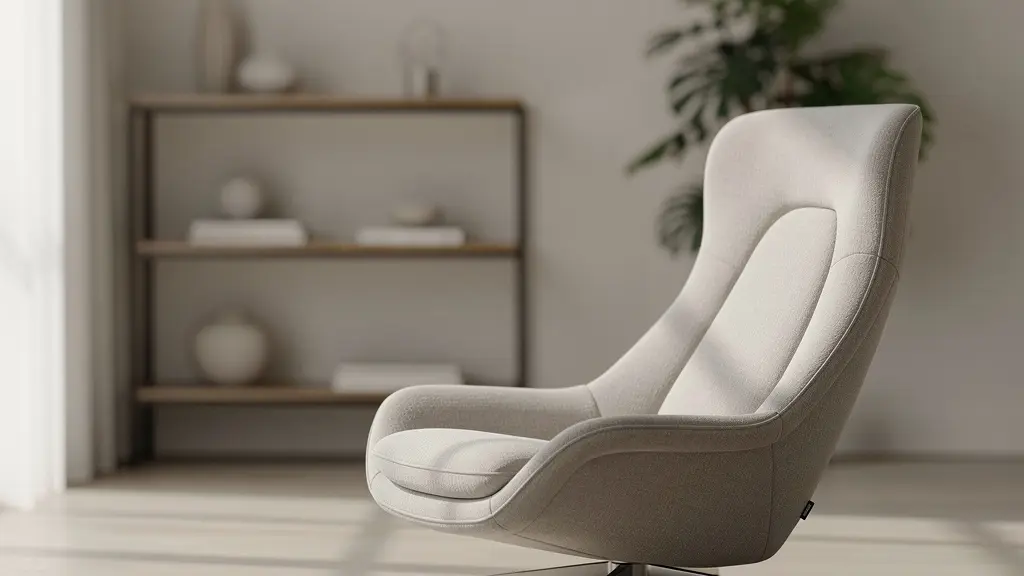
The root cause of back pain from lounge chairs isn’t softness, but poor design that forces your spine out of its natural alignment.
- Deep, unsupportive sofas cause a posterior pelvic tilt, flattening the crucial lumbar curve and straining muscles.
- True durability and support come from high-density foam (2.5+ PCF), not just surface-level firmness.
Recommendation: Test any chair by ensuring your lower back is fully in contact with the cushion, with no gap, to maintain a neutral spinal posture.
That feeling of sinking into a plush, deep lounge chair after a long day feels like the very definition of comfort. Yet for many, especially remote workers and seniors, this moment of relief is short-lived, soon replaced by a familiar, nagging ache in the lower back. The irony is potent: the furniture designed for relaxation is often a primary source of chronic discomfort. A significant portion of the population is affected, with data suggesting that as many as 39.0% of adults experienced back pain in a single year, a problem often exacerbated by our sedentary lifestyles.
The common advice is to “get a firmer sofa” or “use a lumbar pillow.” While not entirely wrong, these are superficial fixes to a much deeper biomechanical problem. These suggestions fail to address the root cause: a fundamental mismatch between the chair’s design and the human body’s anatomical needs. The problem isn’t just about passive support; it’s about how the chair’s structure actively influences your posture, often for the worse.
But what if the solution wasn’t just adding support, but choosing furniture engineered to *prevent* poor posture in the first place? This guide moves beyond generic advice. As an orthopedic physiotherapist, my focus is on the anatomical principles of spinal health. We will deconstruct why so-called “comfortable” chairs fail, explain the science of proper lumbar reinforcement, and provide a clinical framework for choosing a lounge chair that offers genuine, lasting relief. We’ll explore how to test for support, the materials that matter, and the pain signals you must not ignore.
This article provides a comprehensive overview of how to select seating that supports your back’s health. Below, you will find a detailed breakdown of each key aspect, from understanding the flaws in common designs to mastering the technical specifications of quality furniture.
Summary: The Orthopedic Guide to Preventing Back Pain from Seating
- Why a “Deep” Sofa Actually Hurts Your Back After 30 Minutes?
- How to Test a Sofa for Lumbar Support in the Showroom (The 5-Minute Rule)?
- Fixed Cushion vs Adjustable Bolster: Which Accommodates Different Heights Better?
- The “Hammocking” Effect That Destroys Lumbar Support in Old Sofas
- When to Replace Your Chair: The Pain Signals You Shouldn’t Ignore?
- Why You Need “Zero Wall” Technology for Small Living Rooms?
- Why Density (kg/m³) Matters More Than Firmness for Durability?
- How to Choose the Right Foam Density to Avoid Sofa Sagging After 2 Years?
Why a “Deep” Sofa Actually Hurts Your Back After 30 Minutes?
The allure of a deep sofa is its promise of boundless, “sink-in” comfort. However, from a biomechanical perspective, this design is often a trap for your spine. The primary issue lies in its effect on your pelvic position. To sit back fully on a deep seat, your knees must bend, but the excessive depth often means your feet can’t rest flat on the floor while your back is against the cushion. To compensate, you slide forward, or more commonly, you slouch. This slouching posture isn’t just lazy; it’s a specific action called posterior pelvic tilt.
When your pelvis tilts backward, it forces your lumbar spine (the natural inward curve of your lower back) to flatten or even reverse into a flexed, C-shaped position. This spinal flexion puts continuous strain on the posterior ligaments and muscles of your lower back, which are not designed for prolonged tension. Within 30 minutes, these overstretched tissues begin to send pain signals. The very muscles that should be relaxed are now working overtime to stabilize a compromised posture.
Furthermore, this poor posture is not a static problem. Scientific research confirms the link between furniture design and spinal health. A 2022 study on chair ergonomics found that conditions promoting a more neutral spine and pelvic posture were critical in preventing pain development. The study highlighted that features like proper lumbar support and seat pan tilt directly contributed to healthier postures, a stark contrast to the slouch-inducing geometry of a deep, unsupportive sofa. The “comfort” is an illusion that trades short-term relaxation for long-term musculoskeletal stress.
How to Test a Sofa for Lumbar Support in the Showroom (The 5-Minute Rule)?
Walking into a showroom and simply sitting on a dozen chairs is an inefficient way to gauge ergonomic quality. To properly assess lumbar support, you need a systematic approach. The “5-Minute Rule” is a series of tests designed to reveal how a chair will support your body over time, not just in the first 30 seconds. The most critical component is the hand-gap test.
First, sit all the way back in the chair, ensuring your hips are as far back as they can go. Your feet should be flat on the floor with your knees at roughly a 90-degree angle. Now, try to slide your flat hand into the space between your lower back’s natural curve and the chair’s backrest. In a well-designed chair, there should be minimal to no gap. The cushion should make full, gentle contact with your lumbar spine, effectively filling that curve. If you can easily slide your hand, or even your whole forearm, into that space, the chair lacks essential lumbar support. This gap is where your spine will eventually slump, leading to the posterior pelvic tilt we aim to avoid.
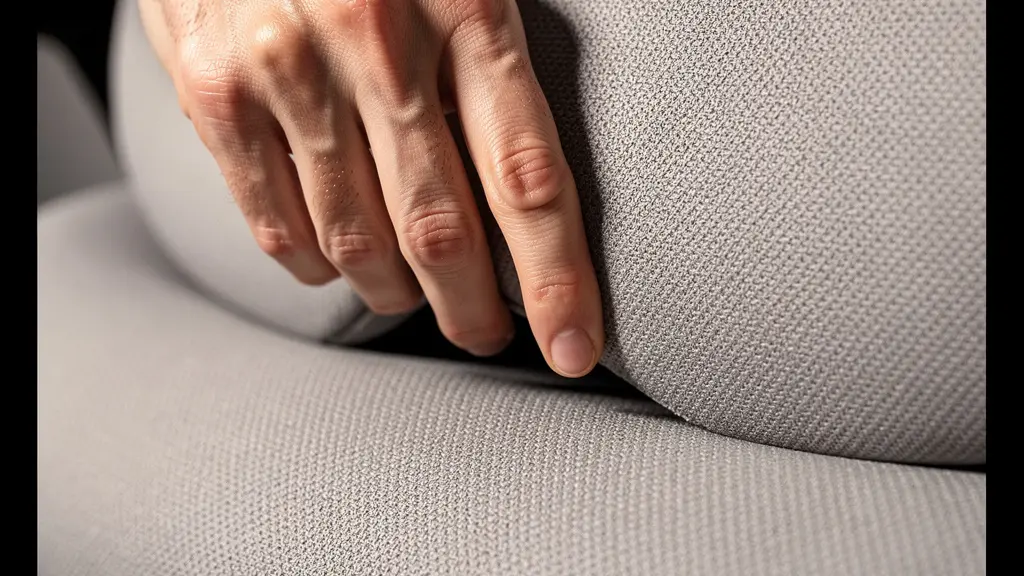
As you can see, this simple tactile test gives you immediate feedback on the chair’s contouring. Beyond this, spend at least five minutes in the chair. Notice if you feel the need to shift, fidget, or place a hand behind your back for support. These are subtle signs that your body is already fighting to find a stable posture, a clear indicator that the chair will become uncomfortable over longer periods. A truly supportive chair should feel natural and require no conscious effort to maintain good posture.
Your 5-Minute Showroom Audit: A 3-Step Testing Process
- Test the Lumbar Contact: Sit all the way back with your feet flat on the floor. Use the hand-gap test to ensure the cushion makes full contact with the natural curve of your lower back. There should be no significant space.
- Check Seat Height and Depth: Verify your feet are flat on the floor and there are about two to three fingers’ width between the back of your knees and the edge of the seat. This ensures proper circulation and prevents pressure on nerves.
- Assess Stability and Alignment: While seated, maintain the position for five full minutes. Observe if you subconsciously start to slouch or feel pressure points developing in your back, sacrum, or hips. The support should feel consistent and effortless.
Fixed Cushion vs Adjustable Bolster: Which Accommodates Different Heights Better?
Once you’ve confirmed a chair offers lumbar support, the next question is its type: is it a fixed, integrated cushion or an adjustable bolster or pillow? Each design has distinct advantages and is suited for different users. The choice hinges on who will be using the furniture and the need for personalized ergonomics.
A fixed lumbar cushion is integrated directly into the chair’s backrest. When designed by a reputable manufacturer, its position is carefully researched to align with the average person’s spine. The primary benefit is its foolproof nature; you can’t misplace it. It provides consistent support at the correct anatomical location, typically targeting the L3-L4 vertebrae, which is the apex of the lumbar curve for most adults. This makes it an excellent choice for a chair that will be used primarily by one person of average height, or in a household where users have similar body types.
An adjustable bolster or pillow, on the other hand, offers customization. This is its greatest strength and potential weakness. It allows users of different heights to position the support precisely at their own anatomical apex. As experts at Eureka Ergonomic note, for support to be effective, “The support must align with the natural apex of your back curve… If it’s too high, it pushes into the mid-back; too low, and it fails to support the curve at all.” This flexibility is ideal for family sofas or for individuals who are taller or shorter than average. However, it requires the user to be knowledgeable enough to place it correctly every time. Misplacing it can create pressure points or negate the supportive benefit entirely.
The following table breaks down the core differences to help you decide which is better for your specific needs. The decision isn’t about which is universally “better,” but which is better for your unique situation.
| Feature | Fixed Lumbar Support | Adjustable Lumbar Support |
|---|---|---|
| Positioning | Pre-set at L3-L4 vertebrae | User-adjustable height |
| Misalignment Risk | Low – professionally positioned | Higher – user may misplace |
| Pressure Distribution | Even, integrated design | Can create focal pressure points |
| Ideal For | Standard body types | Varied heights and preferences |
The “Hammocking” Effect That Destroys Lumbar Support in Old Sofas
Even a perfectly designed sofa will eventually become a source of back pain if its internal structure fails. Over time, the suspension system (the springs or webbing beneath the cushions) and the foam itself can degrade, leading to a phenomenon known as the “hammocking” effect. Instead of a flat, supportive platform, the seat deck sags in the middle, creating a hammock-like dip. When you sit in this depression, your hips sink lower than your knees, forcing your pelvis into a posterior tilt and your lumbar spine into that damaging C-shape, regardless of how good the back cushions are.
This structural failure is directly linked to the quality of the materials used, particularly the foam. The lifespan of foam is not determined by its firmness, but by its density. According to industry data, lower-density foams wear out significantly faster. For instance, 1.8lb foams last approximately 5-8 years, whereas 2.8lb foams last approximately 12 to 18 years under normal use. A sofa that feels great in the showroom may be built with low-density foam that will begin to sag and hammock within just a few years, taking its ergonomic support with it.
Diagnosing hammocking in your current sofa is straightforward. If you suspect your faithful old chair is the culprit behind your new aches, you can perform a simple test:
- Remove all seat cushions to expose the sofa’s frame and suspension deck.
- Place a long, straight edge, like a yardstick or level, across the seat deck from side to side.
- In the center, try to slide a thin object, like a coin, underneath the straight edge.
- If the coin slides through easily, it indicates a significant sag. The suspension or underlying support has failed, and the frame is creating the hammocking effect.
- Repeat this test at several points across the seat to check for uneven wear.
This loss of foundational support is a primary reason why older furniture often becomes uncomfortable. The backrest can no longer do its job because the seat is failing to provide a stable base for your posture.
When to Replace Your Chair: The Pain Signals You Shouldn’t Ignore?
Your body is an excellent barometer for the ergonomic quality of your furniture. While a chair might still look good, it can be functionally failing, and your body will be the first to know. Learning to listen to these physical cues is crucial for preventing acute discomfort from turning into a chronic issue. These are not minor complaints; they are important data points about your environment.
The most obvious signal is pain upon rising. If you feel a sharp ache or stiffness in your lower back specifically when you stand up after sitting for 30 minutes or more, it’s a classic sign that the chair forced your spine into a flexed position. Your muscles and ligaments, held in a strained state, are protesting as they return to a neutral posture. Another key signal is the need to constantly shift your position. If you can’t sit comfortably for more than 15-20 minutes without fidgeting, crossing and uncrossing your legs, or propping yourself up with your arms, your body is telling you it cannot find a stable, supported posture.

Ignoring these signals can have significant consequences that go beyond temporary aches. It’s a serious quality-of-life issue that needs to be addressed at its source.
Approximately 8.2 percent of American adults experience chronic severe back pain. Out of those with chronic severe back pain, an alarming 74.8 percent reported difficulties with mobility, social participation, self-care, or work participation. This highlights the substantial burden that chronic severe back pain places on individuals.
– National Health Interview Survey, 2019 NHIS Back Pain Statistics
Other warning signs include radiating pain or numbness down your leg (sciatica), which can be caused by pressure on the sciatic nerve from poor pelvic alignment, or persistent stiffness in your hips and hamstrings. Your chair should be a place of rest, not a source of physical stress. When it consistently causes more problems than it solves, it is time to consider a replacement.
Why You Need “Zero Wall” Technology for Small Living Rooms?
For those with limited space, a reclining chair often seems like an impossible luxury. Traditional recliners require significant clearance—often a foot or more—between the chair and the wall to fully extend, making them impractical for smaller living rooms, apartments, or dens. This is where “zero wall” technology (also known as wall-hugger or wall-saver) becomes an essential innovation, blending ergonomic benefits with space-saving design.
Unlike a traditional recliner that tilts backward, a zero wall mechanism works by gliding the seat forward on a track as it reclines. This forward motion means the back of the chair never gets significantly closer to the wall behind it. As a result, these chairs require only a few inches of clearance (typically 3-4 inches) to achieve a full recline. This allows you to place a fully functional, ergonomic recliner almost flush against a wall, reclaiming valuable floor space without sacrificing comfort.
From an orthopedic perspective, this forward-gliding motion can also offer a more consistent form of lumbar support. In some traditional recliners, as the chair tilts back, a gap can form between your lower back and the cushion, compromising support. The gliding mechanism of a zero wall recliner helps to keep your body in constant contact with the backrest throughout the entire range of motion. This maintains the integrity of the lumbar support and ensures your spine remains in a neutral, supported alignment whether you are sitting upright or fully reclined.
This technology effectively solves the dilemma of choosing between floor space and ergonomic features. It proves that you don’t need a large room to enjoy the health benefits of a reclining chair, such as elevating your legs to improve circulation and off-loading pressure from the lower spine. It is a practical solution for modern living where space is at a premium.
Why Density (kg/m³) Matters More Than Firmness for Durability?
In the world of furniture, the terms “firmness” and “density” are often used interchangeably, but from a material science and orthopedic standpoint, they represent two completely different properties. Understanding this distinction is perhaps the single most important factor in choosing a sofa that will maintain its supportive qualities for years to come. Firmness is subjective; density is a measurable fact.
Firmness, technically known as Indentation Load Deflection (ILD), measures how much force it takes to compress a piece of foam by 25%. It is a measure of how the foam *feels* initially. A high ILD means the foam feels firm, while a low ILD feels soft. However, firmness has no correlation with quality or durability. A manufacturer can easily make a low-quality, low-density foam feel firm by adding chemical fillers. This foam may feel supportive in the showroom but will quickly soften and break down under regular use.
Density, on the other hand, is an objective measure of quality. It is calculated by the weight of the foam per cubic foot (PCF) or kilograms per cubic meter (kg/m³). It tells you how much actual foam material is packed into a given volume.
Density refers to the overall weight of the foam. It is a measure of how much material is packed into a given volume of foam and is usually expressed in pounds per cubic foot (lbs/ft³). Density is a key indicator of the foam’s quality and longevity.
– Ronco Furniture, Understanding the Difference Between Firmness and Density in Foam
A higher density means the foam’s cell structure is more compact and robust. This allows it to withstand compression and bounce back to its original shape for a much longer period. When you choose a sofa based on its high density, you are investing in its ability to resist the sagging and “hammocking” effect that destroys lumbar support over time. A high-density cushion provides a durable, supportive foundation that will continue to hold your body in a healthy posture for years, long after a low-density “firm” cushion has collapsed.
Key Takeaways
- The primary cause of back pain from sofas is poor posture (posterior pelvic tilt) induced by designs that are too deep and unsupportive.
- True durability is measured by foam density (PCF or kg/m³), not subjective firmness. High-density foam (2.5+ PCF) prevents sagging.
- Always test a chair by ensuring full contact between your lower back curve and the cushion, leaving no gap for your spine to slump into.
How to Choose the Right Foam Density to Avoid Sofa Sagging After 2 Years?
Choosing the right foam density is a proactive measure to ensure your investment in a new lounge chair is also an investment in your long-term spinal health. Since density is the most reliable predictor of durability and support retention, knowing how to interpret the numbers is essential. Most manufacturers won’t advertise low density, so you may need to ask for the technical specifications directly.
Foam density is typically categorized into three main tiers. Low-density foam (under 1.8 PCF) is inexpensive and often found in budget furniture. While it can feel comfortable initially, it degrades quickly and should be avoided for any seating that will see daily use, as it will likely start to sag within 1-2 years. Medium-density foam (1.8 to 2.2 PCF) is a common middle-ground, suitable for furniture with moderate use, but it is still not ideal for a primary living room sofa that you’ll use every day.
For daily-use lounge chairs and sofas, you should exclusively look for high-density (HD) foam, which is defined as anything 2.5 PCF or higher. This level of density ensures the foam has the structural integrity to withstand years of compression without losing its shape or supportive qualities. According to industry specifications, a high-density foam (2.5 lbs/ft³ and above) can last up to 10 years or more. An even more premium category, High-Resiliency (HR) foam, typically starts at 3.0 PCF and offers an even faster bounce-back and longer lifespan, making it the gold standard for high-end, long-lasting furniture.
When shopping, don’t be swayed by how a cushion feels for the first five minutes. Insist on knowing the foam density. If a salesperson cannot provide this information, it is often a red flag that the manufacturer is using lower-grade materials. The following table provides a clear guide to what you can expect from different foam grades.
| Foam Density | Expected Lifespan | Best Use |
|---|---|---|
| Low (1.5 PCF) | 1-2 years | Decorative cushions, guest beds |
| Medium (1.8-2.2 PCF) | 2-4 years | Moderate use furniture |
| High (2.5+ PCF) | 5-10+ years | Daily use sofas and chairs |
| HR Foam (3.0+ PCF) | 10+ years | Premium furniture, commercial use |
By prioritizing proper anatomical alignment and investing in materials with proven durability, you can transform your living space into a genuine sanctuary for rest and recovery. The next logical step is to apply this knowledge by assessing your current furniture or beginning your search for a new chair with these clinical criteria in mind. Your back will thank you for it.
Frequently Asked Questions About Ergonomic Chairs
How much clearance do zero wall recliners need?
Zero wall recliners typically need only 3-4 inches of clearance from the wall, compared to traditional recliners that need 12-16 inches.
Do zero wall chairs compromise on lumbar support?
No, the forward-gliding motion actually helps maintain consistent lumbar contact throughout the recline range, which can enhance support compared to some traditional designs.
Are zero wall mechanisms less durable?
Quality zero wall mechanisms are engineered to be as durable as traditional recliners when properly manufactured. Durability is more dependent on the quality of the manufacturer and materials than the type of mechanism.