Pergolas and Extensions
Transforming your home with a pergola or extension represents one of the most impactful investments you can make in your property. These structures do far more than add square footage—they fundamentally reshape how you experience your living space, creating fluid transitions between indoor comfort and outdoor beauty. Whether you’re considering a sleek wall-mounted pergola to shade your patio, a freestanding structure to anchor a distant garden corner, or a full-scale extension that expands your footprint, understanding the nuances of design, technology, and planning is essential.
The landscape of pergolas and extensions has evolved dramatically in recent years. Modern homeowners now navigate choices involving smart climate control systems, complex structural engineering considerations, and sophisticated financial calculations about return on investment. This comprehensive resource breaks down the essential knowledge across five key domains: the structural distinctions between attached and freestanding pergolas, the emerging role of automation and technology, the strategic planning required for home extensions, and the design principles that create seamless indoor-outdoor living experiences.
Wall-Mounted Pergolas: Extending Your Living Space
Attached pergolas represent the most direct method of expanding your usable living area, creating a structural bridge between your home’s interior and the garden beyond. By anchoring one side to your existing wall, these units leverage your home’s foundation while projecting outward to define new outdoor rooms.
Structural Considerations and Wind Load
The engineering behind wall-mounted pergolas demands careful attention to lateral wind forces. Unlike freestanding structures that distribute wind pressure across four independent posts, attached units create a cantilever effect that transfers substantial force directly to your home’s wall. Think of it like holding an umbrella in strong wind—the further you extend your arm, the more force your shoulder must absorb. Most residential walls can safely support pergolas with projections up to 12-15 feet, but anything beyond requires reinforced attachment points, often involving structural steel brackets bolted through exterior cladding into load-bearing framing.
Climate plays a defining role here. Homes in wind-prone regions may require engineered calculations to determine safe projection depths, while buildings with brick veneer need special consideration since the decorative outer layer cannot bear structural loads. The attachment method typically involves through-bolting a ledger board—a horizontal mounting beam—secured with stainless steel fasteners at 16-inch intervals minimum.
Light, Waterproofing, and Connection Details
One often-overlooked consequence of attached pergolas is their impact on interior light levels. A pergola positioned directly outside large windows or sliding doors will inevitably reduce natural light penetration, particularly when fitted with solid roofing or dense louvered blades. This trade-off requires deliberate design choices: homeowners seeking shade without darkness often opt for adjustable louver systems that can open completely when light is desired, or polycarbonate roofing panels that provide weather protection while maintaining translucency.
The junction where pergola meets house represents a critical vulnerability for water intrusion. Proper flashing installation is non-negotiable—a metal flashing piece must be inserted beneath your home’s exterior cladding and over the pergola’s ledger board, directing water outward rather than allowing it to seep behind the wall. This process often requires temporarily removing siding sections, a detail frequently underestimated by DIY installers. Failed waterproofing can lead to concealed rot, mold growth, and structural deterioration that may go unnoticed for years.
Sizing for Optimal Function
Determining the right projection depth involves balancing practical usage with structural realities. A pergola extending just 8 feet might provide adequate coverage for a small dining set, but leaves little room for circulation or furniture flexibility. Conversely, a 16-foot projection creates generous space but requires robust post sizing and foundation work for the outer support columns.
Height optimization addresses a dual mandate: providing clearance for movement and furniture while maximizing airflow and shade efficiency. Pergolas set too low (below 8 feet) feel oppressive and limit ceiling fan installation, while those exceeding 10-11 feet diminish shade effectiveness as the sun’s angle allows more direct penetration. The sweet spot for most residential applications falls between 8.5 and 9.5 feet—tall enough to feel spacious, low enough to provide meaningful solar control.
Freestanding Structures: Creating Garden Destinations
Detached pergolas serve a fundamentally different purpose than their wall-mounted cousins. Rather than extending the home, they establish independent destinations within the garden landscape—pavilions that invite exploration and create distinct outdoor rooms disconnected from the house’s immediate influence.
Standalone Design and Material Selection
Without a house wall for support, freestanding pergolas require four robust posts and substantial foundation work. Each post must be secured either in concrete footings (typically 12-18 inches in diameter, extending below frost line) or with ground screw anchors in suitable soil conditions. The structural requirements are considerably more demanding than attached units since the entire structure must be self-supporting against wind uplift, lateral forces, and potential snow loads.
Material choices for garden integration extend beyond mere aesthetics—they determine longevity and maintenance burden. Pressure-treated lumber offers affordability but requires ongoing sealing to prevent weathering. Aluminum extrusions provide zero-maintenance durability with contemporary clean lines, though at a premium price point. Engineered wood composites split the difference, offering wood’s visual warmth with improved weather resistance. The decision should account for your garden’s existing materials palette: a rustic cottage garden pairs naturally with stained timber, while modernist landscapes benefit from powder-coated aluminum’s precision.
Legal Considerations and Privacy Optimization
Freestanding structures often trigger different regulatory requirements than attached pergolas. Many jurisdictions classify detached buildings based on size thresholds—structures under 120 square feet or positioned more than 5 feet from property lines might avoid permit requirements, while larger or closer installations demand full building approval. Some areas impose accessory structure limits, capping the total square footage of sheds, pergolas, and detached garages on a property.
Setback regulations—minimum distances from property boundaries—frequently prove more restrictive for freestanding units. Where an attached patio cover might legally approach within 3 feet of a side yard fence, a detached pergola could require 5-8 feet of clearance. Violations risk enforcement actions requiring costly relocation or demolition.
For privacy optimization in exposed gardens, freestanding pergolas offer unique advantages. By positioning the structure away from neighboring sightlines and incorporating vertical screening elements—lattice panels, planted trellises, or privacy curtains—you can create intimate spaces even in overlooked yards. The key is analyzing sun paths and neighbor vantage points before finalizing placement.
Psychological Benefits of Separated Spaces
There’s a subtle but profound psychological shift that occurs when you physically leave your house to reach an outdoor structure. This separation creates what environmental psychologists call spatial distinctiveness—a mental boundary that helps differentiate activities and moods. A freestanding pergola positioned at the garden’s far end becomes a destination for reading, meditation, or morning coffee, offering a sense of retreat impossible to achieve on an attached deck just steps from the kitchen.
This principle explains why many homeowners report using distant garden structures more intentionally than attached patios, which often become cluttered transitional spaces for storing bikes or gardening supplies.
Smart Technology: Automated Climate Control
The integration of motorized systems and environmental sensors has transformed pergolas from static structures into responsive outdoor living platforms that adapt to changing conditions without human intervention.
Weather-Responsive Systems
Contemporary automated pergolas employ multiple sensor types to monitor environmental conditions in real-time. Wind sensors trigger louver or retractable roof closure when gusts exceed predetermined thresholds—typically 20-25 mph—protecting both the structure and furnishings beneath. Rain sensors detect moisture and automatically close roofing elements within seconds, safeguarding electronics and fabrics. Light sensors can adjust louver angles throughout the day to maintain consistent shade levels as the sun’s position changes.
The practical benefit extends beyond convenience. Automated weather response protects your investment by preventing damage during sudden storms when you’re away from home. A motorized retractable canopy left extended during unexpected high winds can suffer torn fabric or bent frames; automatic retraction eliminates this risk entirely.
Integration with Home Automation
Modern pergola systems increasingly connect to whole-home automation platforms, allowing control through the same interfaces managing lighting, security, and climate systems indoors. This integration enables sophisticated programming: your pergola louvers might automatically angle to morning sun positions at breakfast time, close for midday heat protection, then reopen for evening stargazing.
Voice control through smart assistants adds intuitive operation—simply requesting “close the pergola” triggers motorized systems without searching for remotes. Geofencing capabilities can even automate closure when your phone indicates you’ve left home, or opening when you’re approaching after work.
The technical requirements involve running low-voltage control wiring (typically 12-24V) from your home automation hub to the pergola’s motor controller, plus standard electrical service for the motors themselves. Wireless options exist but generally offer reduced reliability in outdoor environments with signal interference.
Motor Technologies and Maintenance
Two primary motor technologies dominate the market: tubular motors housed within rolling tubes for retractable canopies, and linear actuators for louver systems. Tubular motors are compact and hidden but have limited pushing force, making them suitable for fabric canopies and lighter applications. Linear actuators provide substantial force for heavy louvered roofs but are more visibly exposed.
The most common failure mode involves water intrusion into electrical components. Quality systems employ IP65-rated (dust-tight, water-jet resistant) motors and sealed wiring connections, but even these require periodic inspection. Mechanical wear on moving parts—particularly louver pivot points and fabric roller bearings—typically necessitates lubrication every 2-3 years. The risk of complete system failure is relatively low with quality components, but loss of automation during a mechanical breakdown returns you to manual operation, which many homeowners find frustrating once accustomed to motorized convenience.
Home Extensions: Strategic Planning and ROI
Full-scale extensions represent a more substantial investment than standalone pergolas, both financially and architecturally. The decision-making process requires balancing immediate lifestyle needs against long-term property value considerations.
The Financial Case for Extending
The fundamental question many homeowners face is whether extending their current property makes more financial sense than relocating to a larger home. The mathematics involve comparing extension costs (typically $150-400 per square foot depending on complexity and finishes) against the combined expenses of selling, buying, and moving. Transaction costs alone—realtor commissions, closing fees, moving expenses—often total 8-12% of a home’s value, representing a significant baseline before even considering purchase price differences.
Extensions avoid disrupting neighborhood ties, school districts, and commute patterns while allowing you to incrementally add only the space you need rather than purchasing an entirely larger property. However, the calculus shifts in markets where your current home’s ceiling value limits potential returns. Adding $80,000 worth of extension to a home in a neighborhood where properties rarely exceed $300,000 risks overcapitalization—investing more than you can reasonably recover upon eventual sale.
Architectural Integration and Expansion Options
Successful extensions respect your home’s existing architectural language—roofline angles, window proportions, material palettes, and decorative details. A Victorian cottage demands different extension approaches than a mid-century ranch. The process of matching architectural lines often requires custom trim work, specialized roofing materials, or brick/stone matching to ensure the addition appears original rather than obviously tacked-on.
The choice between vertical and horizontal expansion depends on multiple factors:
- Lot coverage regulations: Many areas limit the percentage of your property that structures can occupy, restricting outward expansion
- Foundation realities: Adding a second story to a home built with a single-story foundation may require expensive structural reinforcement
- Roof complexity: Intersecting rooflines where new meets old create potential leak points requiring expert flashing work
- Functional flow: Horizontal additions more easily create direct room-to-room connections, while vertical expansions require stair circulation
Maximizing Return on Investment
Not all extensions deliver equal value recovery. Industry data consistently shows that versatile, multi-functional spaces outperform single-purpose additions. A sunroom extension usable as dining area, home office, or entertainment space appeals to broader buyer demographics than a specialized wine cellar or indoor pool, which many buyers view as maintenance liabilities.
The highest-ROI extensions typically include:
- Kitchen expansions: Opening cramped kitchens into adjacent spaces or adding island workspace addresses the most universally desired home improvement
- Bathroom additions: Particularly in homes with fewer bathrooms than bedrooms, adding an ensuite or powder room removes a key buyer objection
- Multi-purpose rooms: Spaces designed to serve as office/guest room/exercise room adapt to different owners’ needs
- Covered outdoor living: Four-season rooms or substantially covered patios extend usable months in many climates
Timing considerations matter significantly. Completing structural work and weatherproofing before interior finishes ensures electrical, plumbing, and HVAC systems are properly integrated rather than awkwardly retrofitted.
Indoor-Outdoor Living: Blurring the Boundaries
The ultimate expression of pergola and extension design involves creating such seamless transitions between interior and exterior that the boundary becomes perceptually irrelevant—a continuum of living space rather than distinct inside and outside zones.
Biophilic Design and Wellness Benefits
Biophilia—humanity’s innate attraction to nature and living systems—provides the theoretical foundation for indoor-outdoor integration. Research consistently demonstrates that visual and physical connections to natural environments reduce stress markers, improve cognitive function, and accelerate recovery from illness. Designing spaces that erase boundaries between home and garden maximizes these psychological benefits.
Practical applications include maximizing glass area with floor-to-ceiling sliding or folding door systems, using consistent flooring materials that flow from interior to covered exterior, and strategically positioning interior furniture to maintain sightlines to garden focal points. Even in climates with distinct seasons, maintaining visual connection during winter months preserves psychological benefits when physical outdoor use becomes impractical.
Technical Solutions for Seamless Transitions
Achieving genuinely seamless transitions requires solving several technical challenges. Floor level continuity ranks among the most critical—even a single step between interior and patio disrupts the perception of unified space and creates accessibility barriers. The methodology for leveling floors depends on your home’s construction: concrete slab foundations may allow grinding down interior floors slightly, while raised wood floors might require building up exterior deck heights or recessing door thresholds.
Opening mechanisms profoundly impact the connection’s quality. Traditional hinged doors, even when fully opened, maintain a visual and physical barrier. Sliding systems reduce this obstruction but still leave a center post when using two panels. The ultimate solution involves bi-fold or multi-panel stacking doors that disappear entirely to one or both sides, creating uninterrupted openings spanning 12-20 feet.
Material continuity reinforces the seamless effect. Using identical tile or wood flooring from kitchen through to covered patio eliminates visual breaks. Continuing interior ceiling finishes into covered outdoor areas—tongue-and-groove wood or drywall rather than exposed beams—further blurs distinctions.
Security and Seasonal Adaptability
Large openings designed for maximum connection raise understandable security concerns. Modern multi-panel door systems address this with multi-point locking mechanisms that secure panels at top, bottom, and middle positions—often more secure than traditional single-lock doors. Laminated or tempered glass resists breakage, while integrated alarm sensors detect forced entry attempts.
Seasonal adaptability determines whether your indoor-outdoor space functions year-round or sits dormant for months. In moderate climates, retractable screens or glass panels allow closing off the pergola area during cooler months while maintaining the protected space’s utility. Infrared heating elements mounted to pergola beams extend comfortable evening use by 10-15 degrees. In harsh-winter climates, designing the interior space to function independently when outdoor connection is impractical ensures year-round value from your investment.
The transition strategies you employ should align with your climate’s realities: homes in temperate regions might prioritize maximum opening flexibility, while those facing extreme seasonal swings benefit from robust weather sealing and the ability to fully enclose extended spaces during challenging months.
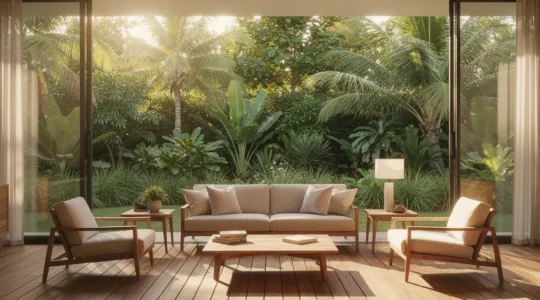
How to Blur the Line Between Living Room and Garden for a “Resort” Feel?
Achieving a true ‘resort’ feel is not about adding features, but about systematically dissolving the psychological and physical barriers between inside and out. Architectural choices like flush thresholds and floor-to-ceiling glass are more critical than decorative elements. The goal is…
Read more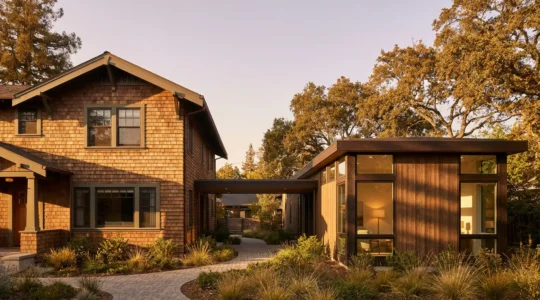
How to Plan a Home Addition That Adapts to Multigenerational Living?
Planning a multigenerational home addition goes beyond simply adding space. It’s a strategic investment in your family’s future, focusing on adaptable design that serves evolving needs—from a home office today to an in-law suite tomorrow. The key is to prioritize…
Read more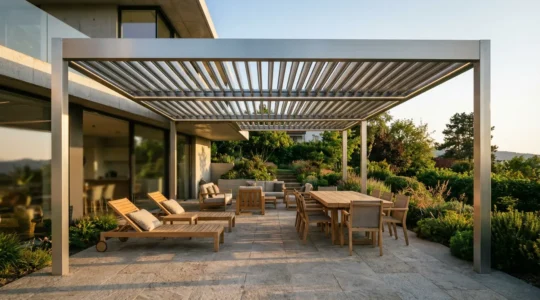
Justifying the Cost of a Motorized Pergola: An ROI Analysis Beyond the Fixed Roof
The premium for a motorized pergola is justified not as a cost, but as an investment in a dynamic system that actively protects assets and enhances your outdoor lifestyle. Automation provides real-time protection for high-value outdoor furniture, preventing costly weather…
Read more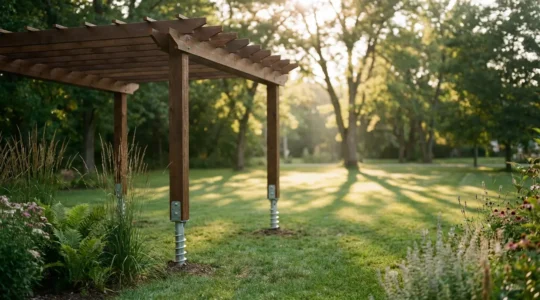
How to Securely Anchor a Freestanding Pergola on a Lawn Without Concrete?
Securing a pergola without concrete isn’t about using bigger spikes; it’s about designing an integrated stability system that works with your landscape. Wind load is the most underestimated force, and it’s easily multiplied by factors like the structure’s height and…
Read more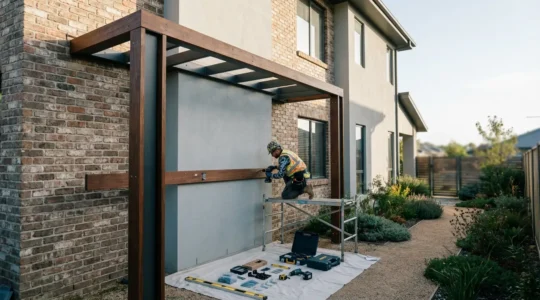
How to Securely Anchor a Wall-Mounted Pergola to a Fragile Facade Without Damage
Attaching a pergola to a fragile facade often leads to structural failure because common methods anchor to non-structural cladding instead of transferring loads to the building’s frame. Wind creates powerful uplift forces that can easily rip improper anchors from the…
Read more