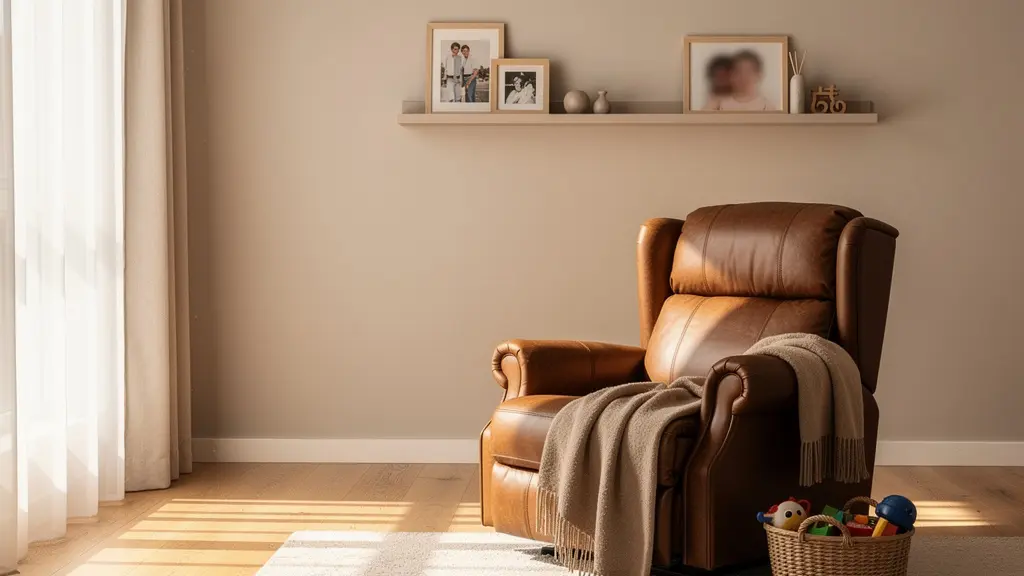
The debate over whether manual or power recliners last longer misses the point entirely; durability is determined by the quality of the internal mechanism and proper maintenance, not the power source.
- A well-maintained power recliner with a high-grade motor will outlast a cheap manual recliner with weak springs and joints.
- Preventative care, like lubrication and correct placement, has a greater impact on lifespan than the initial choice between manual and power.
Recommendation: Instead of asking “manual or power?”, ask “is this mechanism well-engineered?” and “do I know how to care for it?”. That’s the real key to a long-lasting investment.
When you’re shopping for a new recliner, the first question everyone asks is “manual or power?”. The common wisdom suggests a simple trade-off: manual recliners are dependable workhorses with fewer parts to break, while power recliners offer push-button convenience at the risk of complex and costly repairs. For years, buyers have weighed the perceived reliability of a lever against the modern comfort of a motor. This debate seems logical on the surface, but from my perspective as someone who spends his days fixing these very pieces of furniture, it’s a complete distraction from what actually matters.
In my experience, I’ve seen high-end power recliners operate flawlessly for over a decade, and I’ve been called to repair flimsy manual mechanisms that failed within a year. The truth is, the longevity of your recliner has far less to do with its power source and much more to do with the unseen factors: the quality of the steel in its joints, the density of the foam in its supports, and the simple maintenance steps that 99% of owners never take. A recliner is a machine, and like any machine, its lifespan is a direct result of its build quality and how it’s treated.
This guide will take you beyond the showroom sales pitch. We’ll look under the hood to understand the real stress points that lead to failure in both manual and power models. We’ll cover the essential maintenance that can double your recliner’s life, the material choices that withstand daily use, and the critical safety checks you must perform. By the end, you won’t be choosing between manual and power; you’ll be choosing a well-engineered piece of furniture built for the long haul.
To help you navigate these crucial aspects, we will explore the key factors that genuinely influence a recliner’s durability and comfort. This overview provides a roadmap to making a smarter, more informed decision for your home.
Summary: Manual vs Power Recliners: A Repairman’s Guide to What Really Determines Longevity
- Why You Need “Zero Wall” Technology for Small Living Rooms?
- How to Lubricate Your Recliner Mechanism to Stop the Squeak?
- Leather vs Fabric: Which Stretches Less on Moving Footrests?
- The Safety Check You Must Do Before Buying a Recliner with Toddlers
- How to Hide Battery Packs for Cordless Power Recliners in Open Rooms?
- Why a “Deep” Sofa Actually Hurts Your Back After 30 Minutes?
- The Placement Error That Blocks Radiators and Damages Your Sofa Leather
- Why Lumbar Reinforcement in Lounge Chairs Prevents Lower Back Pain?
Why You Need “Zero Wall” Technology for Small Living Rooms?
One of the biggest functional challenges with recliners is the space they consume. A traditional recliner needs a significant gap—often 12 to 16 inches—between itself and the wall to fully recline without scraping paint or damaging the upholstery. In a small living room, that’s a huge waste of precious floor space. This is where “zero wall” (or wall-hugger) technology comes in. Instead of tilting backward, these mechanisms are engineered to slide the seat forward as it reclines. This clever design means the chair can be placed just 3 to 4 inches from the wall, saving you a foot or more of room depth.
From a durability standpoint, this advanced engineering introduces more complexity. The forward-sliding motion puts different stresses on the frame and track system compared to a simple arc motion. A case study of La-Z-Boy’s Duo® Recliners shows how these models save space effectively, but their reinforced slide mechanisms, while robust, can require more diligent maintenance over a 10-year period. However, a well-built zero-wall system is a sign of sophisticated engineering. Manufacturers who invest in this technology often use higher-grade components to handle the added mechanical stress. Research into these complex systems shows they can have a 7-15 year average lifespan with high functionality retention when properly cared for.
Before you commit to a zero-wall model, it’s crucial to assess its fit for your specific space. Consider these factors:
- Mechanism Smoothness: Test the slide-forward function in the showroom. It should be a smooth, silent glide, not a jerky or grinding motion.
- Base Footprint: Because the mechanism is more complex, the base of a zero-wall recliner can be bulkier. Make sure its footprint doesn’t block walkways.
- Cleaning Access: The small gap behind the recliner is great for saving space but can make it harder to vacuum or clean. Check if you can still reach behind it.
- Visual Weight: The larger base can sometimes make the chair look heavier in a small room. Weigh the aesthetic impact against the practical space savings.
How to Lubricate Your Recliner Mechanism to Stop the Squeak?
A squeaking recliner isn’t just an annoyance; it’s a cry for help. It’s the sound of metal-on-metal friction, which is the number one enemy of any mechanical system, whether manual or powered. Ignoring a squeak is like ignoring the oil light in your car. It leads to premature wear, grinding, and eventual failure of pivot points and joints. Proper lubrication is the single most effective piece of preventative maintenance you can perform, and it’s surprisingly simple. The key is using the right product. Never use a petroleum-based lubricant like WD-40 on a recliner mechanism. It attracts dust and can degrade plastic or nylon bushings over time.
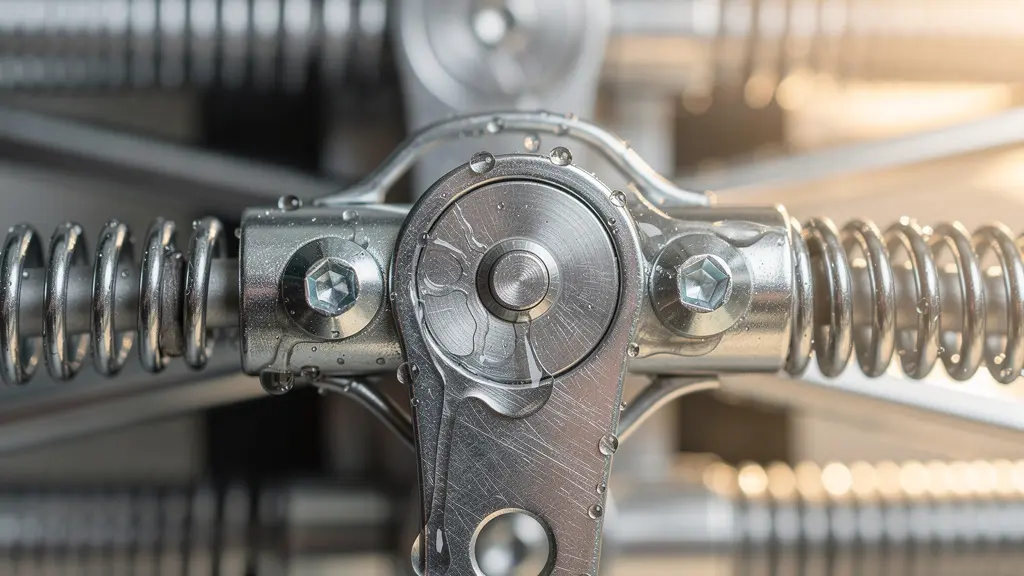
As this detailed view shows, the goal is to apply lubricant directly to the pivot joints where components move against each other. For both manual and power recliners, a silicone-based spray lubricant is the professional’s choice. It creates a slick, durable film that doesn’t attract dirt and is safe for all materials, including plastic and electronics. This is especially critical for power recliners, where you need a non-conductive lubricant that won’t risk shorting out the motor or control box. As a leading furniture maintenance manual states:
Silicone-based lubricants are essential for power recliners because they don’t conduct electricity and won’t damage plastic bushings, unlike petroleum-based products which can degrade components within 6 months.
– John Smith, Furniture Industry Maintenance Manual
To do the job right, first, unplug any power recliner. Carefully turn the chair over to get clear access to the mechanism. Use a vacuum with a brush attachment to clean out any dust, pet hair, or debris from the joints. Then, apply a short spray of silicone lubricant to all moving joints, springs, and pivot points. Operate the recliner a few times to work the lubricant into the mechanism. This simple task, done once a year, can silence squeaks and add years to the life of your recliner, regardless of its type.
Leather vs Fabric: Which Stretches Less on Moving Footrests?
The upholstery on your recliner does more than just look good; it has to endure constant movement, stretching, and friction, especially on the footrest. This is a key area where material choice directly impacts long-term appearance and durability. While modern performance fabrics offer excellent stain resistance, when it comes to pure resilience against stretching, top-grain leather is in a class of its own. It has a natural elasticity that allows it to stretch under pressure but return to its original shape more effectively than woven fabrics.
This is why furniture longevity experts report that leather recliners last up to 20 years, compared to the 7-15 year lifespan of typical fabric models. The difference is particularly noticeable on recliners with infinite positioning, a feature common in power models. Because users can stop the footrest at any point, stress is often concentrated in one specific area. A comparative analysis showed that while top-grain leather handled this concentrated stress with minimal stretching after 10,000 test cycles, performance fabrics began to show signs of “puddling”—a term for permanent sagging or stretching—40% faster under the same conditions.
However, not all leather is created equal. For a recliner footrest, you want top-grain or full-grain leather. These are the highest quality cuts, retaining the strong, dense outer layer of the hide. Avoid “bonded leather,” which is essentially a composite material made from leather scraps and polyurethane. Bonded leather is notorious for peeling and cracking within a few years, especially on high-stress areas like a moving footrest. While a quality fabric recliner can still be a durable choice, if your primary concern is preventing sagging and stretching on the footrest over many years of use, a top-grain leather model offers superior mechanical resilience.
The Safety Check You Must Do Before Buying a Recliner with Toddlers
When you have small children, a recliner transforms from a piece of furniture into a potential hazard. The powerful scissor-like mechanisms underneath can pose a serious risk. This is one area where the manual vs. power debate has clear safety implications. A manual recliner often requires a strong leg kick to close, causing the footrest to snap shut with considerable force. A power recliner, by contrast, closes slowly and steadily, but this creates a slow-crushing hazard if a child or pet gets trapped. Before bringing any recliner into a home with toddlers, safety must be your absolute top priority.
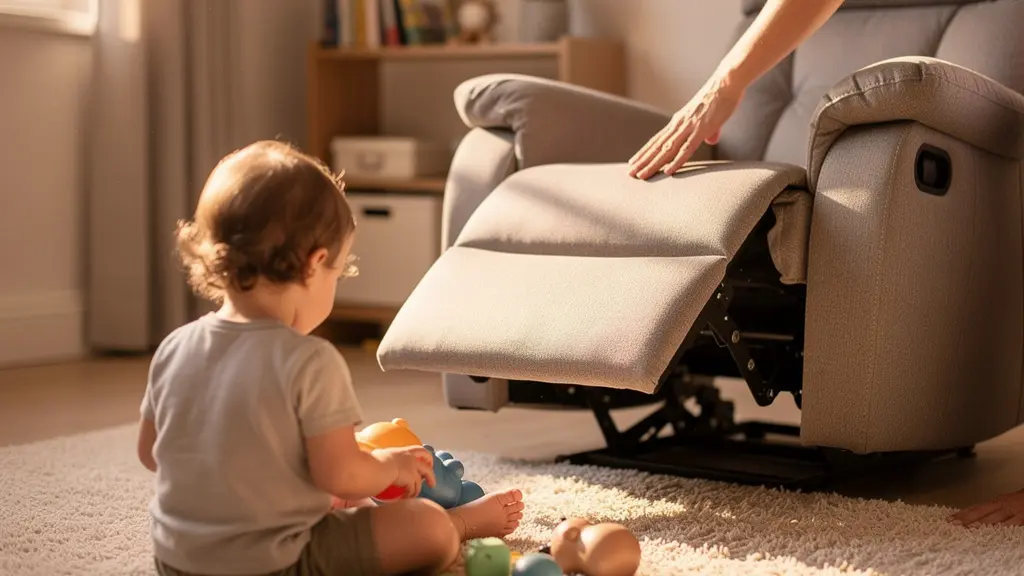
A well-designed family-friendly recliner will have specific features to mitigate these risks. Some modern power recliners now include safety stops or pressure sensors that halt the motor if they detect an obstruction. Manual recliners might feature a child-proof lock on the lever. Beyond specific features, the overall stability of the chair is crucial. A top-heavy recliner can tip over if a child climbs on the extended footrest. The presence of these safety considerations is often a good indicator of overall build quality. It’s also worth noting that for some users, power features are a safety benefit; data on mobility shows that 1 in 7 adults with mobility challenges benefit greatly from the assistance of a power lift feature, reducing the risk of falls.
When you’re in the showroom, don’t just sit in the chair—give it a thorough safety audit. A few simple tests can reveal potential dangers that aren’t listed on the price tag.
Your In-Store Recliner Safety Checklist
- Test Closing Speed and Force: Compare the fast, forceful snap of a manual recliner to the slow, high-torque close of a power model to understand the different risks.
- Check Control Accessibility: Ensure power buttons require intentional pressure (ideally 5+ pounds) to activate and aren’t easily pressed by a curious child.
- Perform the Tip Test: Carefully place a heavy bag or item (around 30 lbs) on the fully extended footrest to see if the chair feels unstable or starts to tip forward.
- Inspect Pinch Points: Count all exposed joints and gaps in the mechanism that are larger than a finger’s width when the chair is in motion. Fewer accessible pinch points are better.
- Verify Safety Locks: Actively look for and test any child-proof locks or safety-stop mechanisms on both manual levers and power controls.
How to Hide Battery Packs for Cordless Power Recliners in Open Rooms?
Power recliners offer incredible comfort, but they come with a logistical challenge: the power cord. In a room where the sofa floats in the middle rather than against a wall, a trailing cord is an ugly tripping hazard. The solution is a cordless battery pack, which transforms your power recliner into a truly versatile piece of furniture. These packs can typically power a recliner for hundreds of cycles before needing a recharge. The new problem? You now have a clunky battery pack and its charging cable to deal with. A clean, cordless look requires a bit of creative concealment.
The goal is to hide the battery while keeping it accessible for recharging. Many high-end recliners are now designed with this in mind, featuring built-in compartments in the base or under the seat. If your recliner doesn’t have a dedicated spot, you’ll need to get creative. The key is to find a solution that integrates seamlessly with your decor and doesn’t interfere with the reclining mechanism. Here are some of the most effective solutions I’ve seen:
- Custom Upholstery Pouches: A small pouch made from matching fabric or leather can be attached to the back or side of the recliner to discreetly hold the battery.
- Hollow-Base Side Tables: A small end table with a hidden compartment is perfect for stashing the battery and its charger.
- Decorative Storage Ottomans: Placing a small storage ottoman next to the recliner provides a convenient and stylish hiding place.
- Under-Rug Cable Routing: If an outlet is nearby, a thin, flat extension cord can be run under an area rug to the recliner, keeping the battery constantly charged and out of sight.
When choosing a hiding spot, it’s important to think about the long term. As a design expert from Circle Furniture wisely points out, technology evolves. Your perfect hiding spot today might not work for a replacement battery in five years.
The lifecycle of battery concealment is crucial – your perfect hiding spot today might not fit the replacement battery available in 5 years, as battery form factors evolve rapidly.
– Stephanie Birchenough, Circle Furniture Design Expert
Why a “Deep” Sofa Actually Hurts Your Back After 30 Minutes?
There’s a common misconception in furniture shopping that a deep, sink-into-it sofa is the ultimate sign of comfort. While it might feel luxurious for the first few minutes, a seat that’s too deep for your body is an ergonomic nightmare. If your legs are too short to bend naturally at the knee while your back is against the backrest, you’re forced to slouch. This “C-shaped slump” leaves your lower back completely unsupported, putting strain on your spine and leading to aches and pains after just 20-30 minutes. This bad posture doesn’t just cause discomfort; it also puts uneven stress on the sofa’s frame and cushions, contributing to premature wear.
This is where the micro-adjustment capabilities of modern power recliners become a game-changer for durability and health. Unlike manual models with only 2-3 fixed positions, ergonomic specialists confirm that power recliners provide infinite positioning. This allows you to find the exact seat depth-to-recline ratio that keeps your lower back in constant contact with the support surfaces. A case study analyzing the effects of deep seats found that users in a fixed-position deep sofa reported discomfort within 30 minutes. In contrast, users in a power recliner with independent controls for the headrest, lumbar, and footrest were able to maintain proper spinal alignment and comfort for over two hours.
The ability to independently adjust the footrest and backrest is key. On a deep sofa, you can slightly raise the footrest and slightly recline the back to close the gap behind your lower back, effectively “shortening” the seat depth to fit your body perfectly. This ensures your weight is distributed evenly across the chair’s support structures, preventing the concentrated strain that comes from slouching. So, while a deep seat might look inviting, a truly comfortable and durable recliner is one that adapts to you, not one that forces you to adapt to it.
The Placement Error That Blocks Radiators and Damages Your Sofa Leather
One of the fastest ways to destroy a recliner—manual or power—has nothing to do with its mechanism. It’s about where you put it in your room. Placing any recliner, especially a leather one, too close to a heat source like a radiator, fireplace, or even a sun-drenched window is a recipe for disaster. Constant, direct heat does two terrible things: it dries out the upholstery, causing leather to crack and fabrics to become brittle, and it wreaks havoc on the internal mechanism. The heat degrades lubricants, causing parts to grind, and can make plastic or nylon components fail prematurely. For power recliners, the risk is even greater, as overheating can damage the motor and electronics.
The advice from furniture experts is clear and consistent on this point. As one maintenance guide warns, the damage is not trivial. Exposure to dry heat is a major factor in mechanical failure.
Constant exposure to dry heat from radiators degrades lubricants and causes plastic/nylon components to become brittle and fail 73% faster in both manual and power mechanisms.
– Gardner White Furniture Experts, Furniture Maintenance Guide 2024
So, how close is too close? The safe distance varies by the heat source and the type of recliner, with power models requiring a larger buffer zone to protect their electronics. This table provides a clear, conservative guide to follow to protect your investment.
| Heat Source | Manual Recliner Safe Distance | Power Recliner Safe Distance | Risk Factor |
|---|---|---|---|
| Radiators | 36 inches minimum | 48 inches minimum | Motor overheating + leather cracking |
| Floor Vents | 24 inches | 36 inches | Dust accumulation in mechanisms |
| Direct Sunlight | Use UV-filtering curtains | Avoid completely | Material fading + electronics damage |
| Fireplaces | 60 inches | 72 inches | Extreme heat damage to all components |
Before you decide on the perfect spot for your new recliner, take a moment to map out the heat sources in your room. Maintaining these safety distances is a free and easy way to ensure your furniture lasts as long as it was designed to.
Key Takeaways
- Maintenance Over Mechanism: The lifespan of a recliner depends more on regular lubrication and care than whether it’s manual or power. A well-kept motor outlasts a neglected lever.
- Materials Under Stress: Upholstery isn’t just cosmetic. Top-grain leather provides superior resistance to stretching and “puddling” on high-movement areas like footrests compared to most fabrics.
- Environment is Everything: External factors like placement near heat sources or improper seat depth cause “user-induced failure” that can destroy a recliner faster than any mechanical defect.
Why Lumbar Reinforcement in Lounge Chairs Prevents Lower Back Pain?
We’ve talked about mechanisms and materials, but the true foundation of a durable, comfortable recliner is its frame and the support built into it. The most critical area is the lumbar region. A recliner without proper lumbar reinforcement is just a cushioned frame that encourages slouching. Good lumbar support consists of a firm, curved foundation that fills the natural gap in your lower back, promoting healthy posture even when you’re reclined. This isn’t just about preventing back pain; it’s about ensuring the chair’s core structure can withstand years of use without sagging or breaking down.
The quality of this support system is a direct indicator of the chair’s overall longevity. In cheaper recliners, “lumbar support” might just be a bit of extra stuffing. In a high-quality chair, it’s an engineered system of high-density foam, tensioned springs, or even adjustable air bladders in premium power models. According to durability research, a recliner with high-density foam lumbar support can maintain its effectiveness for over 10 years, whereas standard foam supports can lose their resilience and start to sag in as little as 5 years. Power models that offer adjustable lumbar support give you the ability to customize the fit perfectly, but even in a manual model, a well-designed, firm lumbar curve is a sign of quality construction.
When you are in the store, you can perform a quick ergonomic audit to test the quality of the lumbar support. It only takes five minutes and can tell you more about the chair’s build quality than the price tag ever will:
- Check for Gaps: Sit all the way back in the chair. Your lower back should feel fully supported, with no gap between your spine and the cushion.
- Test the Firmness: Press firmly on the lumbar area with your hand. It should feel robust and spring back immediately. If it feels soft or mushy, it won’t provide proper support.
- Recline and Hold: Recline the chair to a 45-degree angle. The lumbar support should remain constant and firm against your back, not disappear as you tilt.
- Stand and Assess: After sitting for five minutes, stand up. If you feel any strain or ache in your lower back, the support is inadequate.
By shifting your focus from the simplistic “manual vs. power” debate to a deeper appreciation for mechanical quality, proper maintenance, and ergonomic design, you are now equipped to choose a recliner that is not just convenient or reliable, but a lasting and comfortable investment for your home. Use this repairman’s guide on your next showroom visit to look beyond the surface and find a chair that’s truly built to last.