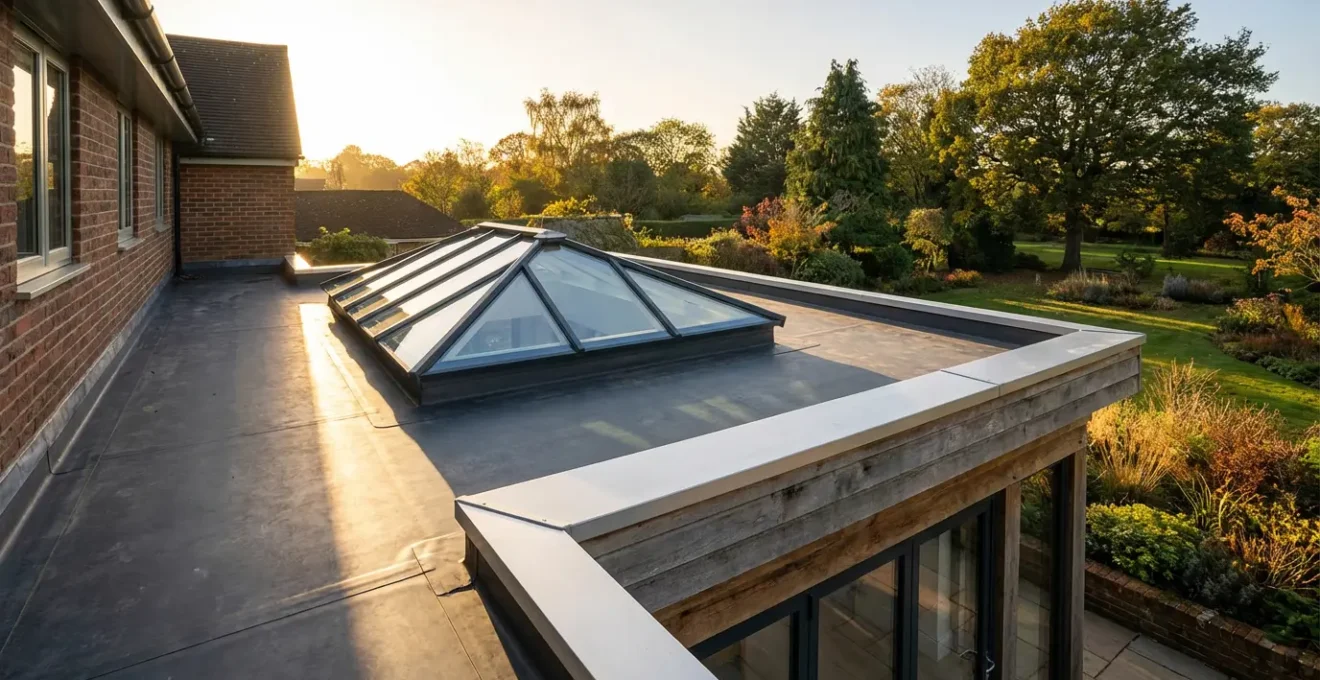
A 20+ year, leak-free orangery roof is not a matter of hope, but of superior engineering defined by a complete system, not just a single material.
- The ‘warm deck’ design is non-negotiable; it places all insulation above the structure, eliminating the primary cause of internal decay: condensation.
- Proactive water management, through a precisely engineered drainage fall and robust detailing around features like roof lanterns, is more critical than the membrane material alone.
Recommendation: Focus on the integrity of the entire roof system—from vapor barrier to drainage outlets—when specifying your project to ensure genuine, long-term performance.
The allure of a modern orangery is undeniable: a space flooded with light, blurring the lines between home and garden. Yet, for many homeowners, this dream is clouded by a persistent fear—the infamous reputation of leaking flat roofs. The internet is filled with cautionary tales, leading many to believe that water ingress is an inevitable fate. Standard advice often revolves around choosing “good materials” or “a reputable installer,” but this vague guidance fails to address the root of the problem and leaves homeowners unable to distinguish a robust design from a future failure.
The common perception is that waterproofing is simply about the final membrane applied to the top. While important, this view is dangerously incomplete. It ignores the complex interplay of forces at work: thermal dynamics, moisture migration, and structural loads. A roof that fails isn’t just a victim of a faulty membrane; it’s a victim of a flawed system that failed to manage these forces effectively. True longevity isn’t found in a single product, but in a holistic design philosophy that treats the roof as an integrated envelope.
This article will demystify the technical principles behind a genuinely long-lasting orangery roof. We will move beyond the platitudes and dissect the “why” behind the “how.” We’ll explore the non-negotiable science of warm deck construction, the critical geometry of drainage, and the precise detailing that turns vulnerable junctions into bastions of resilience. By understanding this system-based approach, you will be empowered to ask the right questions and ensure your investment is not just beautiful, but built to last for decades.
To provide a clear and comprehensive overview, this guide is structured to walk you through every critical aspect of modern orangery roof construction. From architectural features to the hidden science of insulation and water management, each section builds upon the last to give you a complete picture of what constitutes a high-performance, 20-year-plus roof system.
Table of Contents: A System Approach to a 20-Year Orangery Roof
- Why Adding a Roof Lantern Transforms a “Box” into an Architectural Feature?
- How to Construct a Warm Deck Roof to Eliminate Ceiling Condensation?
- Orangery vs Conservatory: Which Offers Better Privacy from Upper-Floor Neighbors?
- The Drainage Design Flaw That Creates Puddles on Your Flat Roof
- How to Hide LED Strips in the Orangery Perimeter Ceiling for Ambient Glow?
- Why Spending 1 Hour in a Sunroom Can Alleviate Winter Blues?
- Why Your Minimalist Decor Is Making Your Living Room Sound Like a Cafeteria?
- How to Create a Visual Flow Between Old House and New Extension?
Why Adding a Roof Lantern Transforms a “Box” into an Architectural Feature?
A standard flat-roof extension can feel utilitarian, like a simple box attached to a house. The introduction of a roof lantern fundamentally alters this dynamic. It breaks the flat plane, drawing the eye upward and pulling natural light deep into the room’s core. This vertical element creates a sense of volume and grandeur, transforming the space from a mere room into a deliberate architectural statement. The interplay of light and shadow throughout the day adds life and character, making the orangery the true heart of the home.
However, this architectural centrepiece is also a critical junction for waterproofing. A lantern is essentially a hole in the roof, and its long-term integrity depends entirely on how it is integrated into the surrounding structure. The key is the kerb or upstand—the raised frame on which the lantern sits. Building Regulations require this upstand to be a minimum of 150mm high to prevent water from splashing or overflowing into the structure. Furthermore, expert design dictates that the external height of this upstand should be lower than the internal height, creating an emergency overflow path to the outside in case the main roof drains become blocked.
Case Study: Seamless Lantern Integration
Leading orangery designers focus on creating a “frameless” interior appearance, where the lantern seems to float above the ceiling. This is achieved by meticulously applying the roof’s single-ply waterproofing membrane up and over the upstand. A successful project by Kingsholme demonstrates a system using Hertalan or Sarnafil membranes, which are so robust they maintain waterproofing integrity even with standing water. This level of detailing is crucial, as the weight of a large, triple-glazed lantern can exceed 500kg, requiring precise calculations for the roof joists to prevent any structural sagging that could compromise the waterproof seals.
This approach highlights the core principle: a roof lantern is not an afterthought. Its integration must be planned from the very beginning, accounting for structural loads, waterproofing continuity, and emergency drainage to ensure its beauty is matched by its resilience.
How to Construct a Warm Deck Roof to Eliminate Ceiling Condensation?
The single greatest, yet often invisible, threat to a flat roof’s lifespan is not rain from above, but condensation from within. This occurs in outdated “cold deck” designs where insulation is placed between the roof joists. Warm, moist air from the house rises, passes through the ceiling, and hits the cold underside of the roof deck, where it condenses into water. This trapped moisture leads to damp, rot, and eventual structural failure. The modern, and only correct, solution for a habitable space like an orangery is the warm deck roof.
In a warm deck design, the entire logic is inverted. A continuous layer of high-performance rigid insulation, such as Polyisocyanurate (PIR), is placed *above* the structural roof deck. This is then covered by the waterproof membrane. This configuration keeps the entire roof structure, including the timber joists and deck, on the warm side of the insulation, preventing the formation of a cold surface where condensation can occur. A vapour control layer (VCL) is installed below the insulation to stop any moisture from the room entering the roof structure in the first place. For this system to be effective, Building Regulations often stipulate a 150mm minimum PIR insulation thickness to achieve the required thermal performance.

The cross-section above clearly illustrates this “sandwich” construction. By keeping the structure warm and dry, the warm deck design not only eliminates condensation risk but also protects the roof from the thermal stresses of expansion and contraction, significantly contributing to its longevity. It is the foundational element of a modern, high-performance orangery roof.
The superiority of this method is so well-established that it is the standard recommended by the NHBC. The following table, based on an industry comparison of roof designs, summarises the key differences.
| Aspect | Warm Deck | Cold Deck |
|---|---|---|
| Insulation Position | Above roof deck | Between ceiling joists |
| Condensation Risk | Minimal – structure stays warm | High – can fail quickly |
| Ventilation Required | No | Yes |
| Thermal Movement | Protected from extremes | Subject to temperature swings |
| Installation Complexity | Straightforward | More complex ventilation needs |
| Recommended by NHBC | Yes – standard form | No longer preferred |
Orangery vs Conservatory: Which Offers Better Privacy from Upper-Floor Neighbors?
When choosing between an orangery and a conservatory, the discussion often centres on aesthetics and thermal performance. However, a crucial and often overlooked factor is privacy, particularly from the vantage point of neighbouring upper-floor windows. A traditional conservatory, with its fully glazed roof, offers virtually no visual barrier. An orangery, by contrast, is defined by its substantial, solid flat roof perimeter, which typically surrounds a central roof lantern.
This solid roof area is the key to privacy. It creates an opaque barrier that effectively shields the majority of the room from overhead views. Occupants can move about freely without feeling exposed. This structural mass provides more than just visual screening. As noted by technical experts, it also offers a significant acoustic advantage. Westbury Garden Rooms’ technical analysis highlights this point clearly:
The mass and insulation of an orangery’s solid roof provide superior soundproofing from external noise compared to a glass or polycarbonate conservatory roof.
– Technical specification analysis, Westbury Garden Rooms Technical Guide
This means an orangery provides a double layer of privacy: visual privacy from being seen and acoustic privacy from outside noise, such as rain drumming on the roof or neighbourhood sounds. This creates a more serene and peaceful interior environment. The thermal benefits are also substantial; a well-insulated solid roof, like the LEKA system, can achieve an exceptional U-value as low as 0.10, ensuring the space is comfortable year-round while contributing to the feeling of a solid, private, and permanent part of the home rather than a temporary glass structure.
The Drainage Design Flaw That Creates Puddles on Your Flat Roof
The most common and visible symptom of a poorly designed flat roof is “ponding”—the formation of standing pools of water that remain long after the rain has stopped. While high-quality modern membranes like EPDM can tolerate standing water, it is a sign of a fundamental design flaw that dramatically shortens a roof’s lifespan. The issue is weight. Water is heavy, and structural calculations reveal the critical load from ponding can be immense; just one inch of standing water over a 20×20 foot area adds nearly 2,000 pounds of additional weight to the structure. This unexpected load can cause the roof deck to deflect or sag, which in turn creates a deeper puddle, leading to a dangerous cycle of increasing load and deflection.
The solution is not a better membrane, but better geometry. A truly professional roof design incorporates positive drainage, meaning it is actively engineered to shed water completely. This is achieved by creating a “fall” or slope across the entire roof surface. The professional standard is a minimum fall of 1:60 (a 1-unit drop for every 60 units of length), which is subtle enough to be invisible but effective enough to ensure no water remains on the roof 48 hours after rainfall. This can be achieved either by building the joists at an angle or by using tapered insulation boards.
Drainage outlets, whether internal drains or through-parapet scuppers, must be correctly sized, positioned at the lowest point, and protected with leaf guards to prevent blockages. Furthermore, a robust design always includes a plan for failure by incorporating secondary overflow outlets. These are positioned slightly above the primary drains and provide an emergency escape route for water if the main system becomes clogged, preventing a catastrophic build-up.
Your Action Plan: Key Points for a Flawless Drainage System
- Design a minimum 1:60 fall (1 in 60 slope) for positive drainage across the entire roof surface.
- Install leaf guards or gravel protection on all outlets to prevent blockage.
- Account for potential structural deflection in all load calculations to prevent sagging.
- Position drainage outlets (internal or scuppers) for a concealed and efficient system.
- Incorporate secondary overflow outlets approximately 50mm above the primary drainage level for emergency situations.
How to Hide LED Strips in the Orangery Perimeter Ceiling for Ambient Glow?
Effective lighting is crucial for transforming an orangery from a day-use space into a welcoming room for evening entertaining. While downlights are a common choice, for a truly sophisticated and modern feel, nothing compares to the ambient glow of concealed LED strips. This technique creates a soft, indirect light that washes across the ceiling, accentuating the height and architectural form of the roof lantern without any harsh glare.
The secret to successful integration lies in the design of the orangery’s perimeter ceiling. The construction of a warm deck roof naturally creates a deep fascia structure on the outside and a corresponding internal plaster perimeter. This perimeter can be designed as a bulkhead or light trough specifically to house LED lighting. This detail must be planned from the outset, as it becomes an integral part of the roof structure itself. It allows for a clean installation where the light source is completely hidden from view, providing a seamless, high-end finish.
However, introducing electrical elements into a roof structure requires careful execution to avoid compromising its thermal and waterproof integrity. According to a case study by Harveys Windows on integrated designs, the key is to ensure that the continuous vapour barrier (VCL) of the warm deck system is maintained. Any penetrations for wiring must be meticulously sealed using approved methods. Low-voltage wiring should be run through dedicated channels before the final waterproofing layers are applied, and all lighting components, such as the LED strips themselves, should be IP65-rated to protect against any potential moisture.
Finally, the quality of the light itself is critical. Balancing the colour temperature of the LEDs (typically a warm 2700K-3000K) to complement the natural daylight from the lantern is essential for a cohesive feel. A Level 5 plaster finish on the ceiling will also ensure a perfectly smooth surface for the light to reflect from, free of imperfections that could create distracting shadows.
Why Spending 1 Hour in a Sunroom Can Alleviate Winter Blues?
The psychological benefits of natural light are well-documented, particularly in combating the low mood and lethargy associated with Seasonal Affective Disorder (SAD), or “winter blues.” An orangery, often referred to as a sunroom, is purpose-built to maximize this exposure. Unlike a standard room with vertical windows, its large roof lantern and extensive glazing capture sunlight from all angles, creating a bright, uplifting environment even on overcast winter days.
However, the therapeutic potential of a sunroom is often nullified if the space is cold and drafty. This is a common complaint with older conservatories, which become virtually unusable in winter. This is where the modern orangery, built with a warm deck roof system, truly excels. The high level of insulation not only makes the space energy-efficient but also fundamentally changes its feel. As one technical analysis notes, the construction method is key to its year-round usability:
A warm deck roof eliminates the cold, drafty feeling often associated with conservatories in winter, creating a genuinely usable and comfortable therapeutic space.
– Technical Analysis, Warm Deck Construction Benefits Study
This feeling of comfort is what allows the space to function as intended. It becomes a sanctuary where one can sit with a book and a coffee, surrounded by the garden, and soak in the available daylight without feeling a chill. This consistent, comfortable temperature is a direct result of the high-performance thermal envelope created by the warm deck and triple-glazing. When this comfort is guaranteed for decades, thanks to robust waterproofing systems, the orangery becomes a long-term investment in well-being. Indeed, studies from the EPDM Roofing Association confirm the exceptional durability of these systems, with many EPDM roofs performing ‘like new’ after 28-32 years in real-world conditions.
Why Your Minimalist Decor Is Making Your Living Room Sound Like a Cafeteria?
Minimalist interior design, with its clean lines, hard surfaces, and lack of soft furnishings, can create a stunning visual aesthetic. However, it often comes with an unintended side effect: poor acoustics. Sound waves from conversation, music, or even footsteps bounce off hard floors, glass walls, and bare ceilings, creating a harsh, echoing environment reminiscent of a noisy cafeteria. This issue is magnified in a space like an orangery, which features large expanses of glass.
The solution lies not in cluttering the space with rugs and heavy curtains that would compromise the minimalist look, but in building acoustic control directly into the structure itself. The solid, insulated flat roof of an orangery presents a significant opportunity to absorb sound and reduce reverberation. While a standard plasterboard ceiling offers some benefit, specifying materials with inherent acoustic properties can make a dramatic difference. This is a key, often-missed detail in creating a truly luxurious space.
Case Study: Integrating Acoustic Insulation
A proven method for enhancing acoustics is to use insulation materials that offer both thermal and sound-dampening properties. For instance, using Rockwool Hardrock insulation boards within the warm deck assembly provides this dual benefit. The dense mineral wool structure is highly effective at absorbing sound energy, significantly reducing both rain noise from above and internal echo. As demonstrated in flat roofing best practices, these boards are mechanically fixed to the roof deck, and their tissue-faced surface is compatible with the direct adhesion of modern EPDM membranes, ensuring no compromise to the waterproofing system.
By integrating acoustic performance into the roof construction, an orangery can maintain its clean, minimalist aesthetic while offering a calm, serene, and acoustically comfortable atmosphere. It’s another example of how a holistic design approach, considering factors beyond just waterproofing, leads to a superior final result. Some advanced lightweight solutions can provide this benefit while being up to 40% lighter than other acoustic products, reducing structural load.
Key Takeaways
- A 20-year lifespan depends on a complete system, not just the top membrane. The ‘warm deck’ design is the non-negotiable core of this system.
- Positive drainage, engineered with a 1:60 fall, is critical to prevent water ponding and the immense structural load it creates.
- Details matter: lantern upstands, VCL continuity around wiring, and seamless flashing are where many roofs fail. Expert execution at these junctions is paramount.
How to Create a Visual Flow Between Old House and New Extension?
The ultimate success of an orangery extension lies not just in its own beauty, but in how seamlessly it integrates with the existing home. A disjointed connection can make the new addition feel like an awkward afterthought, regardless of its quality. Achieving a harmonious visual flow requires careful planning of the key architectural junctions between the old and new structures, creating the impression that the orangery was always part of the original design.
The first principle is aligning horizontal lines. The height of the orangery’s fascia and coping should be designed to match the eaves level of the existing house. This creates a continuous, unbroken sightline that ties the two volumes together. Material and colour matching is equally critical. The powder-coated aluminium used for the roof lantern, windows, and coping should be specified to an exact RAL colour that matches or complements the existing window frames of the main house.
The vertical junction—where the orangery wall meets the house—is another crucial detail. Rather than a clumsy, overlapping lead flashing, a high-end finish involves a recessed or ‘secret’ flashing channel, which is chased into the house wall for a much cleaner and more integrated look. This level of detail extends to the interior, where using matching ceiling finishes (such as plaster or exposed beams) and ensuring a completely flush floor threshold between the old and new spaces removes any physical or visual barrier, encouraging a natural flow of movement. Longevity is assured by using modern liquid membrane systems at these junctions, which offer a 15-25 year lifespan when properly installed.
By considering these points of connection—both external and internal—the orangery becomes a natural and sophisticated evolution of the home, enhancing its overall character and value.
Now that you are equipped with the technical knowledge of what constitutes a durable, high-performance orangery roof, the next step is to use this understanding in your conversations. A truly professional installer will not only recognize but welcome a discussion about warm deck principles, drainage falls, and upstand detailing. Use this guide to confidently specify a system that delivers on the promise of a 20-year, leak-free lifespan.