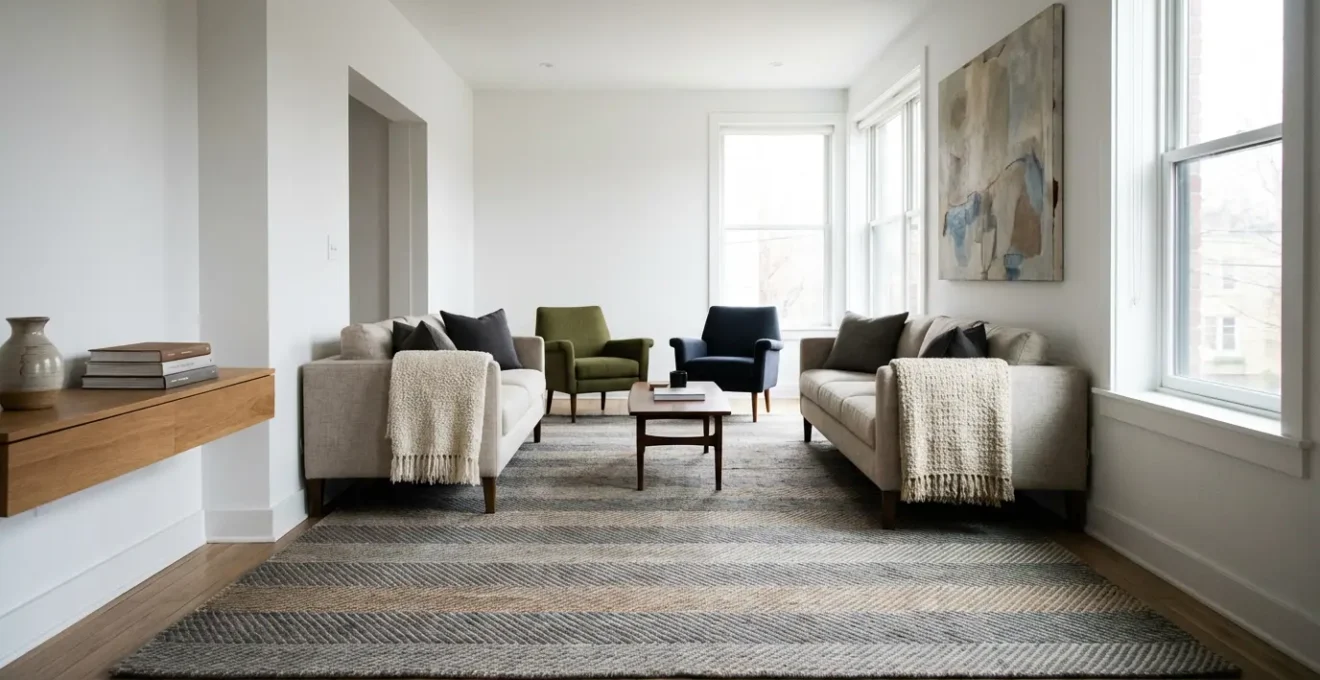
Widening a narrow room isn’t about simple tricks like horizontal stripes; it’s about mastering spatial manipulation with your geometric rug as the primary tool.
- Create a “visual vortex” with round or complex central patterns to draw the eye inward and break the room’s linearity.
- Use a clear “pattern hierarchy” to mix the dominant rug with other textiles without creating visual chaos.
- Anchor “floating” furniture with a large “foundation” rug to define clear, usable zones that make the room feel larger.
Recommendation: Stop thinking of your rug as a passive floor covering and start using it as an active architectural tool to reshape your space.
Living in a home with a long, narrow living room often feels like you’re decorating a hallway or a bowling alley. The default instinct is to push all the furniture against the walls, which only exaggerates the tunnel-like effect. Common advice suggests using light colors or hanging a mirror, but these are passive solutions to a dynamic problem. You might have heard that horizontal stripes can help, and while true, it’s only scratching the surface of a much more powerful design discipline: spatial illusion.
The real secret to correcting an awkward floor plan lies under your feet. A geometric rug is not just a decorative element; it’s an active tool for manipulating perception. The key isn’t just picking a pattern you like, but understanding how its shape, scale, and alignment can fundamentally alter how the brain perceives the dimensions of a room. It’s about moving beyond decoration and into the realm of clever, problem-solving design where geometry becomes your greatest ally.
This guide will deconstruct the strategies of a spatial illusionist. We will explore how to create a “visual vortex” to break linearity, how to mix patterns without clashing, and how to use the rug’s lines to anchor your furniture and create functional, inviting zones. By the end, you will see your rug not as an accessory, but as the most powerful instrument you have for visually reshaping your living space.
To guide you through this process, this article breaks down the essential geometric principles and practical mistakes to avoid. The following sections will provide a clear roadmap for transforming your narrow room into a well-proportioned and visually engaging space.
Summary: A Designer’s Guide to Geometric Rugs in Narrow Spaces
- Why Round Tables Facilitate Better Conversation Than Rectangular Ones?
- How to Mix Geometric Wallpapers with Floral Textiles Without Clashing?
- Soft Curves vs Sharp Angles: Which Shape Reduces Visual Tension?
- The Scaling Mistake That Makes Geometric Tiles Look Dizzying
- How to Align Geometric Wall Art to Anchor Floating Furniture?
- The Rug Size Mistake That Makes Your Living Room Look Tiny
- Why Sectional Sofas Encourage More Family Interaction Than Separate Sofas?
- How to Eliminate Echo in Open-Plan Homes Using Decorative Acoustic Panels?
Why Round Tables Facilitate Better Conversation Than Rectangular Ones?
The principle behind a round dining table’s social success is directly applicable to solving the narrow room problem. A round table has no head, creating a democratic, inclusive arrangement where everyone can see each other. This creates an inward focus. In a narrow living room, your goal is to replicate this effect to counteract the strong parallel lines of the walls that pull the eye lengthwise. You must create a “visual vortex” that draws attention to the center of the room, effectively stopping the eye from racing to the far end.
A large, round geometric rug is the perfect tool for this. Its curves directly oppose the room’s rigid right angles, softening the entire space. By placing a round rug in the center of a seating area, you create a natural focal point that encourages furniture to be arranged in a more conversational, curved grouping. This breaks the “bus seating” layout common in narrow rooms.
This concept is about fighting linearity with curves. The round shape acts as a powerful anchor, creating a self-contained zone that feels like a destination rather than a passageway. The effect is a space that feels more balanced, sociable, and visually wider because you’ve given the eye a compelling circular path to follow instead of a straight line.
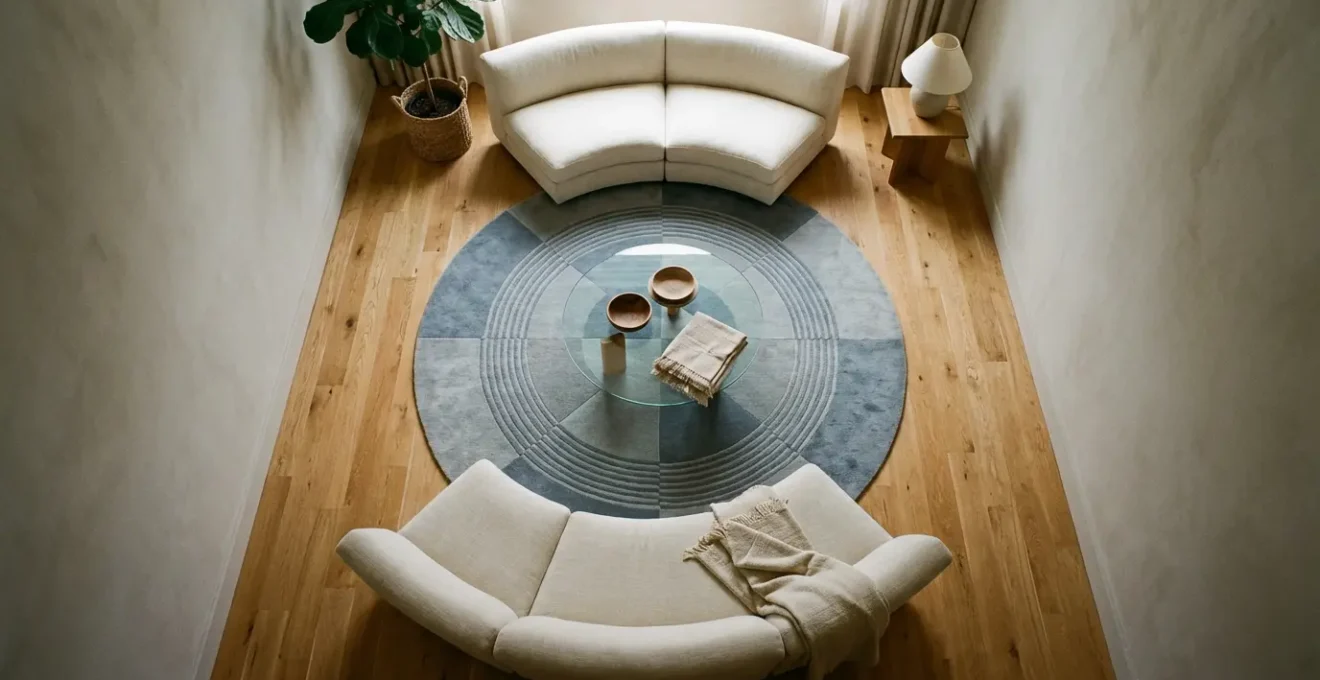
As seen in the image, the concentric circles of the rug pull energy inward, making the seating arrangement the undeniable center of gravity. This strategic use of shape transforms the room’s perceived dimensions. To implement this, choose a round rug large enough to have a significant impact—ideally at least 8 feet in diameter. Then, arrange seating so the front legs rest on the rug, reinforcing the circular geometry and completing the illusion.
How to Mix Geometric Wallpapers with Floral Textiles Without Clashing?
Once you’ve chosen a dominant geometric rug, the next challenge is integrating it with other patterns in the room, like floral cushions or patterned curtains, without creating visual chaos. The secret is not to avoid mixing, but to do so with a clear strategy known as pattern hierarchy. One pattern must be the hero, another the supporting actor, and the third a subtle background texture. In our case, the large geometric rug is the hero.
The most common mistake is using multiple patterns of the same scale (size). Two large, bold patterns will fight for attention and make the room feel busy and smaller. Instead, you need to vary the scale dramatically. If your rug has a large-scale geometric repeat, your floral textiles should have a medium-scale pattern, and any additional patterns, like a throw blanket, should be small-scale or purely textural.
Another key technique is the “color bridge.” Identify one or two unifying colors present in both your dominant geometric rug and your secondary floral patterns. Repeating this bridge color in solid-colored items throughout the room—a vase, a piece of art, a throw pillow—will tie the disparate patterns together into a cohesive and intentional design. This creates harmony, proving that geometrics and florals can not only coexist but thrive together.
This comparative table, based on guidance for coordinating patterns, illustrates the concept of establishing a clear visual order. Following a framework like the one from a professional guide on mixing rug patterns helps ensure a successful outcome.
| Pattern Type | Scale Size | Room Coverage % | Visual Impact |
|---|---|---|---|
| Geometric Rug (Dominant) | Large (12+ inch repeat) | 60% | Bold, commanding presence |
| Floral Cushions (Secondary) | Medium (4-8 inch repeat) | 30% | Complementary accent |
| Textured Throws (Accent) | Small/Minimal | 10% | Subtle texture layer |
Soft Curves vs Sharp Angles: Which Shape Reduces Visual Tension?
While soft curves, as discussed earlier, are excellent for creating a central, calming vortex, sharp angles possess a different kind of power: directional force. Patterns with strong diagonal or horizontal lines—like chevrons, diamonds, or simple stripes—can be actively used to direct the eye and manipulate spatial perception. In a narrow room, the goal is to drive the eye horizontally, from side to side, to create a sense of width.
This is why horizontal stripes are a classic trick. It’s a simple optical illusion where the transverse lines force your brain to scan across the room’s shorter dimension, making it feel wider. This is an optical trick confirmed by design principles for visual perception that show how line orientation affects spatial interpretation. However, you can achieve a more sophisticated effect with other angular patterns. A chevron or herringbone pattern provides the same widening benefit of horizontal stripes but adds more dynamic energy and visual interest.
So, which is better? It depends on your goal. Soft curves reduce visual tension and create a cozy, inward-facing zone. Sharp angles, on the other hand, create energy and are more assertive in their mission to visually stretch the space. You can even combine them: use a rug with bold, angular geometry and then soften the room with a curved sofa or a round coffee table. The key is to be intentional: use curves to centralize and soften, and use angles to direct and widen.
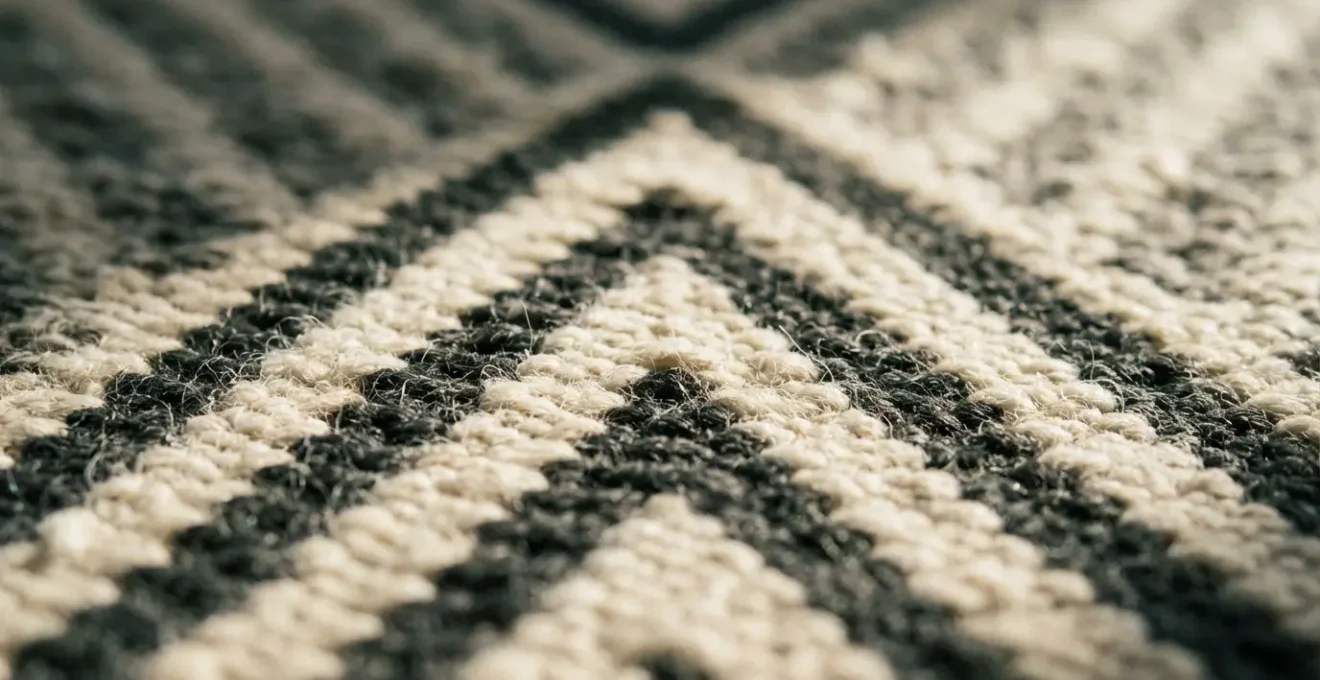
The close-up of this chevron pattern reveals its strong directional lines. This isn’t just a static design; it’s a visual engine pushing the eye outward, a perfect tool for actively combating the inward squeeze of narrow walls.
The Scaling Mistake That Makes Geometric Tiles Look Dizzying
You’ve chosen the perfect shape—say, a bold angular pattern to widen the room. But there’s a critical mistake that can turn your design statement into a dizzying mess: incorrect pattern scale. The scale of a geometric pattern (the size of its repeating elements) must be in proportion to the size of the rug and the room itself. A small, busy, and repetitive pattern on a large rug can create a moiré effect, an optical illusion that feels vibrating and unsettling. This is especially true from a distance, which is how you will typically view the rug.
The cardinal rule is: the larger the rug, the larger the pattern’s scale should be. For a standard 8×10 foot living room rug, you should look for patterns with a repeat of at least 12 inches or more. This gives the design room to breathe and allows the individual shapes to be clearly discernible from across the room. A pattern that looks great on a small swatch can become an overwhelming visual buzz when scaled up to cover a large floor area.
Furthermore, ensure the pattern has enough “negative space”—the background color or area around the main shapes. A pattern with at least 30% negative space will feel more open and less claustrophobic than one where the geometric elements are tightly packed. Always try to get a large sample or use a retailer’s augmented reality (AR) tool to see the pattern in your actual space before buying. Viewing it from 8-10 feet away will give you a true sense of its visual impact.
Your Action Plan: Pattern Scale Testing Checklist
- View from a Distance: Always order a fabric sample before purchasing and view it from 8-10 feet away, which is a normal viewing distance in a living room.
- Follow the Size-to-Scale Rule: Apply the ‘larger rug = larger pattern’ principle. For an 8×10 rug, seek patterns with repeats of 12 inches or more to avoid a busy look.
- Check for Negative Space: Ensure there is at least 30% negative space within the pattern’s design to give the shapes room to breathe and reduce visual clutter.
- Use Visualization Tools: Take advantage of AR (Augmented Reality) visualization tools offered by retailers to digitally “place” the rug in your room and see its true scale.
- Consider a Solid Border: Choose patterns that are contained within a solid border. This acts as a frame, grounding the design and preventing a busy pattern from overwhelming the space.
- Test in Your Lighting: Photograph the pattern samples in your room at different times of day to see how your specific lighting conditions affect the pattern’s appearance and intensity.
How to Align Geometric Wall Art to Anchor Floating Furniture?
In a long, narrow room, one of the best strategies is to pull furniture away from the walls and create a “floating” seating arrangement. However, this can leave the furniture feeling unmoored and disconnected. This is where the geometric rug performs its next act of spatial magic: geometric anchoring. The title mentions wall art, but the principle of alignment begins on the floor. The rug’s lines and placement create the foundation that anchors everything else.
The key is to use the rug to define distinct zones. As one designer notes in a perspective on long room layouts, the goal is to “divide the space into two or more zones.” Your main seating area, defined by the rug, becomes one zone, and the remaining space becomes a clear traffic path or a secondary zone (like a reading nook). To do this effectively, the rug must be large enough for the front legs of ALL pieces in the seating group (sofa, chairs) to rest comfortably on it. This physically and visually ties the pieces together into a cohesive unit.
Next, align the rug’s dominant lines with the room’s main focal point, be it a fireplace, a large window, or a major piece of wall art. If your rug has a grid or striped pattern, its lines should run parallel or perpendicular to that focal point to create a sense of order. For a truly bold move, you can even place the entire rug at a slight 15-degree angle. This breaks all the rigid parallel lines of the room and creates a highly dynamic, designer-led feel. By using the rug to create a unified island, your “floating” furniture suddenly feels intentional, grounded, and perfectly placed.
The Rug Size Mistake That Makes Your Living Room Look Tiny
Perhaps the single most common and most damaging mistake in decorating any living room, especially a narrow one, is choosing a rug that is too small. A small rug that sits alone in the middle of the floor with furniture scattered around it is an “island rug.” It visually breaks up the floor, emphasizes the empty space around it, and ultimately makes the entire room look smaller and disjointed. It forces the furniture back against the walls, defeating any attempt to create an inviting zone.
The correct approach is to use a “foundation rug.” This is a rug large enough to slip under the front legs of every piece of furniture in your primary seating arrangement. By connecting all the elements, the rug creates a single, unified zone. This cohesive block of furniture and textile is perceived by the eye as one large entity, which makes the entire room feel bigger, more organized, and more luxurious. In a narrow room, this is non-negotiable. The foundation rug is what allows you to pull furniture off the walls without it looking lost.
But what if a large, high-quality rug is outside your budget? A clever, designer-approved solution is layering. Start with a large, inexpensive, and neutral base rug (like sisal or jute) that is big enough to be a proper foundation. Then, layer a smaller, more vibrant, and more expensive geometric rug on top. This technique, highlighted in budget-conscious design strategies, gives you the scale you need without the high cost, while also adding depth and texture.
The visual impact of choosing the right size is enormous, as this table comparing the two approaches demonstrates. This data, adapted from analyses on how rug choice dictates room design, makes the case clear.
| Rug Type | Size Relative to Furniture | Visual Effect | Space Perception |
|---|---|---|---|
| Island Rug (Mistake) | Smaller than furniture grouping | Furniture appears to float | Makes room look smaller |
| Foundation Rug (Correct) | Extends under all front furniture legs | Creates unified zone | Makes room look larger |
| Layered Solution | Large neutral base + smaller geometric accent | Adds depth and interest | Budget-friendly expansion |
Why Sectional Sofas Encourage More Family Interaction Than Separate Sofas?
In a narrow living room, a sectional sofa might seem counterintuitive, but it can be a powerful tool for both social interaction and spatial definition, especially when paired with the right geometric rug. Unlike a separate sofa and chairs, which can feel like disconnected pieces in a line, a sectional inherently creates a “C” or “L” shape. This configuration physically turns people towards each other, fostering a more connected and conversational atmosphere. It creates a self-contained nook that feels cozy and inclusive.
The key to making a sectional work in a narrow room is to use it as a room divider. By placing the long side of an L-shaped sectional against the longest wall and letting the shorter “chaise” side project into the room, you create a soft boundary. This carves out a dedicated living zone, separating it from the main traffic path. This act of zoning with furniture is what transforms the “bowling alley” into a multi-functional space.
A geometric rug is the glue that holds this layout together. Choose a large foundation rug that extends at least 8 inches beyond the ends of the sectional. A rug with a grid or diamond pattern can be particularly effective, as its 90-degree angles will echo the shape of the sectional, creating a sense of geometric harmony. The rug solidifies the seating area as a single, intentional zone, while you can even place a complementary runner rug in the walkway you’ve created to clearly define the traffic flow. This creates a cohesive design where the furniture and rug work together to maximize both function and social connection.
Key Takeaways
- A geometric rug is an active tool for spatial manipulation, not just passive decor.
- Fight a room’s linearity by creating a “visual vortex” with round or centrally complex patterns.
- Always use a “foundation” rug that is large enough to sit under the front legs of all seating to unify the space.
How to Eliminate Echo in Open-Plan Homes Using Decorative Acoustic Panels?
While the title mentions acoustic panels, one of the most effective and stylish “acoustic panels” in your home is actually on the floor. Long, narrow rooms, especially those with high ceilings or hardwood floors, often suffer from poor acoustics, resulting in an unpleasant echo that makes the space feel cold and cavernous. Textiles are the number one tool for absorbing sound, and a large area rug offers the most surface area to do so.
However, not all rugs are created equal when it comes to sound absorption. The material and, more importantly, the pile height, play a crucial role. A flat-weave or kilim rug, while excellent for showing off crisp, sharp geometric patterns, offers minimal acoustic benefit. Its thin, tight weave does little to trap sound waves. On the other hand, a high-pile or shag rug made of a material like wool is an acoustic powerhouse. Its thick, dense fibers are incredibly effective at trapping and dampening sound, significantly reducing echo and creating a warmer, cozier, and more intimate atmosphere.
This presents a design choice: do you prioritize maximum pattern clarity or maximum sound control? A high-pile rug will soften the edges of a geometric pattern, giving it a more textured, less graphic look. A flat-weave will deliver the sharpest visual impact. For a balanced approach, a medium-pile rug offers a good compromise, providing decent sound absorption while maintaining good pattern definition. This decision allows you to add another layer of function to your design, using your geometric rug to solve an auditory problem as well as a visual one, as this table sourced from specialist rug collections shows.
| Rug Type | Sound Absorption | Pattern Clarity | Best For |
|---|---|---|---|
| High-Pile Wool/Shag | Excellent (reduces echo by 40-50%) | Soft, textured appearance | Cozy atmosphere, sound control priority |
| Flat-Weave/Kilim | Minimal (reduces echo by 10-15%) | Crisp, sharp geometric lines | Maximum visual impact, graphic clarity |
| Medium-Pile Blended | Good (reduces echo by 25-30%) | Balanced definition | Compromise between acoustics and aesthetics |
By understanding and applying these principles of shape, scale, placement, and even material, you transform from a simple decorator into a true spatial illusionist. The geometric rug becomes your most versatile tool, capable of not only beautifying a space but fundamentally reshaping it. For a truly optimized living space, the next logical step is to analyze your specific room’s dimensions and focal points to create a personalized layout plan.