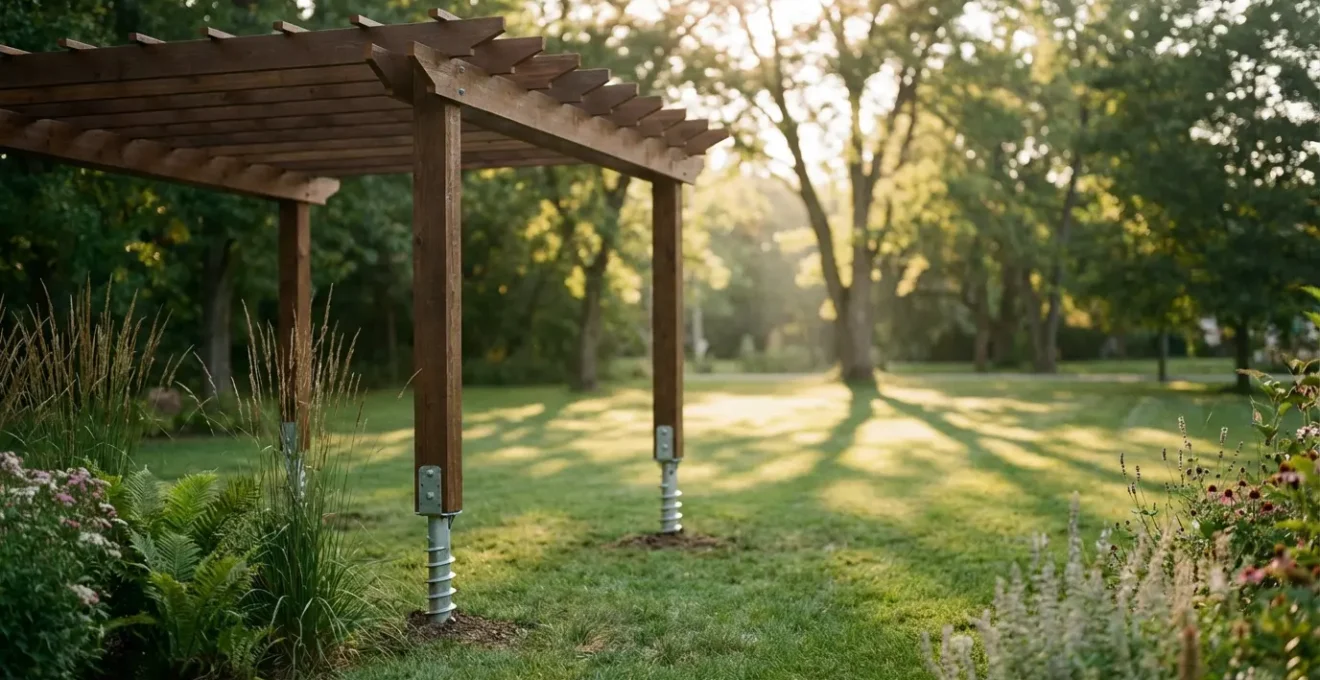
Securing a pergola without concrete isn’t about using bigger spikes; it’s about designing an integrated stability system that works with your landscape.
- Wind load is the most underestimated force, and it’s easily multiplied by factors like the structure’s height and the addition of privacy screens.
- The most effective non-invasive solutions combine weight (ballast) with landscape design, turning elements like large planters or water features into functional anchors.
Recommendation: Before choosing an anchor method, audit your specific site conditions—soil, exposure, and local codes—to calculate the true forces your pergola will need to withstand.
The dream of a garden escape—a freestanding pergola nestled in a far corner of the lawn—often hits a concrete wall, sometimes literally. For tenants, or for homeowners who simply wish to avoid the permanence and disruption of pouring concrete footings, the question of stability becomes a major hurdle. Many conventional guides suggest simple ground spikes or screws, while others propose using heavy planters as a decorative fix. While these methods have their place, they often fail to address the complex physics at play, treating the symptom (a wobbly structure) rather than the root cause.
This approach overlooks the dynamic forces your pergola will endure. The real challenge isn’t just pinning the structure to the ground; it’s about managing leverage, uplift, and lateral shear caused by wind. But what if the most robust, non-invasive solution was less about brute-force hardware and more about systems thinking? This guide reframes the problem entirely. We will move beyond simply “how to pin it down” and explore how to create an integrated anchoring system—one that becomes a functional and beautiful part of your landscape.
We’ll delve into the critical calculations you can’t afford to ignore, explore materials that work with nature rather than against it, and reveal how clever design can turn potential liabilities into stability assets. By the end, you’ll understand how to build a destination in your garden that is both aesthetically pleasing and unshakeably secure, all without a single bag of cement.
This article provides a comprehensive roadmap, from understanding environmental forces to implementing advanced, non-concrete anchoring strategies. The following sections break down each critical component for creating a safe and lasting garden structure.
Summary: A Complete Guide to Non-Concrete Pergola Anchoring
- Why Placing a Pergola 20m from the House Creates a True “Escape” Zone?
- How to Calculate Wind Load for a 4-Post Pergola in Open Terrain?
- Cedar vs Aluminum: Which Freestanding Structure Blends Better with Wild Gardens?
- The Height Restriction That Could Force You to Tear Down Your Garden Pergola
- How to Add Adjustable Screens to a Freestanding Pergola for Instant Privacy?
- Native Species or Exotics: Which Requires Less Water in Dry Climates?
- Why a Water Feature Is the Best Defense Against Traffic Noise?
- How to Create Effective Shade for South-Facing Gardens Without Blocking the View?
Why Placing a Pergola 20m from the House Creates a True “Escape” Zone?
Positioning a pergola deep within the garden, far from the main house, transforms it from a simple patio extension into a true destination—an “escape” pod. This psychological distance is powerful; it creates a sense of journey and arrival, encouraging a mental break from the routines of the home. However, this distance also moves the structure into a more exposed environment, making a robust, independent anchoring system absolutely critical. Without the shelter of the main building, the pergola must stand on its own against all elements.
A popular and effective non-concrete method involves using large, heavy planters as ballast. This approach brilliantly merges form and function, turning a structural necessity into a design opportunity. By filling substantial containers with dense materials like concrete, sand, or gravel, you create immense weight at the base of each post, effectively lowering the center of gravity and resisting tipping forces. This strategy offers significant stability without any ground penetration, making it ideal for renters or those on sensitive terrain.
The beauty of this method lies in its adaptability and aesthetic integration. It allows you to create a lush, green foundation that anchors the structure both physically and visually within the landscape.
Case Study: Hurricane-Resistant Planter Anchoring
A homeowner in Florida devised a stylish and resilient anchoring solution using heavy concrete planters. By filling them with concrete and topping them with decorative river rock, they created a system that has successfully withstood hurricane-force winds for over four years. This method provided exceptional security and enhanced the backyard’s aesthetic without requiring any digging or drilling into a permanent surface, proving that integrated landscape elements can be the strongest anchors.
This approach demonstrates that with the right design, an anchor can be more than just hardware; it can be a living, breathing part of your garden’s design. It’s the first step toward thinking of stability not as an add-on, but as an integral component of the entire structure.
How to Calculate Wind Load for a 4-Post Pergola in Open Terrain?
Placing a pergola in an open field or a large lawn exposes it to the full, uninterrupted force of the wind. This is where most anchoring systems fail—not from a lack of static strength, but from underestimating dynamic load management. Wind doesn’t just push against a structure; it creates complex forces, including lateral (sideways) shear, downward pressure, and most dangerously, upward lift on the roof. Ignoring these forces is a recipe for disaster. Calculating the potential wind load is not an abstract engineering exercise; it’s the most critical step in ensuring your non-concrete anchors are sufficient.
The force exerted by wind increases exponentially, not linearly, with its speed. A 50 mph wind is not half as strong as a 100 mph wind; its force is only a quarter as strong. Understanding this is key. For example, comprehensive wind load calculations show that a 100 mph wind creates a force of over 2,500 pounds on a standard 10×10 foot pergola roof. Your anchoring system must be able to counteract this immense force to prevent lifting or tipping. Without concrete footings, this means your system relies entirely on a combination of ballast (weight) and resistance to pull-out (from screws or spikes).
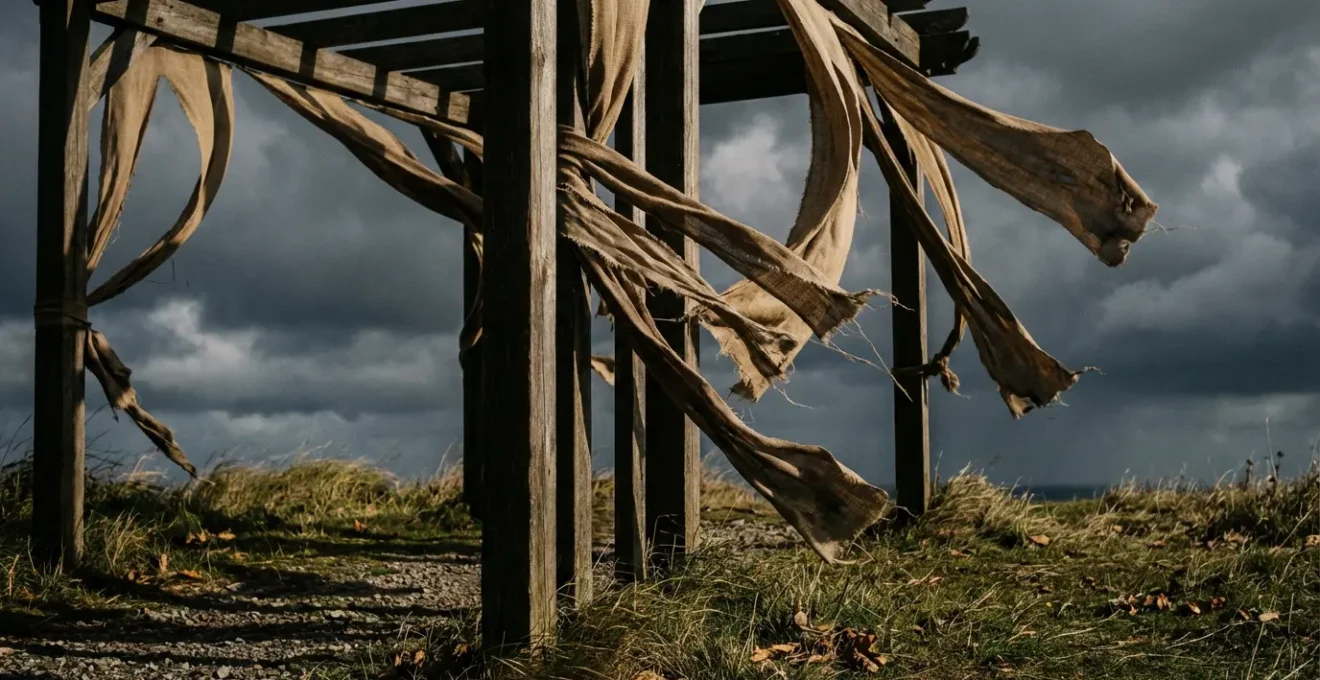
The table below illustrates how dramatically the pressure changes with wind speed. This data is essential for anyone in an area prone to storms, as it provides a realistic basis for choosing an anchoring method. A simple spike anchor sufficient for a 30 mph breeze will be completely inadequate against a 70 mph gust.
| Wind Speed (mph) | Dynamic Pressure (PSF) | Force on 100 sq ft |
|---|---|---|
| 50 | 6.391 | 639.1 lbs |
| 70 | 12.527 | 1252.7 lbs |
| 88.5 | 20 | 2000 lbs |
| 100 | 25.564 | 2556.4 lbs |
This calculation is the foundation of a safe installation. It forces you to move past guessing and into a data-driven approach, ensuring your chosen anchoring system is genuinely capable of handling the worst-case weather scenarios in your specific location.
Cedar vs Aluminum: Which Freestanding Structure Blends Better with Wild Gardens?
The choice between cedar and aluminum for a freestanding pergola in a “wild” or naturalistic garden goes beyond mere aesthetics; it impacts how the structure integrates with its environment and the anchoring systems available. Cedar, with its warm tones and natural grain, weathers over time to a soft silver-grey, allowing it to melt into a landscape of native grasses and untamed perennials. It feels organic and established from day one. Aluminum, on the other hand, offers a sleek, modern contrast. Its clean lines and dark finishes can create a striking architectural statement, framing the wildness of the garden like a piece of art.
From an anchoring perspective, both materials are compatible with non-concrete methods, but the aesthetic goal can influence the choice. For a cedar pergola aiming for maximum naturalism, the concept of “living anchors” is particularly effective. This involves using very large, rustic wooden or stone planters at each post. When filled with soil and planted with deep-rooted native species, these planters provide immense ballast while appearing as an intentional part of the garden design. The structure seems to grow directly from these planted islands.
For an aluminum pergola, the anchor can be more overt. Purpose-built weighted bases or interlocking systems with a clean, modern finish can complement the structure’s industrial-chic look. However, the living anchor concept works just as well, creating a powerful juxtaposition between the manufactured frame and the organic base.
Case Study: Living Anchor System in a Wild Garden
A project successfully used the “living anchor” method where large planters were filled with a mix of gravel and soil to weigh them down. This provided a stable, no-drill foundation for an aluminum pergola. The planters were then filled with native, drought-tolerant grasses and wildflowers. The result was a structurally sound pergola that appeared to float above a miniature meadow, perfectly blending the man-made structure with the wild garden aesthetic and creating a truly integrated landscape.
Ultimately, the best choice depends on the desired relationship between the structure and the garden. Cedar blends in, while aluminum often stands out. In either case, treating the anchor as a design element, rather than just a piece of hardware, is the key to a successful and beautiful integration.
The Height Restriction That Could Force You to Tear Down Your Garden Pergola
While non-permanent structures like pergolas often fly under the radar of building permits, one factor can quickly attract the attention of municipal authorities: height. Many local building codes have specific height restrictions for accessory structures, even those not on permanent foundations. Exceeding these limits can result in fines or, in the worst-case scenario, a tear-down order. Beyond the legal risk, height acts as a powerful force multiplier, dramatically increasing the leverage wind can exert on your structure and placing immense strain on your anchors.
A taller pergola catches more wind and creates a longer lever arm, meaning the same wind speed will generate significantly more tipping force at the base. This is why a simple spike that’s adequate for an 8-foot-tall structure may be dangerously insufficient for a 12-foot one. In fact, many areas prone to strong storms require pergolas to have wind resistance ratings of 100 MPH minimum, a standard that is much harder to meet with tall structures on non-concrete footings. This is why checking local codes isn’t just a formality; it’s a critical step in risk management. It informs not only the maximum legal height but also the minimum strength your anchoring system must possess.
Choosing the right anchor must be directly correlated with the structure’s height. Earthen screws, which twist deep into the ground, offer significantly more pull-out resistance than simple spikes and are often a good choice for mid-height pergolas. For taller structures, more robust solutions like helical piers (professionally installed) or a substantial ballast system become necessary.
Action Plan: Auditing Your Non-Concrete Anchor Strategy
- Assess Site Conditions: Evaluate your soil type (clay, loam, sand) to determine its holding capacity and check for underground utilities before finalizing anchor locations.
- Calculate Load Factors: Realistically estimate your site’s wind exposure and account for force multipliers like structure height and any planned additions like screens or canopies.
- Select Appropriate Anchor Type: Confront your site assessment and load calculations with anchor options (ground screws, helical piers, weighted planters) to find the right match for your stability requirements.
- Verify Local Regulations: Check municipal codes for specific rules on accessory structures, paying close attention to height limits and property line setbacks, even for “temporary” installations.
- Plan for Landscape Integration: Design your anchoring system to be a cohesive part of the landscape, combining the required stability with aesthetic value through the use of planters or other features.
Ignoring the relationship between height and anchoring force is a common and costly mistake. A proactive audit of your plans against local rules and the laws of physics will save you from potential legal trouble and structural failure.
How to Add Adjustable Screens to a Freestanding Pergola for Instant Privacy?
Adjustable screens are a fantastic addition to a freestanding pergola, offering instant privacy, shade control, and a sense of enclosure. Whether they are retractable fabric panels, rolling bamboo blinds, or fixed louvered sections, they can transform an open frame into an intimate outdoor room. However, what is often overlooked is that these screens act like sails. They dramatically increase the surface area exposed to wind, turning a breezy day into a significant structural challenge. This addition is another classic force multiplier that can overwhelm an inadequate anchoring system.
Adding a solid fabric screen to one side of a 10×10 foot pergola can effectively double or even triple the lateral force it must withstand. A porous or mesh screen offers less resistance but still represents a substantial increase in load. This is why the type of screen and its wind resistance must be factored into your anchoring calculations from the very beginning. A system that was perfectly stable as an open frame could become dangerously unstable once screens are installed.
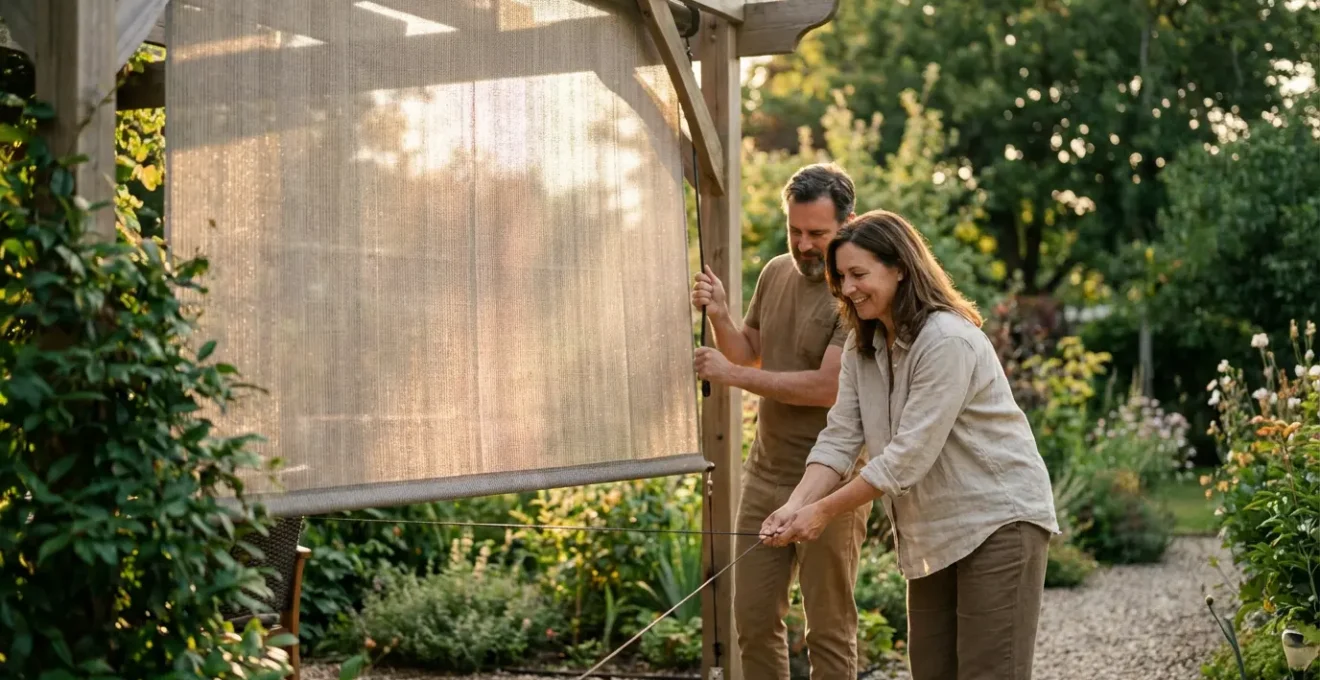
This means your ballast or anchor choice needs to be scaled up accordingly. If you are using weighted planters, you may need to increase their size and weight. If you’re using ground screws, you might need longer screws or additional cross-bracing between the posts to handle the increased lateral shear.
The following table provides a general idea of how different screen types can impact wind load and the corresponding need for additional anchoring weight. These are estimates, but they clearly show that adding any surface area has a direct and significant consequence on stability.
| Screen Type | Wind Resistance | Additional Anchor Weight Needed |
|---|---|---|
| No Screen | Baseline | 0 lbs |
| Mesh/Porous (50% open) | 1.5x baseline | 50-75 lbs per post |
| Solid Fabric | 2-3x baseline | 100-150 lbs per post |
| Retractable Canopy | The maximum sustained wind speed the structure has been engineered and tested to withstand without failing | 150+ lbs per post |
The smart approach is to design the pergola and its privacy features as a single, integrated system. By anticipating the added forces from the start, you can build a versatile and private oasis that remains steadfast and secure, no matter which way the wind blows.
Native Species or Exotics: Which Requires Less Water in Dry Climates?
When using “living anchors”—large planters filled with soil and plants to provide ballast—the choice of what to plant is more than just a decorative decision. In dry climates, this choice has significant implications for water usage and maintenance. Native species, which have evolved over millennia to thrive in the local climate and soil, are almost always the superior choice. They typically require far less supplemental water than exotic plants once established, making them a sustainable and low-maintenance option for landscape integration.
Exotic plants, while they may offer a specific look, often demand more resources, particularly water. In a drought-prone region, keeping them healthy in the confined environment of a planter can become a constant chore. Native grasses, succulents, and wildflowers, however, are adapted to survive and even flourish with minimal intervention. This not only conserves water but also ensures that your living anchors remain healthy and dense, maximizing their aesthetic and structural contribution.
Furthermore, the root systems of native plants can enhance the anchoring effect over time. As one expert notes, this natural process can provide an extra layer of security to your installation.
Deep-rooted native species can help bind sandy or loose soil around spike or screw anchors over time, increasing their holding power naturally.
– Garden Design Expert, Sustainable Pergola Installation Guide
Case Study: Drought-Tolerant Planter Anchors
In a Southern California installation, a cedar pergola was anchored using large Corten steel planter boxes at each post. Instead of thirsty annuals, the planters were filled with a mix of native drought-tolerant species, including Agave and various ornamental grasses. This approach not only provided the necessary weight for stability but also created a water-efficient feature that blended seamlessly with the xeriscaped garden. The deep root systems also helped bind the soil within the planters, increasing the overall mass and effectiveness of the anchors over time.
By selecting plants that are in harmony with the local environment, you create an anchoring system that is not only effective and efficient but also ecologically responsible. It’s a testament to the principle that the best designs often work with nature, not against it.
Why a Water Feature Is the Best Defense Against Traffic Noise?
While a water feature is a well-known tool for masking unwanted noise through the pleasant sound of moving water, it can also serve a powerful, hidden function in a non-concrete pergola installation: ballast. A self-contained fountain or a small pond, when structurally integrated with the pergola’s posts, can act as a massive, immovable anchor. This is perhaps the ultimate expression of landscape integration, where a single element provides aesthetic beauty, acoustic buffering, and formidable structural stability.
The physics are simple: water is incredibly heavy, weighing approximately 8.34 pounds per gallon. A modest 100-gallon feature adds over 830 pounds of weight to your anchoring system before even accounting for the basin, rocks, and other materials. A larger feature can easily provide several thousand pounds of ballast, creating an anchor that is virtually impossible to tip or lift. While most water fountains cost between $1,100 to $7,500 to install, their dual function as both a design feature and a structural anchor can provide exceptional value.
Implementing this strategy requires careful planning. The fountain’s base must be designed to connect directly to the pergola’s posts, ensuring the weight is effectively transferred. Proper drainage, like a French drain system around the base, is also crucial to prevent soil saturation, which could compromise other anchors like ground screws. The water feature’s weight should be considered a core part of the total anchoring system, working in concert with other elements for maximum stability.
Checklist: Integrating a Water Feature as a Ballast Anchor
- Structural Design: Design a self-contained fountain or pond base that structurally connects to the pergola posts, allowing it to act as a unified anchor.
- Weight Calculation: Calculate the total combined weight of the water (8.34 lbs/gallon), the basin materials, and any decorative rocks to ensure it meets your ballast requirements.
- Drainage Planning: Install a French drain or other suitable drainage around the anchor points to prevent soil saturation and potential frost heave issues.
- Vibration Isolation: Position the water pump away from direct contact with the posts to minimize vibration transfer, and use vibration-resistant anchors for any supplemental ground connections.
- System Approach: Consider the fountain’s weight as a primary component of the total anchor system, but not necessarily the sole means of support. Combine it with other methods for redundancy.
By thinking creatively, a solution to one problem (noise) can become a powerful solution to another (stability). This multi-purpose approach elevates the design from a simple assembly of parts to a clever, interconnected system where every element serves multiple roles.
Key Takeaways
- True stability without concrete comes from a systems-based approach, not just hardware.
- Wind load is an exponential force; factors like height and privacy screens act as force multipliers that must be calculated.
- The most effective non-invasive anchors are those integrated into the landscape, such as weighted planters or water features, which combine function with aesthetics.
How to Create Effective Shade for South-Facing Gardens Without Blocking the View?
A pergola’s primary purpose is often to create shade, a particularly vital function in a sun-drenched, south-facing garden. The challenge is to provide this relief without creating a heavy, view-blocking roof. The solution lies in creating “dappled” or “dynamic” shade using elements that filter light rather than block it completely. This can be achieved through strategically spaced slats on the pergola roof, retractable canopies, or, most naturally, by using climbing plants.
Deciduous vines are a perfect solution for landscape integration. In the summer, their dense foliage provides cool, effective shade. In the winter, they lose their leaves, allowing precious low-angle sunlight to warm the space and the home. This natural, responsive system creates shade precisely when it’s needed most. Vines like wisteria, grapevines, or climbing roses can be trained over the pergola’s frame, turning the structure into a living, breathing canopy that changes with the seasons.
Even with a focus on shade, the foundation of stability remains paramount. Fortunately, there are highly effective non-concrete anchoring methods that are both strong and cost-effective, ensuring your shade structure stays put. These innovative systems can be installed by a DIY-savvy homeowner, avoiding the cost and complexity of concrete work.
Case Study: Cost-Effective Anchoring for a Shade Pergola
The Deck Foot Anchor provides an innovative, non-concrete solution ideal for shade-providing pergolas. A study of its use found that at approximately $75 to $80 per anchor, this method is cost-effective and accessible to individuals with average DIY skills. This represents a significant saving compared to pouring concrete footings, all while providing the necessary structural integrity to support the pergola frame and any climbing plants used for shade.
By combining a light, open-roof design with a smart, non-invasive anchoring system, you can create the perfect shady retreat. It allows you to enjoy the comfort of shade and the beauty of your garden view, all while resting on a secure and intelligently designed foundation.
By adopting a systems-thinking approach—calculating forces, integrating anchors into the landscape, and accounting for all variables—you can build a freestanding pergola that is not only beautiful but profoundly stable. This method empowers you to create your garden escape with confidence, knowing it’s secure by design, not by chance. For your project, the next logical step is to perform a detailed site audit to select the anchoring system best suited to your specific needs.