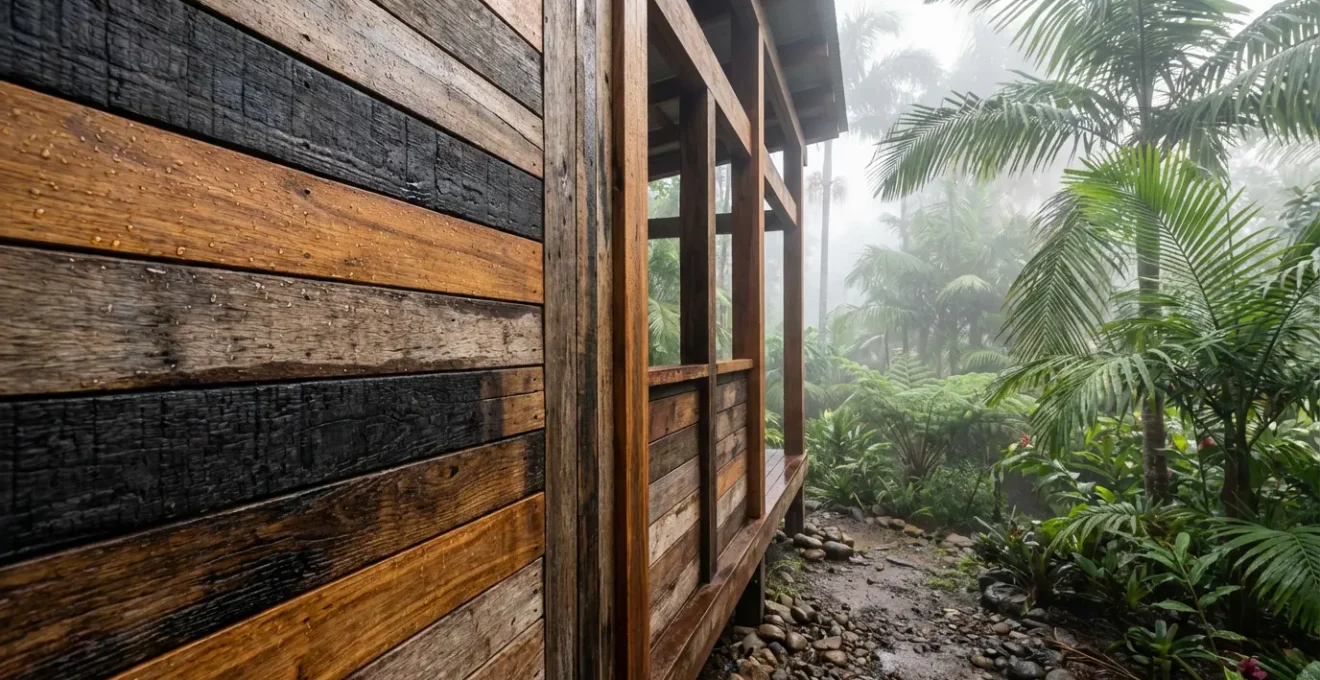
The secret to a long-lasting timber structure in a damp climate isn’t constant sealing and repair; it’s a holistic design that works with nature, not against it.
- Effective rot prevention relies on smart architectural choices like water-shedding joints and material selection, not just surface coatings.
- Integrating the landscape (e.g., trees for shade and moisture control) is a critical, often overlooked, part of the protective system.
Recommendation: Shift your focus from “how to seal it” to “how to design it to dry” from the very beginning of your project.
The warmth, character, and natural beauty of a timber-framed home or extension are undeniable. Wood connects us to the outdoors and offers a sustainable alternative to concrete and steel. Yet, for homeowners in high-humidity climates, this dream is often shadowed by a persistent fear: rot. The nightmare of constant maintenance, peeling varnishes, and the silent threat of decay can feel overwhelming, turning a beautiful feature into a source of anxiety. Many believe the only answer is to drench the wood in harsh chemicals or apply thick, plastic-like coatings year after year.
This approach, however, often traps the very moisture it aims to repel, accelerating decay from the inside out. But what if the conventional wisdom is flawed? What if the key to preserving wood isn’t a relentless battle against moisture, but a more intelligent, holistic strategy? This guide reframes the challenge entirely. We will explore how true, lasting protection comes not from a can of sealant, but from a series of smart design decisions made from day one. It’s about creating a structure with inherent resilience, one that is designed to manage moisture and dry out naturally.
We’ll move beyond surface-level fixes to uncover the architectural principles that give timber its incredible longevity. From the physics of joinery that sheds water to the surprising role mature trees play in foundation health, you’ll discover a system-based approach. This philosophy empowers you to build with wood confidently, ensuring your beautiful timber frame remains a source of joy, not a maintenance burden, for generations to come.
Summary: A Design-First Approach to Protecting Timber Frames
- Why a Timber Frame Extension Has a Lower Carbon Footprint Than Concrete?
- How to Allow for Wood Expansion Without Cracking Your Glass Panels?
- Green Oak vs Glulam: Which Is More Stable for Large Spans?
- The Termite Sign You Usually Miss Until It’s Too Late
- How to Achieve a “Driftwood” Look That Actually Protects the Timber?
- Why Spending $5,000 on Mature Trees Offers Better Returns Than Fancy Pavers?
- Why Dovetail Drawers Last 50 Years Longer Than Glued Joints?
- Why a Solid Oak Dining Table Is a Better Investment Than Veneer?
Why a Timber Frame Extension Has a Lower Carbon Footprint Than Concrete?
Before diving into protection, it’s essential to understand why so many are choosing timber in the first place. Beyond its aesthetic appeal, wood is a champion of sustainability. The primary reason you’re drawn to a timber frame is likely its natural, warm feel, but its environmental credentials provide a powerful, reassuring foundation for that choice. Unlike concrete and steel, which have energy-intensive manufacturing processes, wood actively sequesters carbon throughout its life. A tree absorbs CO2 from the atmosphere, and that carbon remains locked within the timber beams of your home for as long as the structure stands.
This isn’t just a feel-good concept; it has a measurable impact. Mass timber construction, which uses engineered wood products for large-scale structures, offers a dramatic reduction in environmental footprint. In fact, a comprehensive analysis shows that almost 43% of GHG emissions are avoided when mass timber is used as a substitute for reinforced concrete structures. This makes your choice to build with wood a meaningful contribution to a lower-carbon future.
Embracing this benefit means we have a responsibility to ensure the structure lasts. Protecting the timber from rot isn’t just about preserving your investment; it’s about honoring the carbon-storing gift the material provides. This understanding shifts our perspective: preservation becomes a crucial part of the sustainable building lifecycle. The following sections will equip you with the design knowledge to do just that.
How to Allow for Wood Expansion Without Cracking Your Glass Panels?
One of the first anxieties homeowners face with timber, especially when combined with large glass panels, is movement. Wood is a natural, “living” material; it expands and contracts with changes in humidity. A poorly designed frame fights this natural tendency, leading to immense pressure that can stress joints and, in the worst-case scenario, crack expensive glazing. However, a well-designed frame embraces this movement, turning a potential weakness into a demonstration of sophisticated engineering.
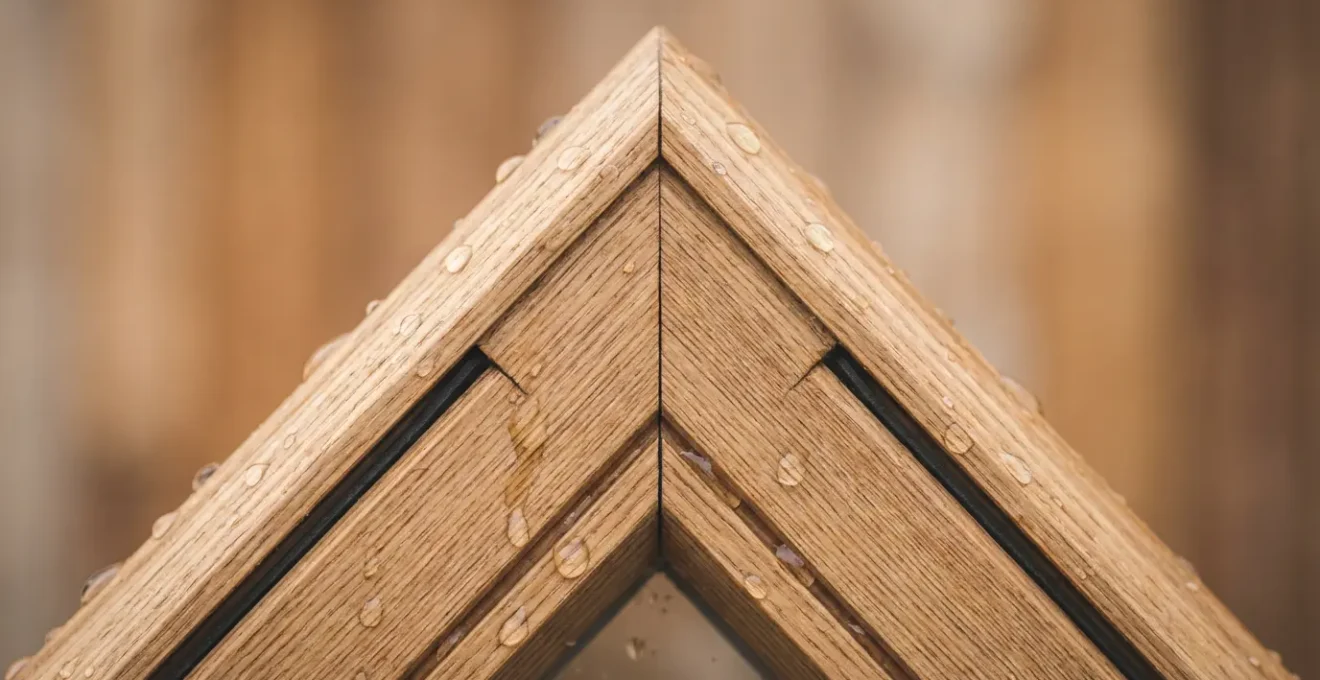
The solution lies in a principle called “design for drying.” Instead of trying to create an impenetrable, rigid seal, expert timber framers design joints that can move while actively shedding water. Techniques like a traditional housed mortise and tenon joint create natural channels that direct water away from the core of the beam. This is often combined with modern innovations like floating channel systems and high-performance compression gaskets. These components create a micro-level rainscreen, allowing the wood to shift without compromising the weatherproof seal on the glass.
The image below shows a cross-section of such a system. Notice how the design anticipates movement and provides clear pathways for water to escape, rather than become trapped.
Furthermore, the design prevents direct contact between timber and moisture-trapping materials. For instance, ensuring timber posts sit on galvanized steel plates, known as moisture breaks, instead of being encased in concrete or masonry, is critical. This single detail prevents the post from constantly wicking moisture from the ground, a primary cause of rot at the base of a structure. It’s a perfect example of inherent resilience built through intelligent design, not chemical application.
Green Oak vs Glulam: Which Is More Stable for Large Spans?
The choice of timber itself is a foundational decision in your fight against rot. The debate between traditional green oak and modern glulam (glue-laminated timber) is not just about aesthetics; it’s about stability and predictability. Green oak is timber that has been recently felled and has a high moisture content. As it dries over several years, it shrinks, twists, and settles, developing a unique character with cracks and checks. This rustic charm is precisely what many people love, but it requires a design that can accommodate significant movement.
Glulam, on the other hand, is an engineered wood product. It’s made by bonding together smaller pieces of kiln-dried timber. This process creates beams that are incredibly strong, dimensionally stable, and predictable. For designs with large spans, minimal visible joinery, or expansive glass walls, glulam is often the superior choice because it won’t move in the same dramatic way as green oak. This stability makes it easier to maintain tight, weatherproof seals over the long term.
Engineered wood like glulam or CLT (Cross-Laminated Timber) also offers other structural advantages. These materials are not only stable but also remarkably lightweight for their strength. Buildings constructed with CLT can achieve a significant weight reduction, with studies showing they can have 33.2% less total mass compared to their concrete counterparts. This reduces foundation requirements and can simplify construction. The choice isn’t about one being “better,” but about which is right for your project’s specific demands and your tolerance for natural movement.
The Termite Sign You Usually Miss Until It’s Too Late
In humid climates, the threat of rot is often accompanied by its destructive cousin: termites. These pests are drawn to the same conditions that foster fungal decay—namely, moisture. The link is so direct that preventing rot is one of the most effective forms of pest control. Wood in the open air becomes highly vulnerable to decay and pests once its moisture level rises. The critical threshold is when wood consistently exceeds 24% moisture content, creating an ideal environment for both rot fungi and termites to thrive.
The problem with termites is that their initial invasion is often silent and invisible. By the time you see obvious damage, the colony may already be well-established within the structure. Early detection is therefore paramount. It requires a vigilant eye for subtle clues that most homeowners overlook. This isn’t about panic, but about creating a simple, regular inspection habit to catch any issues before they become catastrophic.
Forget looking for hollow-sounding wood; that’s a late-stage sign. The earliest indicators are much more subtle. Paying attention to the base of the structure, where wood meets the foundation, is the most critical inspection point. Knowing what to look for can be the difference between a minor fix and a major renovation.
Action Plan: Early Termite Detection Checklist
- Check for Dampness: Regularly inspect the base of your timber structure for any areas of minor, localized rot or persistent dampness. This is the primary attractant for termites.
- Inspect Capillary Breaks: Verify that proper capillary breaks, like moisture-proof membranes, are in place and intact between concrete plinths and timber sills to stop moisture wicking.
- Listen for Sounds: In quiet moments, press your ear against the timber in suspect areas. Faint rustling or clicking sounds can indicate termite activity inside.
- Look for Frass: Scan along walls and baseboards for tiny piles of what looks like sawdust. This is “frass,” or termite droppings, a tell-tale sign they are nesting nearby.
- Find Discarded Wings: After a rain, check windowsills and spiderwebs for discarded insect wings. These can indicate a recent termite swarm, signaling a new or expanding colony.
How to Achieve a “Driftwood” Look That Actually Protects the Timber?
The desire for a natural, weathered aesthetic often leads homeowners towards finishes that offer little actual protection. However, one of the most effective and beautiful preservation methods comes from an ancient Japanese technique that creates a stunning “driftwood” or charred look while making the wood incredibly resilient. This technique is called Yakisugi, or more commonly in the West, Shou Sugi Ban.
The process involves charring the surface of softwood planks, typically cedar, with a controlled flame. After charring, the wood is cooled, cleaned with a stiff brush, and sometimes finished with a natural oil. This is a perfect embodiment of the “inherent resilience” philosophy. Instead of adding a temporary surface layer, you are fundamentally changing the wood’s chemistry. The carbonized layer created by the fire is highly resistant to rot, insects, and even fire itself. It’s a beautiful paradox: wood is preserved by the very element that can destroy it.
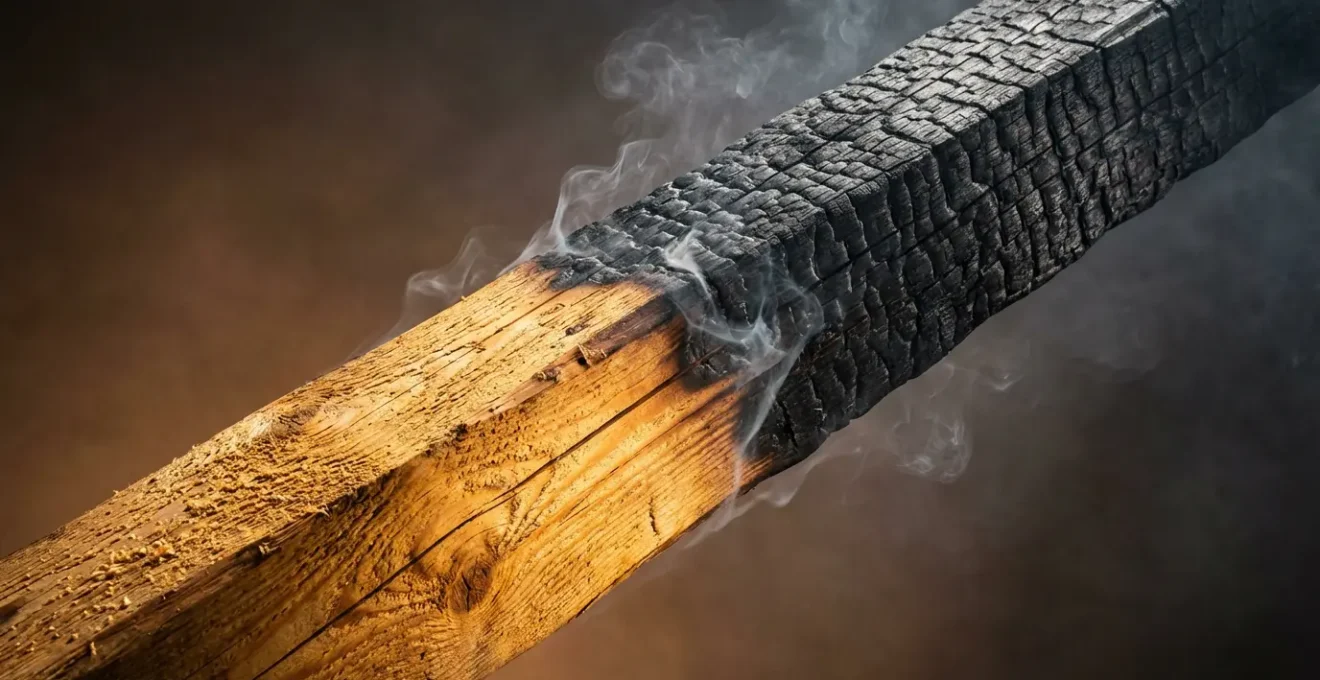
As described by experts in the traditional Japanese process, Shou Sugi Ban (Yakisugi) transforms the wood by heat-treating it to create a protective outer layer. The result is a stunning, deeply textured finish that ranges from a scaly, deep black to a silvery grey, depending on the brushing process. This is a finish that doesn’t peel, flake, or require frequent reapplication like paint or varnish. It’s a low-maintenance solution that offers superior protection while delivering a unique, sophisticated aesthetic that celebrates the nature of the material.
Why Spending $5,000 on Mature Trees Offers Better Returns Than Fancy Pavers?
Protecting a timber structure extends beyond the building itself and into the surrounding landscape. Homeowners often spend significant sums on hardscaping like stone patios and pavers, but an investment in strategically placed mature trees can offer a far greater return, especially in a humid climate. This is the concept of bio-architectural integration: using the living environment as a functional component of your home’s protective system.
A mature deciduous tree is a dynamic, multi-function asset. In the summer, its canopy provides shade, blocking the harsh UV rays that degrade wood finishes and cause surface cracking. More importantly, it acts as a massive umbrella, intercepting thousands of gallons of rainwater annually before it can saturate the ground around your foundation. The tree’s root system then actively draws that moisture out of the soil, helping to keep the foundation and the base of your timber frame drier.
This natural climate control helps maintain the wood’s internal moisture at a healthy equilibrium. For exterior timber to avoid decay, it’s crucial to maintain its moisture content in an optimal range, ideally between 9% and 14%. By reducing extreme temperature swings and moisture loads, trees help keep the wood within this safe zone. Furthermore, thoughtful placement can channel prevailing breezes, promoting airflow around the structure and accelerating the drying process after a storm. A paver patio might look nice, but a tree works for you, actively defending your home from the elements.
Why Dovetail Drawers Last 50 Years Longer Than Glued Joints?
While a dovetail joint on a drawer is a small detail, it represents a profound principle that is critical to the longevity of an entire timber frame: the superiority of mechanical integrity over simple adhesion. In a humid environment, a joint held together only by glue is a ticking time bomb. As the wood expands and contracts, it places immense stress on the rigid glue line. Eventually, micro-fractures form, allowing moisture to penetrate. Once water gets into a glued joint, it gets trapped, creating a perfect pocket for rot to begin.
Traditional joinery, like the mortise-and-tenon or dovetail, works on a completely different principle. These joints interlock mechanically. Their strength comes from the precise cutting and fitting of the wood itself, not from a chemical bond. They are designed to hold tight while still allowing for the wood’s natural seasonal movement. When exposed to rain, a well-designed traditional joint is configured to shed water. And even if some moisture gets in, the joint is open enough to allow the wood to dry out fully, a critical factor for longevity. The integrity is often secured with wooden pegs (traditionally oak), which move with the timber, unlike metal fasteners which can corrode and create new entry points for water.
This table clearly illustrates the fundamental differences in how these joint types perform under the stress of a damp climate.
| Joint Type | Moisture Resistance | Movement Tolerance | Failure Mode |
|---|---|---|---|
| Dovetail/Mortise-Tenon | Remains tight, sheds water | Accommodates seasonal movement | Gradual wear over centuries |
| Glued Butt Joint | Creates gaps that trap water | Fails under stress and movement | Catastrophic failure leading to rot |
Choosing a builder who understands and employs traditional joinery is one of the most important decisions you can make. It’s an upfront investment in a structure that is designed to endure, rather than one that will rely on future repairs.
Key Takeaways
- True rot prevention is achieved through holistic design that allows wood to dry, not just by applying surface sealants.
- Mechanical joinery and smart material selection are more critical for long-term durability in humid climates than any chemical treatment.
- Your landscape is a functional part of your home’s defense system; use trees and airflow to manage moisture and UV exposure.
Why a Solid Oak Dining Table Is a Better Investment Than Veneer?
The final pillar of our holistic approach to wood preservation is the choice of solid timber over veneered products. While a solid oak dining table is a microcosm of this principle, the logic extends to the very structure of your home. Veneer is a thin layer of attractive wood glued over a core of cheaper material, often particleboard or MDF. Its weakness is its fragility. The moment that thin surface is scratched, dented, or chipped, you have created an entry point for moisture. Water can then seep underneath the veneer, becoming trapped against the absorbent core material, which swells and disintegrates. This damage is often irreparable and leads to catastrophic failure.
Solid wood, by contrast, possesses an inherent resilience that veneer can never match. If a solid oak beam or board gets scratched, it’s merely a cosmetic issue. The material underneath is the same solid wood. The damage can be sanded out and refinished, not just once, but multiple times over the life of the home. Solid wood can develop a beautiful patina over decades of use, telling a story of its history, whereas a damaged veneer simply looks broken.
This resilience is your greatest ally against rot. With solid timber, there is no hidden, absorbent core waiting to turn into a soggy mess. The entire piece of wood has the same density and resistance. It manages moisture as a single, cohesive unit. This is why investing in solid timber for structural elements, and even for finishes in high-humidity areas, is a far wiser long-term strategy. It’s the ultimate “what you see is what you get” material, offering transparency and repairability that ensures a much longer lifespan.
By embracing a holistic design philosophy—from material selection and joinery to landscape integration—you can build a timber frame home that is not only beautiful and sustainable but also inherently resistant to the challenges of a humid climate. The peace of mind that comes from this knowledge is the ultimate return on your investment.