Mastering your louvered pergola isn’t about memorizing settings; it’s about understanding the physics of passive climate control.
- Your pergola is a thermodynamic system; its louvers and frame directly manage solar gain, convective cooling, and heat loss.
- Specific angles create aerodynamic effects like the Venturi principle for cooling, while material science (thermal breaks) is non-negotiable for energy efficiency.
Recommendation: Apply precise, season-specific angles to your louvers to actively manage your environment, transforming your outdoor space from a simple patio cover into a high-performance, energy-saving machine.
For many homeowners, a louvered pergola represents the pinnacle of outdoor living—a sleek, modern structure promising sun, shade, and shelter at the touch of a button. Yet, many users only scratch the surface of its potential, defaulting to simple “open” or “closed” positions. They treat it like a simple switch, missing the sophisticated engineering at their fingertips. The common advice often stops at blocking direct sun or keeping rain out, failing to address the structure as a dynamic tool for climate management.
But what if the true value of your investment lies not in its binary functions, but in the nuanced adjustments between them? The secret to unlocking your pergola’s full potential is to stop seeing it as a roof and start seeing it as a thermodynamic system. The key isn’t just to block the sun, but to actively manage solar gain. It’s not just to let a breeze through, but to create and accelerate cooling airflow using aerodynamic principles. This requires a deeper understanding of the physics at play.
This guide moves beyond the basics. We will deconstruct the science behind your bioclimatic pergola, exploring how louver geometry, material science, and strategic angling can transform your patio into a model of passive energy efficiency. We will delve into how S-shaped blades manipulate water, how specific angles generate a cooling Venturi effect, and why the very material of your frame can make or break your energy savings. By understanding these principles, you can precisely control your environment, maximizing comfort in every season while reducing your home’s energy consumption.
To navigate these advanced concepts, this article is structured to build your expertise from the ground up. The following summary outlines the key physical and mechanical principles we will explore to help you master your louvered roof.
Summary: How to Orient Adjustable Louvers to Maximize Winter Sun and Block Summer Heat?
- Why S-Shaped Blades Seal Better Against Rain Than Flat Blades?
- How to Clean Between Louvers Without Damaging the Rotation Mechanism?
- 90° vs 135° Rotation: Which Allows for Easier Cleaning from Below?
- The Winter Mistake That Snaps Aluminum Louver Pins
- How to Angle Louvers to Create a Cooling Venturi Effect on Hot Days?
- How to Eliminate Condensation on Aluminum Frames Using Thermal Breaks?
- Why Solid Aluminum Frames Are Terrible for Energy Efficiency?
- How to Justify the Cost of a Motorized Pergola Compared to a Fixed Roof?
Why S-Shaped Blades Seal Better Against Rain Than Flat Blades?
The difference between a dry patio and a damp one often lies in louver design. While flat blades appear sleek, their effectiveness against precipitation is limited by basic physics. S-shaped louvers, by contrast, are engineered to actively manage water flow through a series of interlocking curves. This design creates a superior barrier by leveraging principles of fluid dynamics. When closed, the overlapping “S” curves form a continuous, multi-point seal that prevents water from seeping through gaps, a feature that allows some designs to claim a 100% rainproof interlocking capability.
The geometry of an S-shaped blade does more than just block water; it channels it. Each louver acts as a miniature gutter. As raindrops hit the curved surface, their impact is diffused, reducing noise. The water is then guided along the contour of the “S” into an integrated drainage system. This design creates a definitive ‘drip edge’ that breaks the surface tension of water, preventing it from clinging to the underside of the louver and dripping onto the space below. This active water management is far more effective than the passive resistance offered by a simple flat surface, which can allow water to pool or find its way through even the smallest seam.
Furthermore, the interlocking nature of S-shaped blades provides a more robust and forgiving seal. Minor misalignments or debris that might compromise the seal on a flat louver system are often accommodated by the deeper engagement of the “S” profile. This ensures consistent performance even in driving rain and wind, guiding both water and light debris away efficiently. It’s a clear example of how advanced engineering, based on understanding water behavior, results in a more resilient and effective weather protection system.
Ultimately, the S-shape is not merely an aesthetic choice; it is a functional one rooted in superior water diversion and sealing science, ensuring your outdoor space remains usable regardless of the weather.
How to Clean Between Louvers Without Damaging the Rotation Mechanism?
Maintaining a louvered pergola is crucial not just for its appearance but for the longevity of its mechanical components. The rotation mechanism, with its delicate pivot pins and motor linkages, is particularly vulnerable to damage from improper cleaning techniques. The primary rule is to avoid applying force or high-pressure water near these sensitive areas. A methodical, low-impact approach is essential to preserve the smooth operation of the system for years to come.
Before beginning any cleaning, the first step is to position the louvers correctly. Setting them to a fully vertical (90°) position provides the best access to both sides of each blade while minimizing stress on the pivots. Most importantly, always cut power to the motor. For motorized systems, this means switching it off at the breaker or unplugging it to prevent accidental activation, which could cause injury or damage the mechanism. Start by removing loose debris like leaves and dust with a soft-bristled brush or a microfiber duster. This prevents abrasive particles from scratching the finish during washing.
For the washing phase, a gentle solution of mild detergent and warm water is all that is needed. Harsh chemicals like bleach or ammonia-based cleaners must be avoided as they can degrade the powder-coated finish and damage seals. Apply the solution with a soft cloth or sponge. When rinsing, use a garden hose on a low-pressure setting, directing the spray away from pivot points and the motor housing. Finally, after the louvers are dry, applying a silicone-based lubricant to the pivot points can ensure continued smooth rotation. Avoid oil-based lubricants like WD-40, which can attract dirt and gum up the mechanism over time. Following these steps ensures a clean pergola and a protected investment, as an industry guide suggests that proper cleaning can extend a powder coat’s lifespan to 15-20 years.
This careful maintenance routine ensures that the precision engineering you invested in continues to function flawlessly, protecting both its beauty and its operational integrity.
90° vs 135° Rotation: Which Allows for Easier Cleaning from Below?
The range of motion of your pergola’s louvers is not just for controlling sun and shade; it directly impacts the ease of maintenance. When it comes to cleaning from below, the choice between a 90° and a 135° rotation angle presents a clear trade-off between airflow and accessibility. Understanding the geometry of each position is key to cleaning efficiently and safely.
A 90° vertical orientation creates narrow, perpendicular slots between the blades. While this position is excellent for maximizing airflow and allowing the structure to dry quickly after rain, it presents a challenge for cleaning. The gaps are tight, making it difficult to reach the full surface of each louver with standard cleaning tools. This angle typically requires a long, flexible duster or a specialized tool that can navigate the restricted space.
This image illustrates the geometric difference in access between the two main cleaning angles.
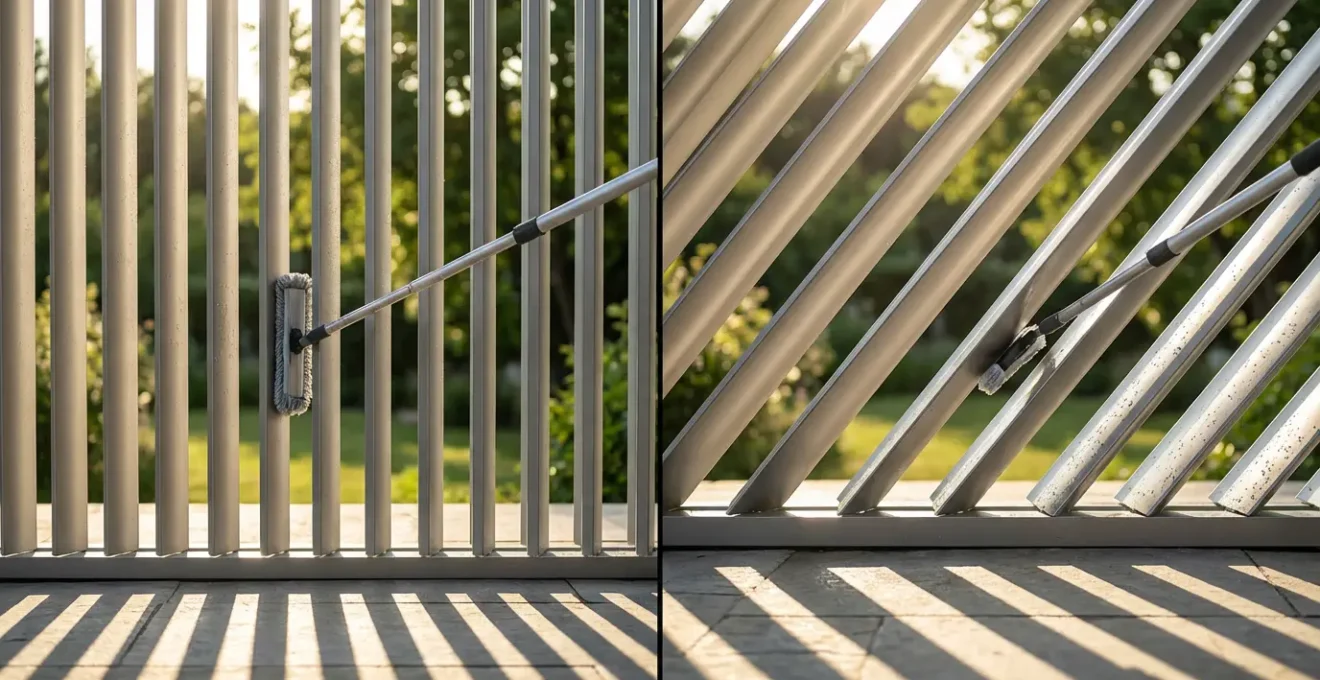
In contrast, a 135° rotation (or the maximum angle your system allows past vertical) creates a much wider, more ergonomic corridor for access. As shown in the comparison, this diagonal opening allows a person standing below to comfortably reach the upper and lower surfaces of the blades with a telescopic pole fitted with a pivoting cleaning head. This angle significantly reduces the physical strain and time required for a thorough cleaning, as it provides a clear, unobstructed path for the tool. For homeowners who prioritize ease of maintenance, a system that offers a rotation beyond 90° is a distinct advantage.
Therefore, while a 90° angle has its uses for ventilation, the 135° position is unequivocally superior for the practical task of cleaning from below, making it a key feature to consider for long-term user convenience.
The Winter Mistake That Snaps Aluminum Louver Pins
The most common and costly winter mistake homeowners make with their louvered pergolas is underestimating the power of ice. Leaving the louvers in a closed or partially closed position during freezing weather creates a perfect trap for water. When this trapped water freezes, it undergoes a significant volumetric expansion. This is not a trivial force; a guide from a leading manufacturer notes that frozen water expands by approximately 9%, exerting immense pressure on its surroundings. This force is more than enough to bend aluminum, shear screws, and snap the delicate pivot pins that control the louver rotation.
The damage occurs silently overnight. Rainwater or melting snow collects in the channels of the closed louvers. As temperatures drop below freezing, the expanding ice acts like a hydraulic press, pushing outwards against the louvers and the frame. The pivot pins, which are the connection points between the louvers and the rotation mechanism, become the primary failure point. They are not designed to withstand this type of static, lateral force and can easily snap, rendering the system inoperable. Attempting to operate the motor when the louvers are frozen is even more destructive, as it can burn out the motor and strip the gears in a matter of seconds.
Preventing this damage requires proactive winterization before the first hard freeze. This simple protocol protects the system’s most vulnerable components from the powerful forces of nature.
Your Pergola Winterization Checklist
- Position Louvers: Set the louvers to their fully vertical (90°) winter position to prevent any water or snow accumulation.
- Lock in Place: If your system has one, use the designated winter locking pin to secure the louvers and prevent them from moving.
- Disable Automation: Turn off any automatic sun or rain sensors to prevent the system from attempting to rotate when frozen.
- Protect Motor: If recommended by the manufacturer, disconnect and store the motor and any batteries for the winter.
- Clear Snow Promptly: After heavy snowfall, use a soft brush to clear any snow that may have accumulated between the vertical louvers to reduce weight stress.
By simply setting the louvers to a vertical position, you allow precipitation to pass through freely, eliminating the risk of trapped water and ensuring your pergola is ready for spring without any surprise repair bills.
How to Angle Louvers to Create a Cooling Venturi Effect on Hot Days?
On a sweltering summer day, a louvered pergola can do more than just provide shade; it can actively generate a cooling breeze through a principle of fluid dynamics known as the Venturi effect. This phenomenon occurs when air is forced to pass through a constricted space, causing it to accelerate. By angling your louvers correctly, you can turn your pergola into a giant Venturi nozzle, creating a noticeable airflow that enhances convective cooling and comfort.
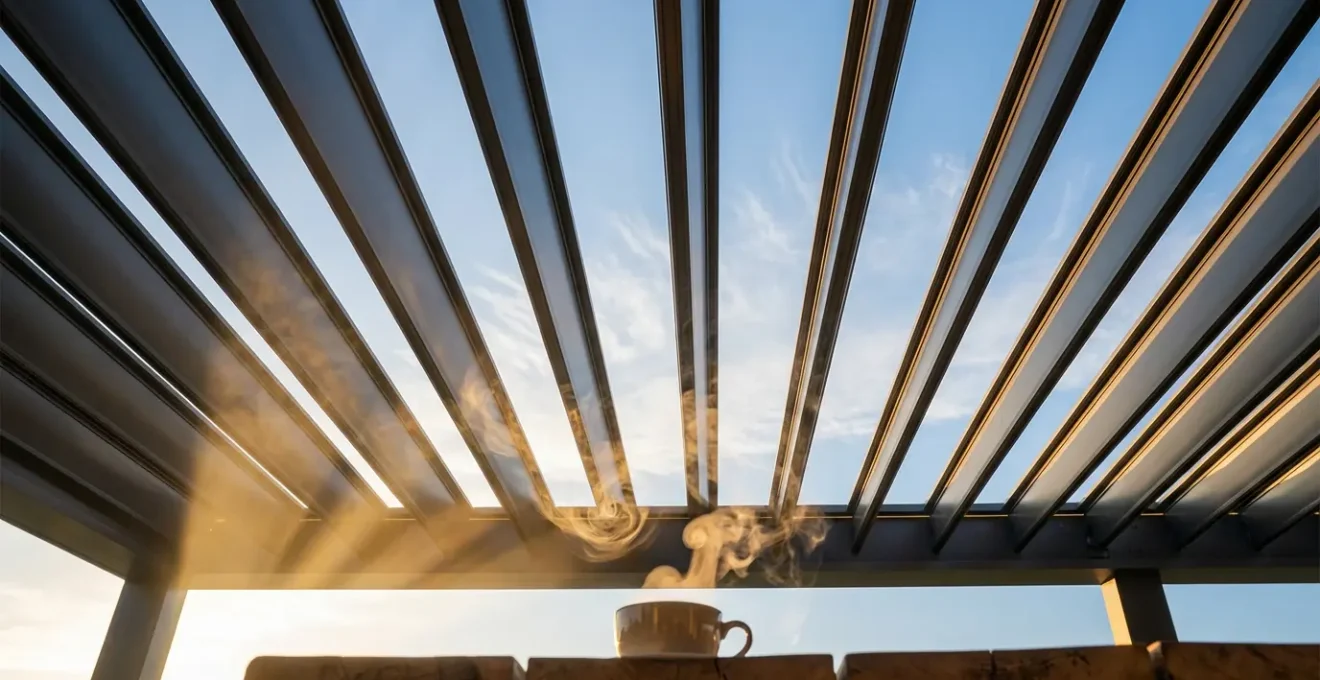
To achieve this, you must create a pressure differential. By angling the louvers slightly upwards (typically in the 15° to 35° range from horizontal), you allow the hot, buoyant air trapped underneath the pergola to escape. As this warm air rises and flows through the angled gaps, it creates a low-pressure zone. This low pressure, in turn, draws in cooler, denser air from the sides of the pergola. The angled louvers act as the “nozzle,” constricting the path of this incoming air and forcing it to speed up as it flows through the space below. The result is a self-sustaining, gentle breeze, even on a relatively still day.
The visualization below shows how partially opened louvers can channel air to create this cooling effect.
Finding the optimal angle is a process of balancing airflow with shade. The ideal setting depends on the time of day and the sun’s position. A good starting point is a 15-20° angle. From there, you can make small adjustments and physically feel for the point where the airflow is most noticeable. During midday, when the sun is directly overhead, you may need a steeper angle to provide adequate shade, which might slightly reduce the Venturi effect. In the morning or late afternoon, a more open angle can be used to maximize airflow. It’s an active process of tuning your environment for maximum comfort.
By understanding and applying this principle, you elevate your pergola from a passive shade structure to an active cooling system, making your outdoor space more comfortable on the hottest days.
How to Eliminate Condensation on Aluminum Frames Using Thermal Breaks?
A common issue with standard aluminum frames, especially in climates with significant temperature differences between inside and outside, is condensation. This occurs because aluminum is an excellent conductor of heat. In winter, the cold exterior temperature is transferred directly through the solid frame to the warmer, more humid interior surface, causing moisture in the air to condense on the cold frame. This can lead to water damage, mold growth, and a significant loss of energy. The solution lies in a crucial piece of material science: the thermal break.
A thermal break is a barrier made of a material with low thermal conductivity that is inserted between the interior and exterior sections of the aluminum frame. This barrier, typically made from a reinforced polyamide or other composite, physically separates the two metal pieces. It effectively “breaks” the path of thermal energy transfer, a phenomenon known as a thermal bridge. The cold from the outside cannot travel directly to the inside surface, and likewise, the heat from inside cannot easily escape. This innovation is incredibly effective, with one technical source stating that thermal breaks can improve aluminum window efficiency by 70-85%.
The impact on condensation is direct and dramatic. Because the thermal break keeps the interior surface of the frame much closer to room temperature, it no longer falls below the dew point. As a result, moisture in the air has no cold surface on which to condense. This is quantified by the frame’s U-factor, which measures the rate of heat loss. A standard aluminum frame might have a high U-factor around 2.0, indicating poor insulation. As noted in a study by the Efficient Windows Collaborative, implementing a thermal break can decrease aluminum frame U-factors…to about 1.0 Btu/hr-sq, effectively halving the heat loss and keeping the interior surface warm and dry.
Therefore, when selecting a louvered pergola, insisting on a thermally broken frame is not an upgrade; it is an essential feature for energy efficiency, structural longevity, and a comfortable, condensation-free environment.
Key Takeaways
- Louver performance is rooted in physics: S-shapes manage water via fluid dynamics, while specific angles create cooling via the Venturi effect.
- Material science is non-negotiable: Solid aluminum frames create a “thermal bridge” causing massive energy loss; thermally broken frames are essential for efficiency.
- Proactive maintenance based on physical principles—like setting louvers vertically in winter to prevent ice expansion—prevents costly damage.
Why Solid Aluminum Frames Are Terrible for Energy Efficiency?
Aluminum is prized for its strength, low weight, and corrosion resistance, making it an ideal structural material for outdoor pergolas. However, it has one major flaw: it is a highly effective thermal conductor. A solid aluminum frame acts as a “thermal bridge,” a superhighway for heat energy to travel. In winter, it rapidly pulls heat from your home’s exterior wall (if attached) and radiates it into the cold air. In summer, it absorbs the sun’s heat and conducts it directly into your living space, forcing your air conditioning to work harder. This makes solid, non-thermally broken aluminum frames a terrible choice for any energy-conscious homeowner.
The scale of this inefficiency is staggering. The material used in thermal breaks, typically polyamide, is a very poor conductor of heat. One analysis highlights this disparity by noting that aluminum conducts heat approximately 1,000 times faster than polyamide. This means a solid aluminum frame will lose or gain heat at a rate 1,000 times greater than the insulating barrier in a thermally broken frame. This is quantified by the U-Value, a measure of heat transfer (lower is better). A solid aluminum frame has an abysmal U-Value, making it one of the least efficient materials available.
This comparative data starkly illustrates the performance gap between frame types.
| Frame Type | U-Value (W/m²K) | Meets Building Standards | Condensation Risk |
|---|---|---|---|
| Solid Aluminum | 5.0-6.0 | No | Very High |
| Traditional Steel | ~5.0 | No | High |
| Thermally Broken Aluminum | 1.2-2.0 | Yes | Low |
| Vinyl/PVC | 0.9-1.1 | Yes | Very Low |
As the table shows, a solid aluminum frame’s performance (U-Value of 5.0-6.0) is not just poor; it fails to meet modern building standards for energy efficiency. A thermally broken aluminum frame, with a U-Value between 1.2 and 2.0, represents a monumental improvement, drastically reducing heat transfer and minimizing the risk of condensation. Choosing a solid frame is akin to leaving a window open year-round.
For any application where the pergola is attached to a conditioned space or where energy performance is a concern, a thermally broken frame is not a luxury—it is an absolute necessity.
How to Justify the Cost of a Motorized Pergola Compared to a Fixed Roof?
A motorized louvered pergola carries a higher initial cost than a traditional fixed roof, a fact that can give homeowners pause. However, justifying this expense requires shifting the perspective from a simple cost comparison to a long-term Return on Investment (ROI) analysis. A fixed roof is a static, one-dimensional product. A motorized pergola is a dynamic, multi-functional system that delivers value across several key areas: energy savings, property value, asset protection, and year-round usability.
The most direct financial return comes from energy savings. In summer, by angling the louvers to block solar radiation while still allowing for cooling airflow (the Venturi effect), a louvered pergola significantly reduces the heat load on your home’s windows and walls. This translates directly to lower air conditioning costs. Conversely, in winter, the louvers can be angled to allow low-angle sunlight to stream in, providing passive solar gain and reducing heating costs. This adaptability, impossible with a fixed roof, generates tangible savings on utility bills season after season.
Beyond energy, the pergola adds significant functional living space, which directly increases property value. It also protects expensive outdoor furniture, decking, and fabrics from harsh UV radiation and rain, extending their lifespan and reducing replacement costs. This flexibility provides a “usability premium”; a patio with a fixed roof is often too hot in summer and too dark in winter, while a louvered pergola is comfortable year-round. As the experts at Azenco Outdoor state in their product description, this versatility makes it a worthwhile upgrade:
Installing a modern pergola design like the R-BLADE™ increases curb appeal and adds functional living space. Its durable construction, integrated technology, and aesthetic appeal make it a smart, long-term investment for homeowners and commercial property owners alike.
– Azenco Outdoor, R-BLADE Motorized Louvered Pergola Product Description
When you calculate the combined value of energy savings, increased property value, asset protection, and year-round usability, the initial investment in a motorized pergola is not just a cost, but a strategic investment in your home’s comfort, value, and efficiency.