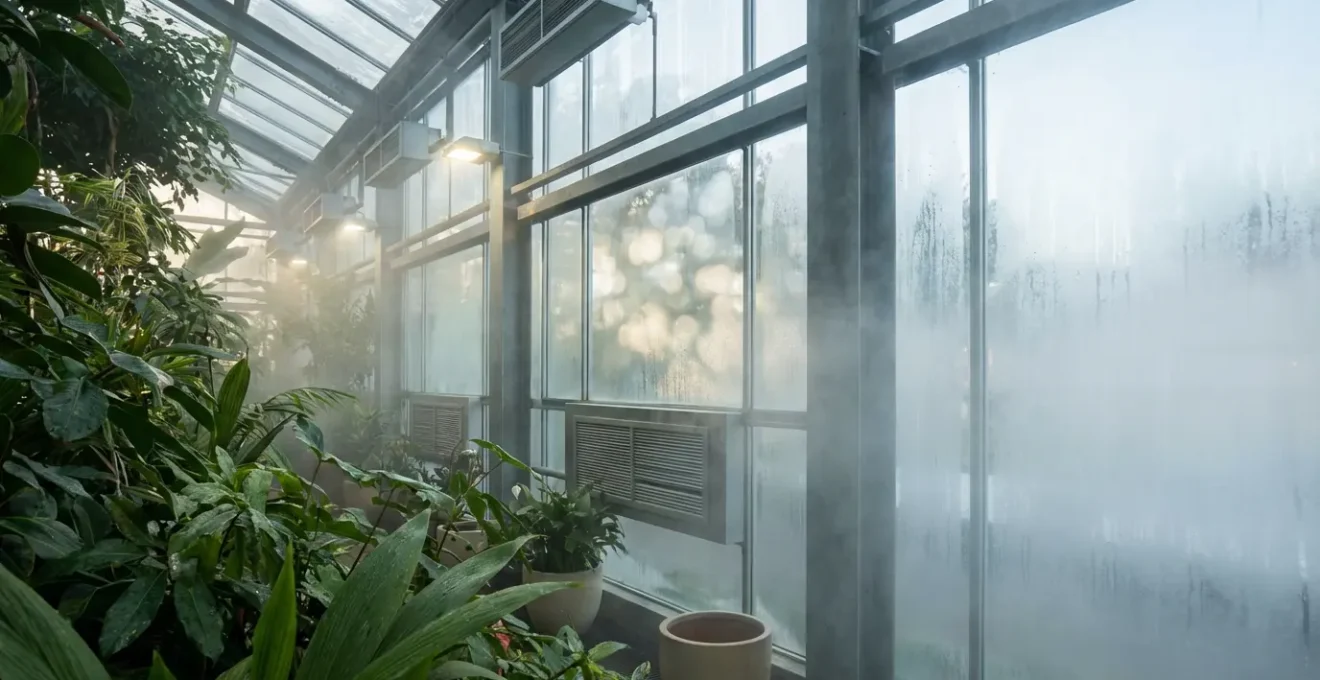
Achieving the perfect tropical climate in your winter garden isn’t about constantly adding moisture; it’s about mastering the physics of dew point to prevent condensation from ever forming.
- High humidity is essential for plants, but it becomes destructive moisture the moment it condenses on a cold surface.
- Strategic airflow and intelligent heating are your primary tools for controlling surface temperature, not just air temperature.
Recommendation: Shift your focus from chasing a static humidity percentage to actively managing the dynamic equilibrium between temperature, airflow, and surface condensation to protect your structure.
For the dedicated plant lover, the dream of a winter garden filled with lush, exotic flora is a powerful one. You envision a verdant sanctuary, a pocket of the tropics thriving against the winter chill. The goal is clear: a stable, high-humidity environment, often around 60% relative humidity (RH). Yet, this ambition is shadowed by a significant fear—that the very moisture giving life to your plants could be the agent of decay for the conservatory’s structure. Wood frames can warp and rot, mold can colonize hidden corners, and insulated glass units can fail. Many believe the solution is a powerful humidifier balanced by aggressive ventilation, but this often leads to a constant, energy-intensive battle against nature.
The common advice—mist plants, use pebble trays, or run a fan—scratches the surface but fails to address the core issue. The problem isn’t humidity itself, but uncontrolled condensation. But what if the key wasn’t simply adding and removing moisture, but rather managing the physical conditions that allow that moisture to exist harmlessly in the air? This guide re-frames the challenge from a purely horticultural perspective to one balanced with engineering and physics. It’s about understanding and controlling the dew point.
We will explore how to create specific micro-zones for different plants, utilize automated systems for intelligent air management, and compare heating solutions based on their impact on moisture. We will also delve into the consequences of an imbalanced environment, like pest explosions, and reveal the science behind timing plant movements. By treating your winter garden as a complete, dynamic ecosystem, you can create a thriving horticultural sanctuary without sacrificing the integrity of the building that houses it.
This article provides a detailed roadmap for managing your winter garden’s climate. Below, the summary outlines the key systems and principles we will cover to help you achieve a perfect balance between a thriving plant environment and a healthy, long-lasting structure.
Summary: A Systemic Approach to Winter Garden Climate Control
- Why Your Citrus Trees Need a Winter Temperature Between 5°C and 10°C?
- How to Set Up Automatic Vents to Prevent Water from Cooking at Noon?
- Underfloor Heating vs Trench Heaters: Which Is Better for Tropical Plants?
- The Red Spider Mite Explosion That Happens in Dry Winter Gardens
- When to Move Your Sensitive Plants Inside: Watching the Dew Point?
- How to Arrange Furniture in a Bay-Front Conservatory to Maximize Flow?
- The AC Mistake That Dries Out Your Eyes and Wood Furniture
- How to Build an Ornamental Pond That Naturally Attracts Dragonflies?
Why Your Citrus Trees Need a Winter Temperature Between 5°C and 10°C?
A winter garden is rarely a homogenous environment, nor should it be. Different plants have evolved for different climates, and accommodating them requires thinking in terms of “micro-zoning.” Citrus trees are a prime example. To encourage flowering and fruiting, they require a cool, dormant period in winter, ideally between 5°C and 10°C. Exposing them to the same warm, humid conditions as your tropical orchids would be counterproductive, preventing them from setting fruit and making them susceptible to pests.
This illustrates the central challenge: creating multiple climates within a single glass structure. The solution lies in strategic placement. Cooler zones are typically found near the exterior glazed walls, while the warmest, most stable temperatures are in the center or near the house wall. You can enhance these zones with thermal curtains or screens, creating physical, yet temporary, separations. Under this model, your citrus trees would be placed in a designated cooler zone, receiving the winter chill they need, while your more sensitive tropicals occupy the warmer core.
The goal is to maintain a healthy baseline humidity across all zones, which greenhouse experts suggest is in the optimal range of 50% to 70% for most mature plants. This creates a balanced environment where even plants in cooler zones benefit from adequate air moisture without being subjected to stressful temperatures. This is the first step in creating a dynamic equilibrium rather than a single, static climate.
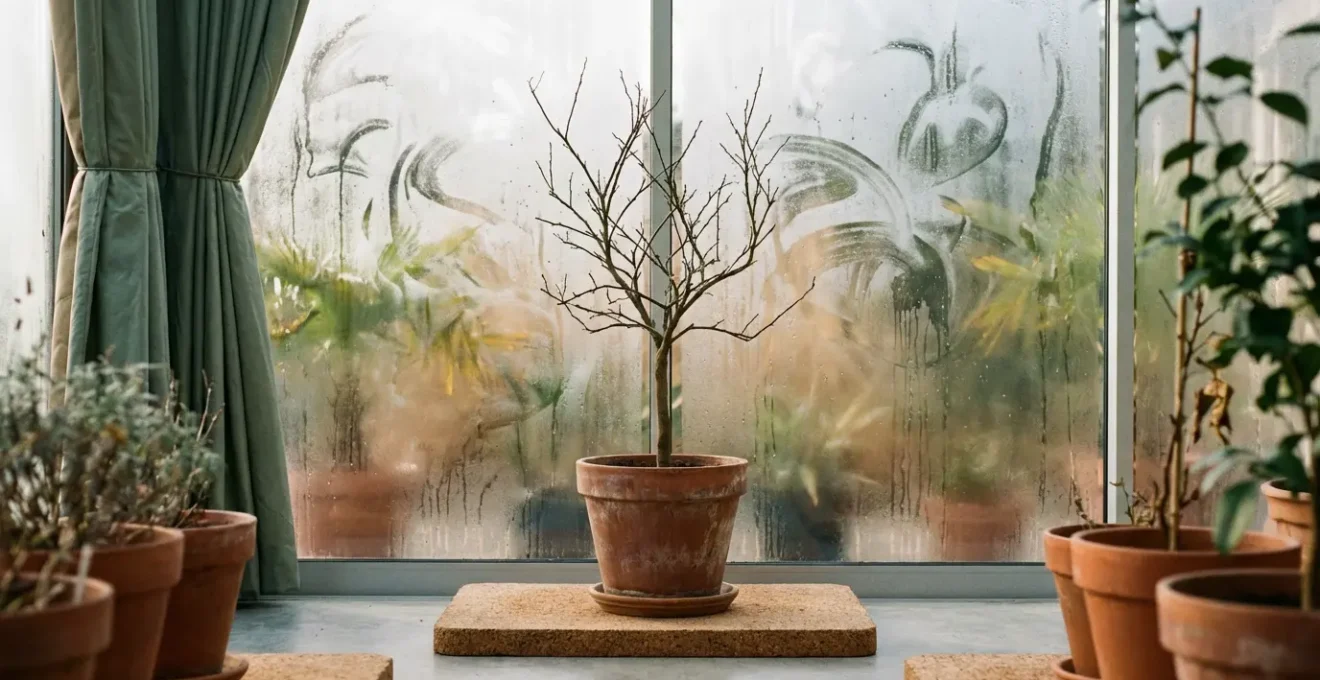
As you can see in this setup, the citrus tree is intentionally placed in its own micro-climate. The subtle condensation on the glass indicates a cooler surface temperature, perfect for the tree’s dormancy. The use of simple tools like cork mats under the pot provides an additional thermal break from a cold floor, demonstrating how small adjustments contribute to the overall systemic approach to plant health.
How to Set Up Automatic Vents to Prevent Water from Cooking at Noon?
Ventilation is often misunderstood as simply a way to “air out” a space. In a winter garden, it is a critical engineering tool for managing energy and moisture. On a clear winter day, solar gain can cause the temperature inside a conservatory to spike dramatically, even when it’s cold outside. This trapped hot, humid air can literally “cook” tender foliage and create a breeding ground for fungal pathogens. The key is not just to ventilate, but to ventilate intelligently and automatically.
Automatic vents, whether ridge or side-wall mounted, are non-negotiable for serious winter garden management. They operate on simple wax-filled pistons that expand with heat, opening the vent without any need for electricity or manual intervention. Setting them to open at a specific temperature (e.g., 24°C / 75°F) prevents the midday heat buildup and expels the most moisture-laden air. This is a crucial first line of defense against excessive humidity. It’s far more efficient to vent out excess moisture than to remove it later with a dehumidifier.
For a more active approach, Horizontal Air Flow (HAF) fans are essential. These fans are not for cooling; their purpose is to create a gentle, continuous, circular air motion throughout the conservatory. This does two things: it prevents stagnant, moist air pockets from forming around plants and it helps maintain a more uniform temperature, breaking up thermal layers. HAF fans should run 24/7 to ensure this constant movement, which is a key factor in preventing condensation from forming on cooler surfaces overnight.
The following table provides a clear comparison of ventilation strategies, helping you choose the right system based on your conservatory’s size and your management goals.
| System Type | Advantages | Best For | Installation Cost |
|---|---|---|---|
| Natural Ventilation | No energy required, uses convection | Small to medium greenhouses | Low |
| Mechanical Ventilation | Precise control, works in all weather | Large or commercial greenhouses | High |
| Hybrid System | Energy efficient with backup control | Year-round growing operations | Medium |
Underfloor Heating vs Trench Heaters: Which Is Better for Tropical Plants?
The method you choose to heat your winter garden has a direct and significant impact on humidity and plant health. The debate often centers on two main radiant systems: underfloor heating and trench heaters. From a botanical perspective, both are superior to forced-air systems, which blast dry, hot air directly at foliage, causing stress and desiccation. However, they operate on different principles that are important to understand.
Underfloor heating, or hydronic radiant heat, involves circulating warm water through pipes embedded in the floor. This turns the entire floor into a gentle, low-temperature radiator. This approach is highly beneficial for tropical plants as it provides consistent warmth directly to the root zone, simulating the warm soil of their native habitat. It creates a very stable environment with minimal air movement, which helps maintain high humidity levels as the warm air rises slowly and evenly. It’s an exceptionally comfortable and efficient system, but it has a slow response time and is a major installation project.
Trench heaters are installed in a trench around the perimeter of the room, typically below the windows. They work by convection: cool air falls from the cold glass surface into the trench, is heated by a heating element (a convector), and then rises, creating a curtain of warm air that insulates the room from the cold glass. This is extremely effective at preventing condensation on the windows—a major source of potential rot. Their response time is much faster than underfloor systems. However, this convective loop can create more air movement, potentially drying the air more than a pure radiant floor system.
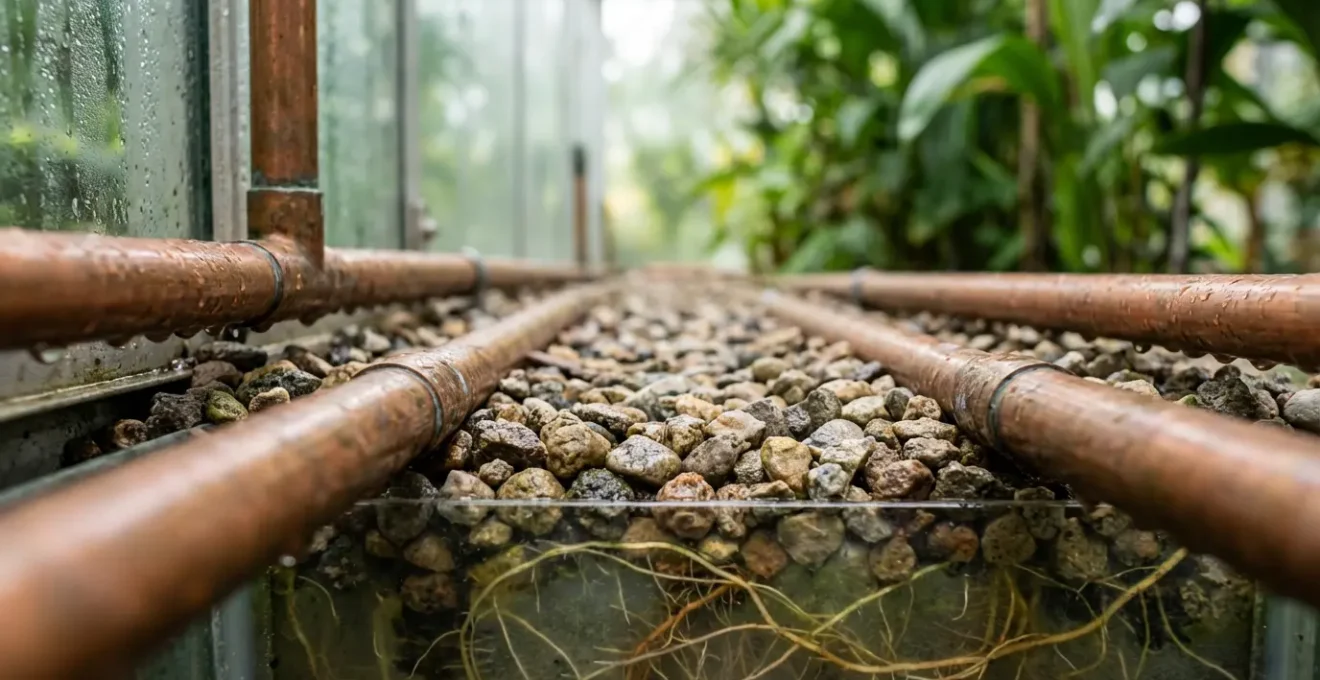
This cross-section reveals the elegance of underfloor heating. The heat radiates gently upward, warming the soil and root systems first—a critical factor for tropical plant health. Furthermore, some heating types have a direct effect on moisture. For instance, unvented propane heaters release water vapor as a byproduct of combustion, actively increasing humidity, whereas electric systems do not. The choice of heating is therefore an integral part of your overall humidity management strategy.
The Red Spider Mite Explosion That Happens in Dry Winter Gardens
While the primary fear in a humid conservatory is rot and mold, the opposite condition—air that is too dry—presents an equally potent threat: pest infestations. The red spider mite (Tetranychus urticae) is the nemesis of the indoor gardener, and it thrives in warm, dry conditions. An improperly managed winter garden, especially one with a forced-air heating system, can become a perfect breeding ground for these pests, leading to a sudden, explosive population boom.
Spider mites are tiny arachnids that feed by piercing plant cells and sucking out their contents, leaving behind a characteristic stippling of yellow or white dots on the leaves. In severe infestations, you’ll see fine, silky webbing, particularly on new growth and between leaves. They reproduce at an astonishing rate when humidity is low. This is the other side of the dynamic equilibrium: by focusing so much on avoiding dampness, it’s easy to create an environment that is too arid, inadvertently rolling out the red carpet for pests that are much harder to control than a bit of mildew.
The solution is to maintain a consistent level of humidity that is comfortable for your plants but inhospitable to spider mites. The goal is not to eliminate dryness, but to prevent the arid conditions mites love. Most indoor growers find that maintaining a humidity level within the 50-70% relative humidity range is the sweet spot. This range is high enough to deter spider mites and support the health of most tropical plants, but low enough that, with proper air circulation, it doesn’t lead to widespread condensation and mold issues. It underscores the importance of a monitored, controlled environment over a reactive one.
Proactive pest management is key. Regularly inspect the undersides of leaves, especially on susceptible plants like Calathea, Alocasia, and palms. At the first sign of mites, isolate the plant and treat it. But the best defense is a good offense: maintaining that ideal humidity range is the most effective preventative measure you can take against a spider mite explosion.
When to Move Your Sensitive Plants Inside: Watching the Dew Point?
For gardeners who move tender plants outdoors for the summer, the question of when to bring them back into the conservatory is critical. Many rely on the first frost warning, but by then, plants may have already suffered cold damage. A more scientific and proactive approach is to monitor the dew point, not just the air temperature. This concept is the absolute key to understanding and preventing condensation and rot in your winter garden.
The dew point is the temperature at which air becomes saturated with water vapor and that vapor condenses into liquid water (dew). Relative humidity tells you how much moisture is *in* the air, but the dew point tells you the exact surface temperature at which that moisture will become a problem. The most dangerous hours are not in the middle of the night, but at dusk, as the sun goes down. Plant leaves and glass panes cool down faster than the surrounding air by radiating heat to the cold night sky. If a leaf’s surface temperature drops to the dew point, it will become wet, even if the air temperature is still well above freezing. This wetness is the invitation for fungal diseases like botrytis.
Therefore, the decision to move plants inside should be guided by nighttime dew point forecasts. When the predicted dew point approaches the minimum safe temperature for your sensitive plants (e.g., 10°C / 50°F), it’s time to bring them in. Inside the conservatory, this principle is even more crucial. You must prevent any surface—be it glass, a metal frame, or a plant leaf—from reaching the dew point of the interior air. This is achieved through two primary methods:
- Insulating Surfaces: Using thermal screens or curtains at night slows down the rate at which plants and glass radiate heat, keeping their surfaces warmer.
- Managing Air: Good air circulation (from HAF fans) ensures that the layer of air directly against a cold surface doesn’t become saturated. Active dehumidification or ventilation can lower the dew point of the entire air mass.
Monitoring both temperature and humidity allows you to calculate the dew point continuously. According to the University of Massachusetts Amherst, this relationship is critical for disease prevention. By managing your conservatory to keep all surfaces above the dew point, you can maintain high humidity levels without ever seeing a drop of destructive condensation.
How to Arrange Furniture in a Bay-Front Conservatory to Maximize Flow?
The arrangement of furniture and plants in a conservatory is not just an aesthetic choice; it’s a crucial component of your climate control system. In a bay-front conservatory, with its curved or angled glass facade, airflow can be complex. Poor placement can create dead zones where air stagnates, leading to pockets of high humidity and fungal growth, or block the natural convective loops that help manage temperature.
The first principle is to create clear corridors for airflow. Your HAF fans are designed to move air in a large, circular pattern. Furniture, large plant stands, or dense groupings of tall plants can act like dams, obstructing this flow. Arrange seating and tables to maintain open pathways, especially along the perimeter where air circulation is most needed to prevent condensation on the glass. Think of your furniture not as static objects, but as elements that sculpt the movement of air.
Secondly, use plant groupings to your advantage. Most plants grow better when grouped together, as the collective transpiration from their leaves creates a local cloud of higher humidity—a beneficial microclimate. You can enhance this by placing them in clusters away from the main airflow corridors. Use plant stands or upturned pots to vary their heights, which not only looks better but also improves light exposure and air circulation within the group. A large, low bowl of water placed in the center of such a group can act as a passive humidifier for that specific zone.
Finally, material choice is critical in a high-humidity environment. Opt for furniture made from moisture-resistant materials. Teak, cedar, and certain metals are excellent choices. For upholstered items, use performance fabrics designed for outdoor use. Avoid materials like untreated steel, which will rust, or standard MDF, which will swell and delaminate. The right furniture, thoughtfully placed, becomes an active part of your conservatory’s success, contributing to both its beauty and its biological and structural health.
The AC Mistake That Dries Out Your Eyes and Wood Furniture
In the quest to control a conservatory’s climate, especially during warmer months, many turn to an air conditioning system. An AC is an incredibly powerful dehumidifier—it works by chilling coils to a temperature below the dew point, causing atmospheric moisture to condense on them. While effective for cooling, its aggressive drying power can be a critical mistake in a winter garden, creating an environment that is hostile to both plants and certain materials.
When an AC unit runs, it can plummet the relative humidity in a sealed space, creating an arid environment. This is stressful for tropical plants, which may respond with drooping, brown leaf tips, and an increased vulnerability to spider mites. But the damage isn’t limited to your flora. This overly dry air pulls moisture from everything it touches. Wood furniture, structural beams, and flooring can shrink, crack, and warp. Your own comfort is affected, too, leading to dry eyes, skin, and respiratory passages.
This does not mean AC is forbidden, but it must be used as a strategic tool, not a blunt instrument. It should be paired with a reliable humidistat and used only to cap extreme temperature and humidity spikes, rather than running continuously. The greater danger, however, is the cycling of the system. When the AC turns off, the cold, wet coils are suddenly exposed to the warm room air, which can lead to rapid re-evaporation or, worse, become a collection point for condensation if not drained properly. This creates a localized damp zone that is a prime spot for mold.
It’s a delicate balance. The goal is to keep humidity below the threshold where mold can thrive. According to HVAC experts, mold growth typically starts when humidity exceeds 60% for prolonged periods. An AC can keep you below this danger zone, but if mismanaged, it can cause as many problems as it solves. A dedicated, properly sized dehumidifier often offers more precise control without the intense cooling effect, making it a better choice for many conservatory applications.
Key Takeaways
- The primary goal is not just high humidity, but preventing surface condensation by managing the dew point.
- A winter garden is a system of systems: heating, ventilation, and layout must work in concert.
- Active air circulation (HAF fans) is more important than simply venting for preventing mold and ensuring uniform conditions.
How to Build an Ornamental Pond That Naturally Attracts Dragonflies?
Integrating a water feature, such as a small ornamental pond, into your winter garden is one of the most elegant ways to create a self-regulating, balanced ecosystem. Beyond its aesthetic appeal, an indoor pond acts as a large, passive humidifier, creating a natural humidity buffer that stabilizes the environment. The large surface area provides a constant, gentle source of evaporation, raising the ambient humidity without the energy consumption or noise of a mechanical humidifier. This can be the cornerstone of your systemic approach to climate management.
To make the pond a truly integrated feature that also benefits local wildlife, the design should encourage biodiversity. Attracting dragonflies, for example, is a sign of a healthy aquatic ecosystem. Dragonflies require water for their larval stage and emergent plants (plants that grow in water but emerge into the air) for the nymphs to climb out on when they are ready to become adults. Including plants like Dwarf Cattails, Pickerel Weed, or Arrowhead provides this essential structure. Submerged, oxygenating plants like Hornwort are also vital for keeping the water clean.
The presence of dragonflies is more than just a delight to watch; they are voracious predators of smaller flying insects like gnats and mosquitoes, acting as natural pest control for your conservatory. A small, quiet pump to create a gentle waterfall or ripple not only enhances the tranquil sound but also increases the rate of evaporation and helps oxygenate the water, making the environment healthier for both plants and aquatic life.
Building such a feature requires careful planning to protect your home’s structure, but the rewards are immense. It transforms your conservatory from a simple collection of potted plants into a living, breathing biome that contributes to its own stability.
Action Plan: Indoor Pond Construction for Humidity Control
- Foundation First: Ensure the pond is structurally isolated. Install a high-quality, puncture-proof pond liner, and ensure it is fully separated from the building’s foundation to prevent any possibility of leaks into the structure.
- Promote Evaporation: Incorporate a small, energy-efficient pump to power a miniature waterfall or bubbler. The moving water significantly increases the surface area for evaporation, boosting ambient humidity.
- Build a Complete Ecosystem: Introduce a mix of plants. Use submerged oxygenators to keep the water clear, floating plants like water hyacinths for cover, and emergent plants along the edges for dragonfly nymphs.
- Centralize for Effect: Position the pond in a central location within the conservatory. This allows the evaporated moisture to distribute more evenly throughout the space, benefiting all your plants.
- Monitor and Maintain: Check water levels weekly, especially when heating systems are active in winter, as evaporation will increase. Top up with clean, dechlorinated water as needed to maintain a consistent level.
Begin designing your winter garden as a balanced ecosystem, not just a collection of plants, to ensure both botanical success and structural longevity. By integrating these principles of physics and biology, you can create the lush, tropical sanctuary you’ve always wanted, with full confidence in the health of your home.