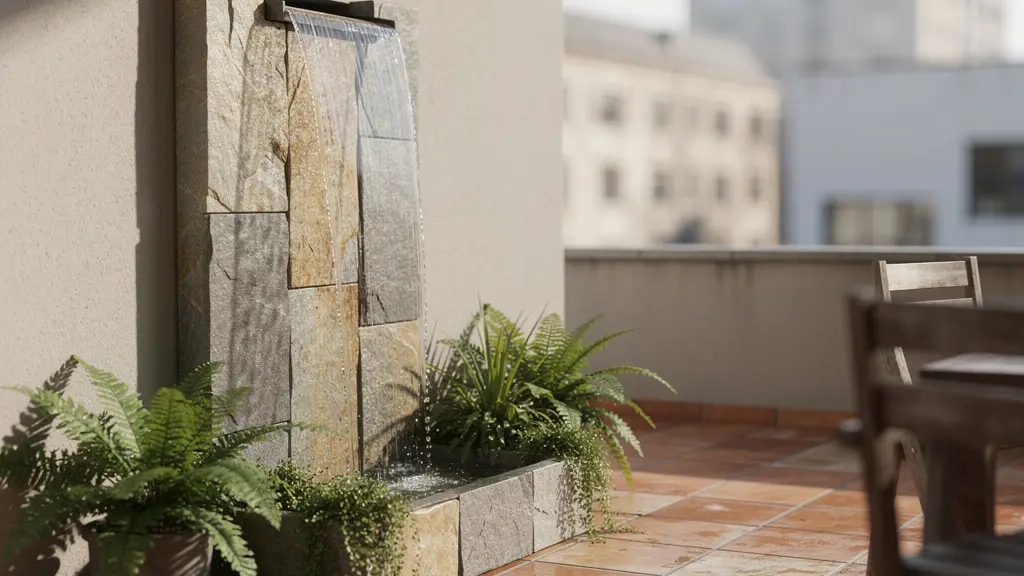
A well-chosen water feature does more than add charm; it actively reclaims your patio’s soundscape and visual space, making it feel larger and more serene.
- Focus on “acoustic masking” to dissolve urban noise, using multi-tiered designs for varied and effective sound.
- Prioritize “invisible infrastructure” by hiding pumps and cables beneath decorative elements for a clean, professionally integrated look.
Recommendation: Start by analyzing your patio’s primary noise source and its daily sun exposure—these two factors will dictate the perfect location and type of water feature for your needs.
For the urban gardener, every square foot of a patio is precious territory. The desire for the tranquil sound of water often clashes with the fear of cluttering this limited space with a bulky, awkward object. Many homeowners believe adding a water feature means sacrificing room for seating or plants. They see it as a decorative accessory, a final touch if there’s space left over.
This perspective misses the true potential of water in a small environment. The common advice—to simply buy a small fountain or use a wall-mounted unit—treats the symptom of limited space but ignores the deeper opportunity. What if the water feature wasn’t an object you add *to* the space, but a sensory tool you use to fundamentally redefine it? The key isn’t just to make it fit, but to leverage its sound, movement, and reflection to create an illusion of spaciousness and privacy.
This guide reframes the challenge. We will move beyond simply placing a fountain and explore how to strategically integrate water as a core element of your patio’s design. We will look at how to sculpt the soundscape to your advantage, how to create visual depth by hiding the mechanics, and how to maintain this living element so it remains a source of joy, not a chore. By treating water as a design material, you can transform your small patio into a sensory escape that feels more expansive and immersive than you ever thought possible.
This article provides a complete roadmap, from the acoustic science of noise reduction to the practicalities of installation and seasonal care. Discover how to turn your small outdoor area into a true sanctuary.
Summary: A Designer’s Guide to Water Features in Compact Patios
- Why a Water Feature Is the Best Defense Against Traffic Noise?
- How to Hide the Pump and Cables for a Clean, Modern Look?
- Recirculating vs Piped: Which Is Easier to Install for Beginners?
- The Location Error That Turns Your Water Feature Green in a Week
- When to Drain Your Fountain: The First Frost Warning?
- Why Your Minimalist Decor Is Making Your Living Room Sound Like a Cafeteria?
- How to Run Gas and Electric Lines for a Future Outdoor Kitchen Safely?
- How to Build an Ornamental Pond That Naturally Attracts Dragonflies?
Why a Water Feature Is the Best Defense Against Traffic Noise?
In an urban setting, the greatest luxury isn’t space; it’s silence. The constant hum of traffic, sirens, and city life can make a patio feel less like a retreat and more like an extension of the street. While fences and plants can offer a visual barrier, they do little to block sound. This is where a water feature becomes a strategic tool for acoustic masking. The sound of moving water, with its broad spectrum of frequencies, is remarkably effective at covering the sharp, irritating noises of the city.
The principle is simple: your brain can only pay attention to so much auditory information at once. The pleasant, consistent sound of a fountain or waterfall captures your focus, pushing intrusive background noise to the periphery of your awareness. It doesn’t eliminate the noise, but it changes your perception of it, replacing stress-inducing sounds with a calming, natural one. Indeed, studies from urban parks demonstrate that small-scale water features along pathways effectively mask street traffic sound.
To maximize this effect, you can “tune” the sound of your water feature. The goal is to create a sound profile that directly counteracts the specific noise you want to block. Consider these techniques:
- Material Choice: Use hard materials like stone, concrete, or metal for the basin to amplify and reflect the sound of the water.
- Multiple Tiers: Add several tiers or spouts to create a more complex and varied range of sound frequencies, which is more effective at masking diverse noises.
- Strategic Positioning: Direct the fountain spouts toward the areas where you sit or where the noise reduction is most needed.
- Reflective Surfaces: Utilize adjacent walls or hard patio surfaces to bounce the fountain’s sound back into your space, enhancing its presence.
- Drop Height: Adjust the height of the water drop to create different tones. A higher drop produces a deeper, more resonant sound, while a shorter drop creates a gentler burble.
By thinking like a sound designer, your water feature becomes more than decoration—it becomes an active shield, carving out a pocket of tranquility in the heart of the city.
How to Hide the Pump and Cables for a Clean, Modern Look?
In a small patio, every detail matters. A tangle of black cables or a visible plastic pump can instantly shatter the illusion of a natural, serene oasis. For a water feature to feel truly integrated, its mechanical heart must become invisible. The concept of invisible infrastructure is paramount for achieving a clean, modern, and high-end aesthetic. The goal is for water to appear as if it emerges magically from stone or earth, with no hint of the machinery that powers it.
This is most effectively achieved with a “pondless” or “disappearing” fountain design. In this setup, the water reservoir is a basin buried beneath the ground or hidden within a larger planter. The pump sits inside this hidden reservoir, and the water is pushed up through a tube that runs through your chosen feature—be it a drilled boulder, a ceramic urn, or a series of stacked slates.
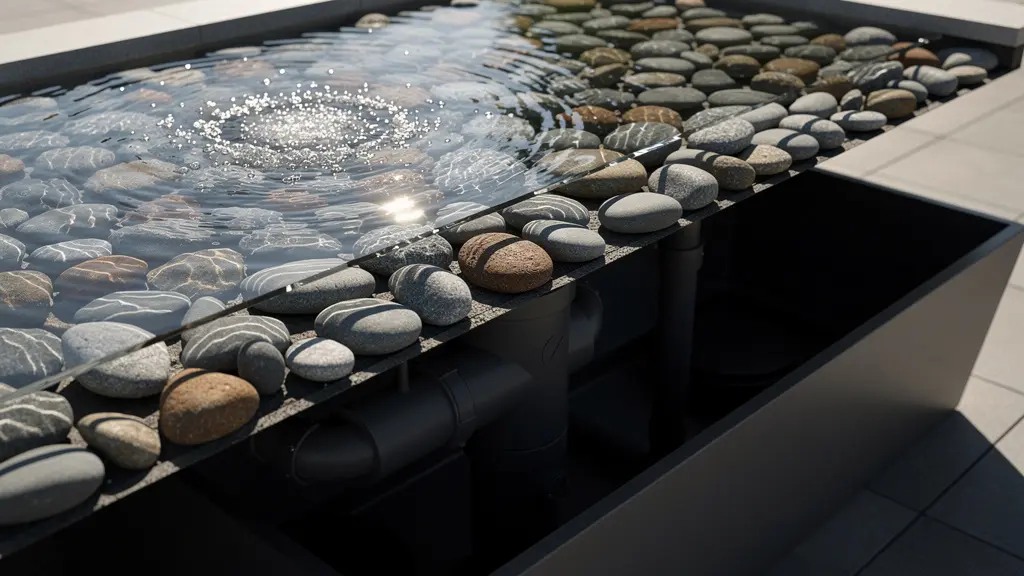
The water then spills over the feature and trickles down through a layer of decorative pebbles or river rock, which completely conceals the reservoir lid and all infrastructure below. The effect is stunningly simple and clean, and it’s also safer for patios frequented by children or pets, as there is no open pool of standing water.
Case Study: The Zero-Maintenance Pondless Rock Fountain
A home gardener detailed their installation of a pondless fountain where the entire underground reservoir was filled with smooth river rock, completely hiding the pump and its vault. This design made all mechanics invisible beneath the decorative stones. The key benefit noted was the minimal maintenance; when the pump eventually needs replacement, one simply has to move the rocks directly above the pump vault to access and swap it. This approach provides both a striking aesthetic and a practical, near-zero-maintenance operation, proving that invisible infrastructure is as functional as it is beautiful.
Recirculating vs Piped: Which Is Easier to Install for Beginners?
Once you’ve decided on a design, the next practical question is how the water will be supplied. For a small patio, you have two primary options: a self-contained recirculating system or a piped-in system connected to your main water line. For beginners and those looking for a straightforward DIY project, the choice is clear: the recirculating system is overwhelmingly easier to install and manage.
A recirculating fountain is a closed loop. It uses a submersible pump to push water from a hidden reservoir up through the feature, where it then flows back into the same reservoir to be used again. The only installation required is a weatherproof electrical outlet to power the pump. This makes it a perfect weekend project. The main ongoing task is simply topping off the reservoir with water every week or so to replace what’s lost to evaporation.
A piped-in system, by contrast, is a professional-level job. It involves running a dedicated water line from your home’s plumbing to the feature, often with an auto-fill valve to keep the water level constant, and an overflow drain. While it offers the convenience of never having to refill the fountain, the installation is significantly more complex and expensive, requiring trenching and plumbing expertise.
The long-term effort commitment also differs significantly, as this comparative analysis of their 5-year effort score reveals.
| Aspect | Recirculating System | Piped-In System |
|---|---|---|
| Initial Installation | Low effort (2-3 hours DIY) | High effort (professional recommended) |
| Weekly Maintenance | Water refilling needed | None with auto-fill valve |
| Algae Control | Regular treatment required | Less frequent due to fresh water |
| Winter Prep | Simple – turn off and cover | May need pipe draining |
| 5-Year Total Hours | ~100 hours maintenance | ~10 hours maintenance |
For most small patio applications, the simplicity and flexibility of a recirculating system make it the ideal choice, allowing you to focus on the aesthetics rather than complex construction.
The Location Error That Turns Your Water Feature Green in a Week
There is nothing more frustrating than installing a beautiful water feature, only to see it turn into a murky, green science experiment within days. The single biggest mistake that leads to rapid algae growth is a simple one: placing your fountain in direct, prolonged sunlight. Algae, like any plant, photosynthesizes to live. Give it water, nutrients (from tap water minerals and debris), and abundant light, and you’ve created the perfect breeding ground.
The culprit is prolonged sun exposure, as research shows algae growth is triggered by as little as 8-10 hours of light per day to thrive. A patio that gets blasted with sun all afternoon is a high-risk zone. Before you install, spend a day observing your patio’s light patterns. The ideal spot for a water feature is one that receives partial shade or, at most, a few hours of direct morning sun. This simple act of strategic placement is your first and best line of defense.
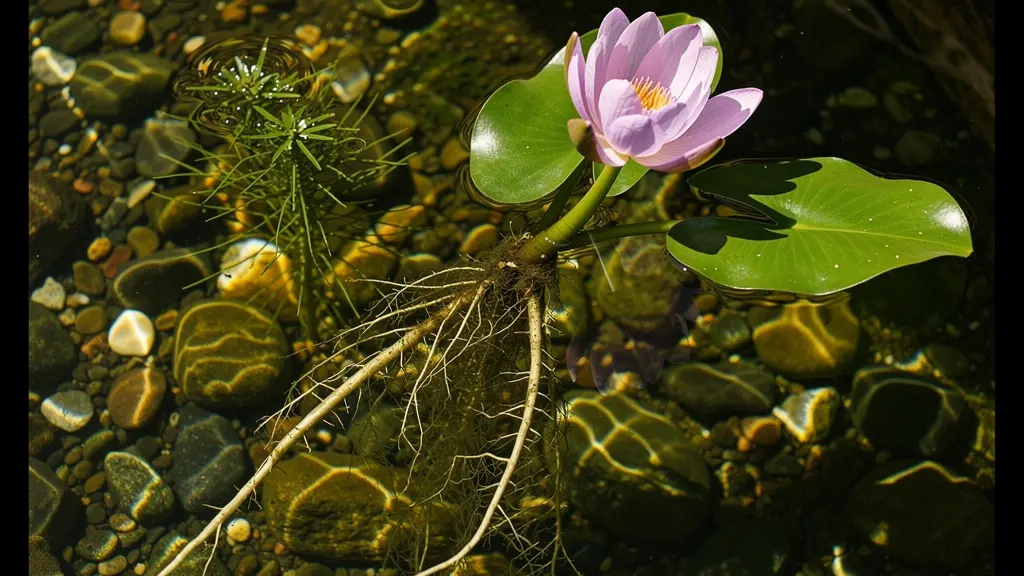
Beyond choosing a shady spot, you can create a balanced micro-ecosystem that naturally starves algae of the resources it needs. This involves a more holistic approach to water health, transforming your feature from a simple decoration into a tiny, self-regulating environment.
Action Plan: Passive Algae Prevention Strategies
- Start with Pure Water: Use distilled water for the initial fill. Tap water is often rich in phosphates and nitrates, which are powerful fertilizers for algae.
- Introduce Competing Plants: Install floating plants like water lettuce or hyacinths. Their roots will hang in the water and absorb the excess nutrients that would otherwise feed algae.
- Add Barley Straw: Place a small mesh bag of barley straw in the reservoir. As it decomposes, it releases compounds that naturally inhibit algae reproduction without harming other plants or wildlife.
- Recruit Algae Eaters: If your feature is large enough, add a few algae-eating organisms like Japanese trapdoor snails or freshwater shrimp. They are tireless cleaners.
- Ensure Good Circulation: Make sure your pump is adequately sized to keep the water moving. Algae prefers stagnant, still conditions, so good circulation is a powerful deterrent.
When to Drain Your Fountain: The First Frost Warning?
As autumn deepens and the first frost warnings appear on the forecast, a critical question arises: should you drain your water feature? The answer isn’t a simple yes or no; it depends almost entirely on the materials your fountain is made of and your local climate. Acting incorrectly can lead to cracked basins, burned-out pumps, and costly repairs come spring.
Porous materials are the most vulnerable. Terracotta, certain types of concrete, and unglazed ceramics absorb water. When that water freezes, it expands, causing the material to crack and spall. If your feature is made of any of these materials, you must drain it completely before the first hard freeze. The pump and any plumbing should also be removed and stored indoors.
However, many modern fountains are made from materials that can withstand winter’s wrath. High-grade cast stone, fiberglass, and resin are non-porous and can often handle light freezes without issue. For these, a full draining may not be necessary, especially in milder climates.
Case Study: Material-Specific Winter Survival Strategies
Experienced fountain owners in cold climates report that pondless water features made of durable materials require surprisingly little winterization. One installer’s advice for a client facing below-freezing winters was simply to “turn it off and go back inside.” The key is that resilient materials like high-grade resin and fiberglass can withstand freezing, while porous terracotta requires complete draining. Some owners even successfully use a floating pond de-icer to keep a small hole open in the ice, protecting the pump and creating beautiful, dynamic ice formations throughout the winter.
If you do drain your fountain, don’t let it sit as an empty void on your patio. A drained fountain can be transformed into a striking piece of winter art.
- Transform it into a dry zen garden with raked sand or decorative stones.
- Use it as a platform for weather-resistant sculptures or seasonal displays.
- Fill the basin with large, decorative LED light spheres for a magical nighttime ambiance.
- Arrange evergreen branches, pinecones, and winterberry boughs for a festive container display.
- With proper safety modifications, some basins can even be converted into a temporary fire bowl for a dramatic shift from water to fire.
Why Your Minimalist Decor Is Making Your Living Room Sound Like a Cafeteria?
The acoustic principles that govern your patio are the same ones at play inside your home. Consider a modern, minimalist living room: clean lines, hard floors, glass tables, and sparse furnishings. It looks beautiful, but it can often sound like a cafeteria—every conversation echoes, and every footstep clatters. This happens because hard, smooth surfaces reflect sound waves, causing them to bounce around the room and create reverberation and echo.
This interior design challenge provides a perfect analogy for designing your patio’s soundscape. On a patio, hard surfaces like concrete, brick walls, and large glass doors will also reflect sound. While this can be a problem, a water feature allows you to harness this effect. Instead of reflecting the harsh sounds of traffic, you can position your fountain so that its pleasant gurgle is what gets reflected and amplified, filling the space with calming sounds.
Just as you would add a plush rug, heavy curtains, or an upholstered sofa to absorb and soften the sound in a minimalist room, you can use strategic plantings around your patio to absorb unwanted external noise. By understanding that every surface either reflects or absorbs sound, you can begin to sculpt the acoustic environment of your patio with the same intentionality you apply to its visual design.
How to Run Gas and Electric Lines for a Future Outdoor Kitchen Safely?
While a water feature is today’s project, a smart patio design always looks to the future. The same foresight needed to plan for a future outdoor kitchen—with its requirements for gas and electricity—applies directly to integrating any powered element on your patio. The core principle is future-proofing your infrastructure safely and efficiently from the outset. Running electrical lines is not a step to be taken lightly.
For any outdoor electrical component, including your fountain’s pump, safety is non-negotiable. All wiring must be rated for outdoor, underground use (UF-B cable) and protected within a conduit. Furthermore, it must be connected to a Ground Fault Circuit Interrupter (GFCI) outlet. A GFCI is a fast-acting circuit breaker that will instantly cut power if it detects an imbalance, preventing electric shock—an absolute necessity in any area where electricity and water are in proximity.
When planning the electrical run, think beyond the immediate need. If you might want landscape lighting, a charging station for your devices, or even a small outdoor refrigerator down the line, consider running a conduit with a larger capacity or laying extra, unconnected wires for future use. Burying the lines to the proper depth required by local building codes (typically 18-24 inches) is a one-time job. Doing it right once saves you from having to dig up your beautifully established patio later to add another powered feature.
Key Takeaways
- A water feature’s primary value in a small space is acoustic masking, using pleasant sound to block out urban noise.
- Hiding the pump and cables (“invisible infrastructure”) is essential for a clean, modern aesthetic that makes the feature feel integrated, not added.
- Strategic location (avoiding all-day sun) and creating a balanced micro-ecosystem are the most effective ways to prevent algae growth naturally.
How to Build an Ornamental Pond That Naturally Attracts Dragonflies?
Integrating a water feature can go beyond sensory pleasure and become an act of ecological generosity. Even the smallest patio can host a vibrant micro-habitat that attracts beneficial wildlife like dragonflies. These dazzling insects are not only beautiful to watch but are also voracious predators of mosquitoes. Creating a welcoming environment for them is surprisingly simple and can be done in a compact container pond.
Dragonflies have specific needs, but they are easy to meet. They need still or gently moving water for laying their eggs, and they require emergent plants—plants that grow in the water but stick out above the surface—for perching and hunting. A strong jet or cascading waterfall will deter them; a gentle bubbler or still surface is ideal. As DIY water garden examples show, even containers as small as galvanized tubs can support a vibrant micro-ecosystem.
To build your own dragonfly sanctuary, choose a wide, shallow container (a half whiskey barrel or large ceramic pot works well). Add a layer of gravel and aquatic soil, then fill with water. Introduce a mix of plants: include submerged oxygenators to keep the water healthy, a floating plant like a dwarf water lily for cover, and—most importantly—an emergent plant like dwarf cattail, pickerel rush, or blue flag iris. Place a few flat stones at the edge to give them a place to land and sun themselves.
Case Study: Creating a Patio Dragonfly Sanctuary
Landscaping experts in Maryland have demonstrated that even small container ponds with the right elements can successfully attract dragonflies and support urban biodiversity. Their successful projects highlight a few key elements: providing areas of still water, incorporating emergent plants like dwarf cattails for perching, and creating shallow edges for easy access. They found that even tabletop fountains with gentle bubblers, rather than powerful sprays, can create a suitable habitat, turning a simple decorative piece into a thriving part of the local ecosystem.
By making these small, intentional choices, your water feature transcends its role as a design element and becomes a living, breathing part of the natural world, right on your patio.
Start sculpting your own sensory escape today by choosing the right water feature to redefine your small patio, transforming it into a private sanctuary of sight and sound.