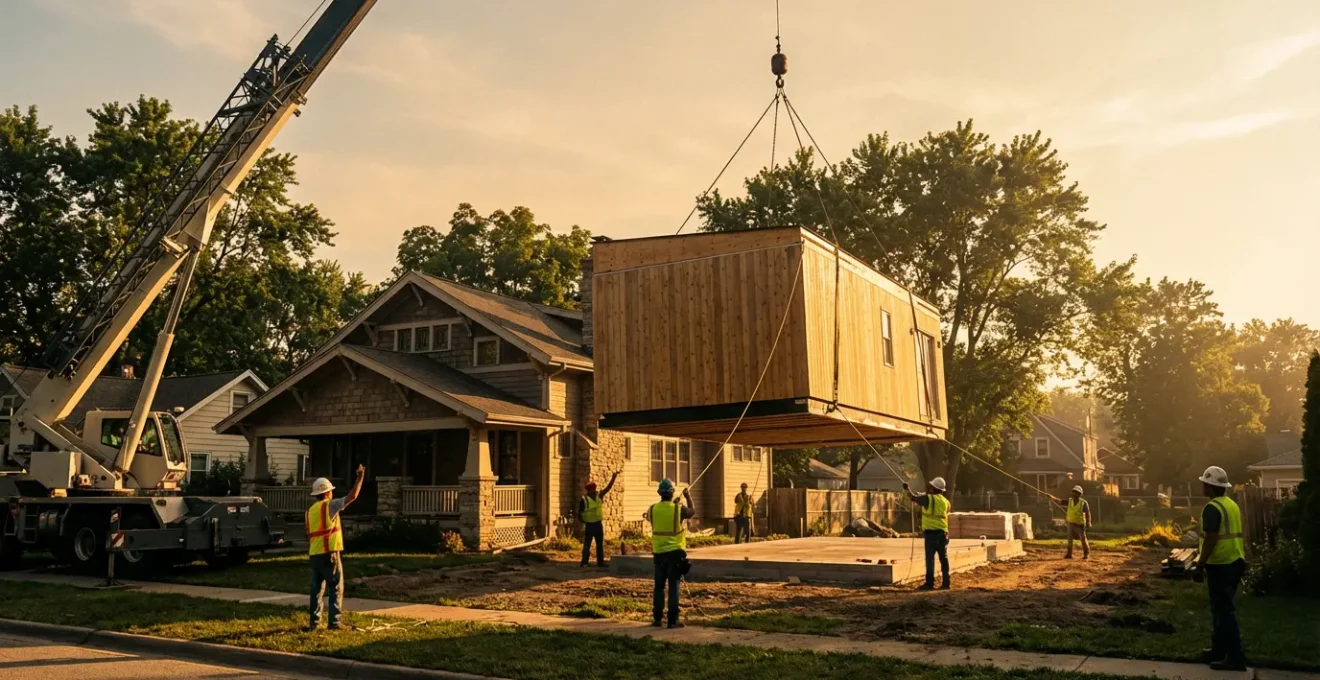
Expanding your home doesn’t have to mean months of dust and disruption; the key is shifting 90% of the work off-site.
- Factory-built modules slash construction time by up to 50% and reduce material waste by as much as 90% compared to traditional builds.
- Success hinges on meticulous ‘upstream’ planning: laser-precise foundations and detailed crane access logistics are non-negotiable.
Recommendation: Focus your energy on meticulous site prep and coordination with the factory. The rapid 3-day on-site installation is the reward for getting the planning phase right.
The dream of a larger home—a new master suite, a sun-drenched office, or an in-law unit—often crashes into the reality of construction: months of noise, dust, and disruption. The traditional “stick-built” process turns your property into a chaotic worksite, slowly taking shape while your daily life is upended. It’s a slow, inefficient, and wasteful process that many homeowners dread, causing them to postpone their expansion plans indefinitely.
But what if the speed of construction wasn’t an incremental improvement, but a radical paradigm shift? This is the promise of modular additions. The secret to a 3-day installation isn’t some on-site magic trick; it’s the result of a fundamentally superior system of upstream efficiency. Over 90% of the construction work is completed with robotic precision in a climate-controlled factory, concurrent to your site’s foundation being prepared. The speed you witness is merely the final, visible payoff of a meticulously engineered process that has already solved for quality, waste, and timing.
This article demystifies the 3-day modular installation. We will not just tell you it’s faster; we will show you *how* this incredible efficiency is achieved. We’ll explore the science of waste reduction in factory settings, the critical importance of precision measurements, the logistical choreography required for urban installations, and the strategic planning that makes it all possible. Forget the image of a messy, months-long project; it’s time to embrace the future of efficient home expansion.
To fully grasp how this process unfolds with such speed and precision, this guide breaks down the core components you need to master. The following sections will walk you through each critical stage, from factory advantages to on-site execution.
Summary: The Blueprint for a 3-Day Modular Home Expansion
- Why Factory-Built Modules Have 20% Less Material Waste Than On-Site Builds?
- How to Ensure Crane Access for Your Modular Unit in a Tight Urban Lot?
- Prefab vs Stick-Built: Which Holds Its Resale Value Better?
- The Measurement Error That Prevents Modular Units from Sitting Flush
- When to Order Your Module relative to Permit Approval?
- How to Get a Weathertight Lean-To Shell Up in Just 48 Hours?
- Building Up vs Building Out: Which Is Less Disruptive to Daily Life?
- How to Modernize a Historic Home Extension Without Violating Heritage Laws?
Why Factory-Built Modules Have 20% Less Material Waste Than On-Site Builds?
The environmental and cost benefits of modular construction begin long before the module reaches your home. The factory environment is a closed-loop system designed for maximum efficiency, starkly contrasting the open-air, often wasteful nature of a traditional construction site. This controlled setting enables a systematic approach to material management that is simply impossible on-site. Industry analysis reveals a staggering up to 90% waste reduction in modular construction, a figure driven by several key factors.
At the heart of this efficiency is precision. Materials are cut to exact specifications using computer-guided equipment, which minimizes off-cuts. Any leftover materials are not discarded but are immediately inventoried and repurposed for other projects within the same facility. This waste-to-value cycle is a core tenet of modular manufacturing. Furthermore, bulk purchasing and centralized, weatherproof storage prevent material loss due to weather damage, misplacement, or theft—common issues on a dispersed building site.
Case Study: The Tangible Impact of Factory Efficiency
The difference in waste is not trivial. Traditional building generates 25-30 kg of waste per square meter, with material utilization often hovering around a mere 60%. In contrast, modular construction slashes waste to just 10-15 kg/m² while boosting material utilization to 85%. For a typical 2,000-square-foot home, a stick-built project generates about 8,000 pounds of waste, enough to fill a large dumpster. Modular methods reduce this stream by 75-90%, resulting in direct cost savings of $2,000-$4,000 in disposal fees alone, alongside significant environmental benefits.
This systematic reduction of waste is achieved through a combination of smart processes:
- Precision cutting: Computer-controlled saws and cutters eliminate the 15-20% of wood waste typically generated from manual framing on-site.
- Centralized storage: All materials are kept in a secure, climate-controlled warehouse, preventing damage from rain, sun, or job-site theft.
- Standardized designs: These allow for the exact ordering of materials with minimal excess, eliminating guesswork and over-ordering.
- Systematic recycling: Well-established recycling streams for cardboard, plastics, and metals are integrated directly into the factory workflow.
How to Ensure Crane Access for Your Modular Unit in a Tight Urban Lot?
The dramatic moment when a modular unit is lifted into place is the culmination of intense logistical planning. In spacious suburban lots, this can be straightforward. But in dense urban environments, with narrow streets, overhead power lines, and close neighbors, ensuring crane access becomes a complex puzzle. This logistical choreography is a critical phase that determines the feasibility of the entire project. Success depends on proactive planning and clear communication with a specialized crane company long before delivery day.
The process begins not with a crane, but with a camera and a measuring tape. You must meticulously document your site’s constraints. This includes the width of your street, the height of any overhead obstructions like wires or tree branches, the condition of the ground where the crane will sit, and the exact path the module must travel from the truck to the foundation. This initial documentation allows a crane company to perform a preliminary “go/no-go” assessment, often using satellite imagery to map the crane’s swing path and identify potential obstacles you may have missed.
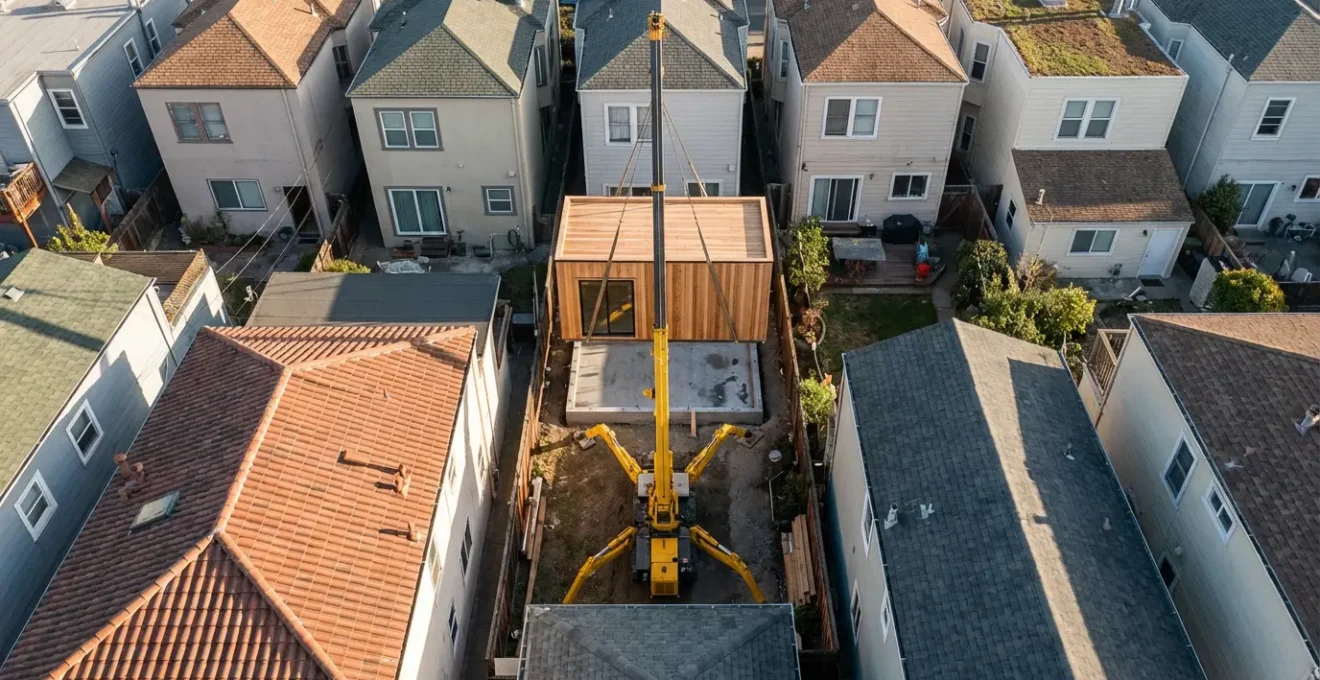
As you can see in the aerial view above, specialized equipment like spider cranes can navigate incredibly tight spaces. However, their placement and operation require absolute certainty. It’s not just about fitting the crane; it’s about ensuring its outriggers have stable ground to stand on and that its boom can swing freely without endangering property or public safety. This phase often requires coordination with local authorities to schedule temporary road closures or manage traffic, adding another layer to the planning process.
Your Action Plan for Securing Crane Access
- Document Site Conditions: Take detailed photos and measurements of street width, power line heights, ground conditions, and any potential obstructions.
- Get a Preliminary Assessment: Contact a reputable crane company with your documentation to get an initial evaluation of feasibility and potential challenges.
- Map the Swing Path: Use satellite tools like Google Earth with the crane operator to trace the exact path the module will take from the delivery truck to the foundation.
- Verify All Insurance: Confirm that the crane operator has comprehensive liability insurance and check that your own homeowner’s policy covers this type of operation.
- Coordinate with Authorities: Work with your modular builder and local municipality to secure any necessary permits for road closures, traffic management, or temporary parking restrictions.
Prefab vs Stick-Built: Which Holds Its Resale Value Better?
A common misconception about modular or prefab additions is that they are somehow inferior to traditional “stick-built” construction and, therefore, may not hold their value. The reality is quite the opposite. Once a modular addition is completed and seamlessly integrated with the existing home, it is visually indistinguishable from a site-built structure. However, beneath the surface, its superior engineering often translates to better long-term value. The key lies in the quality, consistency, and performance that factory construction provides.
Modular additions are built to incredibly tight tolerances in a controlled environment. This precision results in a structure that is often more airtight, structurally robust, and energy-efficient than its on-site-built counterpart, whose quality can vary significantly based on the contractor and daily job site conditions. A more energy-efficient and durable home is inherently more valuable to a future buyer. As highlighted in a detailed comparison by Next Modular, the advantages are clear across multiple fronts.
| Factor | Prefab/Modular | Traditional Stick-Built |
|---|---|---|
| Average Cost Savings | 10-20% less expensive | Baseline cost |
| Build Quality | More airtight and sturdy due to factory tolerances | Variable based on contractor |
| Visual Difference | Indistinguishable when complete | Standard appearance |
| Energy Efficiency | 15% better operational efficiency | Standard efficiency |
| Construction Time | 50% faster completion | Standard timeline |
The combination of lower initial costs, faster completion time, and enhanced energy performance creates a compelling value proposition. A homeowner not only saves money and time during the build but also ends up with a higher-performing asset. This superior performance is a tangible benefit that can be a strong selling point upon resale, debunking any myths about prefab being a “cheaper” or less valuable option.
When completed, you won’t be able to tell the difference between the two visually. However, the exact tolerances required to meet both the manufacturing and local building codes means that the modular addition is more airtight and sturdy than other means of construction.
– Next Modular Construction Experts, Next Modular Building Guide
The Measurement Error That Prevents Modular Units from Sitting Flush
While modular construction is celebrated for its speed, its success is absolutely dependent on one thing: precision. The entire system is built on a Precision Mandate where there is virtually zero tolerance for error. The single most common point of failure in a modular installation is not the module itself, but an imperfectly prepared foundation. A deviation as small as one-eighth of an inch in the foundation’s level can prevent the massive module from sitting flush, causing a cascade of installation problems.
Modules are engineered to be perfectly square, level, and plumb. They arrive on-site as a complete, rigid structure. Unlike stick-framing, which can be adjusted and shimmed on-site to compensate for a slightly off-kilter foundation, a modular box cannot be easily altered. If the foundation isn’t flawless, the unit will not align correctly with the existing home, creating gaps that compromise the weathertight seal and structural integrity. This is why professional installers use high-precision laser levels to verify every inch of the foundation before the module is even scheduled for delivery.

The laser-like focus on accuracy extends beyond just the foundation. The connection point to the existing house must also be measured with absolute precision. Modern builders often create a 3D laser scan of the existing structure to build a “digital twin.” This allows engineers in the factory to design the connection with surgical accuracy, accounting for any settling or idiosyncrasies of the original home. This upstream digital work ensures a perfect marriage between the old structure and the new module.
To avoid costly on-site errors, a series of critical measurements must be verified:
- Foundation Level: Must be verified with a laser level to be within a maximum tolerance of 1/8 inch over its entire surface.
- Foundation Square: The diagonal measurements of the foundation must be equal to within 1/4 inch to ensure it is perfectly square.
- Existing Structure Scan: A 3D laser scan of the existing home provides a perfect digital model for designing the interface points.
- Interface Marking: All points where the new module will connect to the old structure must be clearly marked with exact tolerance requirements.
When to Order Your Module relative to Permit Approval?
One of the greatest advantages of modular construction is the ability to perform tasks in parallel. While a traditional builder must wait for permits before they can even break ground, the modular process allows for parallel processing: the factory can begin building your module at the same time as your local building department is reviewing your permit application. This overlapping timeline is a primary reason why industry analysis reveals that modular projects can achieve 50% faster completion. However, this raises a critical strategic question: when exactly should you place the order?
Ordering a module is a significant financial commitment, and you don’t want to have a completed module with no permit to install it. Conversely, waiting for full permit approval before ordering means losing the time-saving advantage of parallel processing. The solution lies in strategic negotiation and phased commitments with the factory. Most experienced modular builders have a process designed to mitigate this risk while maximizing efficiency.
The ideal strategy begins as soon as your architectural plans are complete. You submit your permit application to the local authorities while simultaneously engaging the modular factory. Instead of placing a full, non-refundable order, you negotiate a conditional agreement. This might involve paying a smaller deposit to reserve a production slot and have the factory begin the detailed engineering and shop drawings. This deposit is often refundable or partially refundable if the permit is unexpectedly denied. This allows the critical “soft work” to proceed, so that the moment the permit is approved, the factory can immediately move the module into production without delay.
A smart timeline follows a clear sequence of events to optimize for speed and reduce risk:
- Submit Permit Application: As soon as architectural plans are finalized, submit them to your local building department.
- Negotiate Conditional Order: Simultaneously, work with the factory to place a conditional order that allows engineering work to begin.
- Reserve Production Slot: Secure your place in the factory’s production line with a refundable deposit, contingent on permit approval.
- Plan Foundation Work: Schedule your foundation contractor based on the average permit approval time in your area (typically 60-90 days), aiming to have the foundation cured and ready just as the module is completed.
How to Get a Weathertight Lean-To Shell Up in Just 48 Hours?
The breathtaking speed of a modular installation is most evident when the shell is erected. While a traditional stick-built shell can take weeks to frame and weatherproof, a modular addition can be set and made weathertight in a matter of days—sometimes as little as 48 hours for a simpler lean-to design. This isn’t an exaggeration; it’s the direct result of having a 100% complete structure delivered to the site, ready for immediate assembly. Avalon Building Systems notes that a modular addition can be set up in as few as three days, a timeline that feels revolutionary to anyone familiar with conventional construction.
The “48-hour weathertight” goal is achieved through a systematic, almost military-like protocol on-site. The process relies on prefabricated components like Structural Insulated Panels (SIPs) or fully completed volumetric modules that already have walls, flooring, and roof systems installed. Day one is dedicated to verifying the foundation and meticulously installing the sill plate, which is the critical interface between the foundation and the walls. By the afternoon, wall panels or entire modules are craned into place. The day ends with temporary weatherproofing and securing the site.
Day two is focused on “drying in” the structure. Roof panels or trusses are installed, and all seams are meticulously taped and sealed to create a continuous, impenetrable weather barrier. Windows, which are often pre-installed in the panels at the factory, are given their final sealing. By the end of the second day, the structure is completely protected from the elements, allowing interior work to begin immediately, regardless of the weather outside. This rapid enclosure is a massive advantage, preventing moisture damage and construction delays.
Building Up vs Building Out: Which Is Less Disruptive to Daily Life?
When you need more space, you have two primary options: build out with a ground-level addition or build up with a second story. While both can be achieved with modular construction, the impact on your daily life during the project can be dramatically different. The consensus among experts and homeowners is clear: building up with a modular second story is significantly less disruptive than building out, especially when your family plans to live in the home during construction.
A ground-level addition, by its nature, directly interfaces with your primary living space. It often requires knocking down an exterior wall of a high-traffic area like the living room or kitchen, creating a massive amount of dust and noise right where you live. Access to your backyard may be cut off, and the main floor can feel like a constant construction zone. Conversely, a second-story modular addition involves work that is largely isolated from your main living area. As Westchester Modular Homes points out, they can build a second-story addition quickly and efficiently without displacing your family for months on end.
The most disruptive part of a second-story addition—opening the roof—is reduced from weeks in a traditional build to a single day with modular. The crane lifts the new modules into place, and the structure is made weathertight almost immediately. The primary interior disruption is the construction of a new staircase, but the rest of the work happens overhead, largely separate from your day-to-day activities. This comparison highlights the key differences in disruption.
| Disruption Factor | Building Up (Second Story) | Building Out (Ground Level) |
|---|---|---|
| Primary Living Space Impact | Top floor only during installation | Main floor access restricted |
| Installation Time | 1-2 months for modular | 3 days for modular setup |
| Roof Opening Duration | 1 day with modular (weeks traditional) | No roof disruption |
| Interior Work Required | New staircase construction needed | Minimal interior changes |
| Noise Level | Moderate (mostly exterior) | Higher (adjacent to living spaces) |
Westchester Modular Homes can build your family a second-story or side modular home addition quickly, efficiently and cost effectively without displacing your family for months on end.
– Westchester Modular Homes, Westchester Modular Construction Services
Key Takeaways
- Speed is a System: A 3-day install is possible only because 90% of the work (fabrication, engineering) is done efficiently in a factory beforehand.
- Precision is Non-Negotiable: The success of the project hinges on laser-accurate foundation prep. An error of just 1/8th of an inch can cause total installation failure.
- Planning is Paramount: Logistical choreography, from crane access in tight lots to strategic permit timing, is more critical than the on-site construction itself.
How to Modernize a Historic Home Extension Without Violating Heritage Laws?
Adding a modern extension to a historic home is a delicate balancing act. The goal is to gain functional, contemporary space without compromising the character and integrity of the original structure. This challenge is further complicated by heritage laws and local preservation boards that often have strict rules about alterations. Paradoxically, modular construction offers one of the most respectful and compliant ways to achieve this goal. Its key advantages are minimal site impact and the ability to create a clear, intentional contrast between old and new.
Preservation experts often advocate for additions that are “of their time” rather than poor imitations of the historic style. A modern modular box, with its clean lines and materials like glass and steel, can create a beautiful and honest dialogue with the original architecture. More importantly, the modular installation process is far less invasive than a traditional build. Because the unit is built off-site, the on-site disruption, vibration, and potential for damage to the historic fabric are dramatically reduced. This minimal impact is a powerful argument to present to a heritage board.
Furthermore, modular additions can be designed as “reversible interventions.” This means they can theoretically be removed in the future without causing permanent damage to the original home, a concept highly valued in architectural preservation. The sustainability of the modular process is another compelling point; research shows that modular construction can achieve a 20.7% reduction in CO2 emissions, aligning with modern conservation principles.
A successful strategy for a heritage-compliant modular addition involves a few key principles:
- Design a Reversible Intervention: Propose an addition that is structurally independent and can be removed without damaging the original building’s fabric.
- Embrace Contrast: Use high-quality, modern materials like glass, steel, or dark wood that contrast, rather than poorly imitate, the historic materials.
- Create Visual Separation: Design a “shadow line” or a glass-enclosed link that sets the new addition back from the main facade, clearly differentiating the old from the new.
- Highlight Minimal Impact: Emphasize in your proposal to the heritage board how factory precision and a swift crane installation will prevent damage to the historic structure and landscape.
Now that you’ve seen how the modular system enables speed, precision, and even historical sensitivity, the path to your own home expansion should be much clearer. The efficiency gained in the factory translates directly into less stress, less waste, and a faster move-in date for you. Ready to trade months of construction chaos for a few days of logistical brilliance? The next step is to see how this process applies to your specific property and vision. Evaluate the possibilities and start planning your swift, efficient home expansion today.