The difference between cabinetry that lasts a lifetime and one that fails in five years is hidden in the joinery details of your quote.
- True quality is physically testable; learn to check for drawer racking, runner deflection, and edge banding adhesion before you buy.
- The best material is not always ‘solid wood’. Dimensional stability for the specific application, like a large door, is far more critical.
Recommendation: Use the simple, physical tests in this guide to verify the claims and specifications in your quote before you sign any contract.
Receiving a multi-page, five-figure quote for custom cabinetry can be daunting. It’s a document filled with industry jargon, material codes, and line items that feel both critically important and utterly opaque. Most homeowners are told to look for two things: “solid wood” and “dovetail drawers.” While not incorrect, this advice is dangerously incomplete. It’s the equivalent of judging a car solely on its leather seats and brand name, without ever looking at the engine or transmission.
The truth is, these terms have become marketing buzzwords. A poorly executed dovetail joint can be weaker than a well-engineered alternative, and “solid wood” can be a disastrous choice for large doors in a humid environment. The real measure of quality isn’t in the words on the page, but in the specific, measurable, and testable details of construction. Quality is a question of physics: how a drawer box resists twisting forces, how a runner handles load over time, and how a door remains flat against the pull of gravity and seasonal change.
This guide provides you with a master cabinet maker’s diagnostic toolkit. We will move beyond the superficial checklist to give you the questions, physical tests, and red flags to look for. You’ll learn to read a quote not as a price list, but as a technical blueprint. By the end, you’ll be able to distinguish true craftsmanship from a clever disguise, ensuring your investment becomes a 50-year heirloom, not a 5-year disappointment.
To fully appreciate the skill involved in high-quality joinery, the following video offers a masterclass in the patience and precision required for creating a classic dovetail joint by hand. It provides a valuable visual context for the principles we’re about to discuss.
This article is structured to walk you through the most critical components of custom cabinetry, from the internal structure of drawers to the final finish on the doors. Each section provides the insights you need to scrutinize a quote and inspect a showroom model with an expert eye.
Summary: Decoding the Secrets of Heirloom-Quality Cabinetry
- Why Dovetail Drawers Last 50 Years Longer Than Glued Joints?
- How to Test Drawer Runners for Weight Capacity Before Buying?
- Solid Wood vs Engineered Core: Which Is More Stable for Large Wardrobe Doors?
- The Edge Banding Sign That Indicates Your Cabinet Doors Will Peel in 2 Years
- When to Install Joinery: Before or After Final Floor Finishing?
- Why Solid Oak Can Be Sanded and Refinished 10 Times Over?
- Green Oak vs Glulam: Which Is More Stable for Large Spans?
- High-Gloss vs Matte Lacquer: Which Facade Finish Is Easier to Keep Clean?
Why Dovetail Drawers Last 50 Years Longer Than Glued Joints?
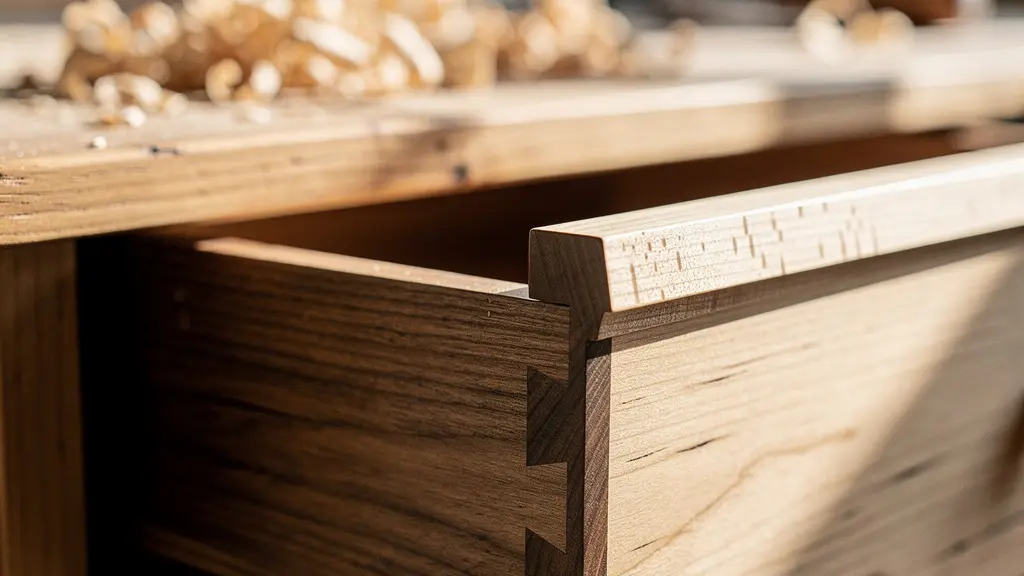
The dovetail joint is the poster child of quality cabinetry, and for good reason. Its longevity stems from a simple principle of mechanical physics. The angled “tails” and “pins” interlock, creating a joint that is incredibly resistant to being pulled apart. This is the primary force a drawer front must withstand every time you open it. Considering that kitchen cabinet drawers are opened and closed up to 3,500 times per year, this mechanical strength is not a luxury; it’s a necessity. A simple glued or stapled butt joint relies solely on the adhesive, which will inevitably fail under the shear stress of thousands of cycles.
The interlocking nature of the dovetail also provides immense resistance to “racking”—the tendency of a box to twist and go out of square. This is what keeps a drawer running smoothly in its tracks for decades. While the oldest examples found in ancient Egyptian tombs prove the joint’s timeless design, its real value is in how it handles the daily, repetitive stress of a modern kitchen. A well-made dovetail drawer feels solid and unyielding when you try to wiggle it. It’s a tangible feeling of quality that you can test yourself in any showroom.
- The Racking Test: Pull the showroom drawer halfway out of its cabinet.
- Grasp the drawer firmly with both hands on opposite corners.
- Try to wiggle the drawer side-to-side with moderate force.
- A quality dovetail drawer should feel completely solid with minimal flex or racking.
- Listen for any creaking or clicking sounds, which indicate weak or poorly fitted joints.
When you see “dovetail drawers” on a quote, you are paying for this inherent mechanical integrity. It is one of the clearest indicators of a commitment to longevity over cost-cutting.
How to Test Drawer Runners for Weight Capacity Before Buying?
A beautifully crafted drawer box is useless if the hardware it runs on is inadequate. Drawer runners (or slides) are the unsung heroes of cabinetry, and their quality is defined by a “dynamic load rating”—the amount of weight they can support while in motion. A quote that simply says “soft-close runners” is not specific enough. You need to know the brand, the type (undermount or side-mount), and most importantly, the load rating. For a cutlery drawer, 66 lbs (30kg) might be sufficient. But for a deep drawer intended for heavy cast iron pans, you should be looking for ratings closer to 143 lbs (65kg).
The best runners for high-end cabinetry are typically full-extension undermount soft-close models. “Undermount” means they are concealed beneath the drawer, providing a cleaner look and preventing the slides from collecting dust and grime. “Full-extension” allows you to pull the drawer all the way out, giving you access to the entire space without having to reach into a dark corner. While a quote should specify the load rating, you can perform a simple physical test in a showroom to gauge the quality and stability of a runner system.
This comparative table shows how load ratings correspond to specific uses, a detail that should be reflected in a thorough quote.
| Application Type | Recommended Load Rating | Runner Type | Typical Use |
|---|---|---|---|
| Cutlery Drawer | 30kg (66 lbs) | Side-mount ball bearing | Light kitchen utensils |
| Pan Storage | 65kg (143 lbs) | Undermount soft-close | Cast iron cookware |
| File Cabinet | 45kg (99 lbs) | Full extension | Heavy documents |
The “Full Extension Deflection Test” is a crucial diagnostic. Fully extend the drawer and press down firmly on the front edge. A premium undermount runner will show minimal sag or “deflection” (less than 3mm), feeling solid and stable. A lower-quality side-mount runner will often dip noticeably under the same pressure. This sag is a clear sign that the runner will wear out faster and cause the drawer to function poorly over time.
Solid Wood vs Engineered Core: Which Is More Stable for Large Wardrobe Doors?
The “solid wood is always best” argument is one of the most pervasive and misleading myths in furniture making. While solid wood is beautiful, strong, and highly desirable for many applications (like drawer boxes or face frames), it has one significant drawback: it moves. Wood expands and contracts with changes in humidity and temperature. For a small component, this movement is negligible. For a large, 2-meter-tall wardrobe door, this movement can lead to significant warping, twisting, and bowing, preventing the door from closing properly.
This is where high-quality engineered materials come in. An “engineered core” refers to materials like premium Moisture-Resistant MDF (Medium-Density Fiberboard) or multi-laminate plywood. These are specifically designed for dimensional stability. By arranging wood fibers or veneers in opposing directions, they counteract the natural tendency of wood to move. For a large door that will be painted or finished with a high-gloss lacquer, a perfectly flat and stable engineered core is not a compromise—it is the superior technical choice. As a leading industry expert explains:
The premium choice is not ‘solid vs. engineered,’ but the right material for the right application. For a perfectly flat, high-gloss lacquered door, a high-quality, moisture-resistant MDF or multi-ply core is dimensionally superior.
– Stacey Lindstrom, Dura Supreme Cabinetry National Training Manager
This does not mean solid wood doors are bad. For a traditional, stained-finish look, a solid wood door constructed with a “stile and rail” frame is the gold standard. This method, shown below, uses a frame to hold a central panel that is not glued in place, allowing it to “float” and expand or contract freely within the frame without distorting the door itself. A quality quote will specify “stile and rail construction” for solid wood doors.
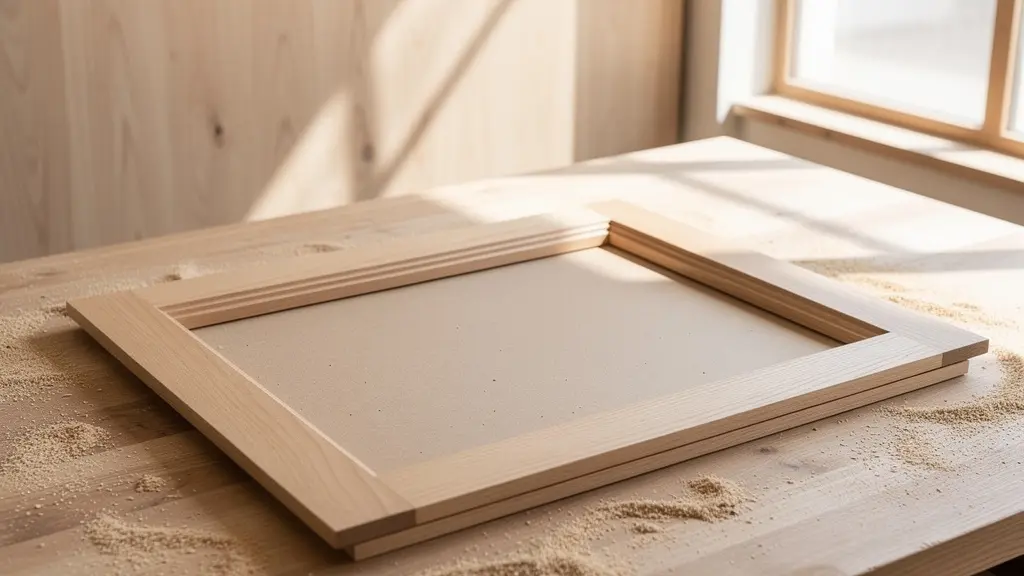
So, when reviewing your quote, the question isn’t “is it solid wood?” The right questions are: “What is the application?” and “How is this material being used to ensure long-term stability?” For large painted doors, look for a high-quality engineered core. For solid wood doors, look for stile and rail construction.
The Edge Banding Sign That Indicates Your Cabinet Doors Will Peel in 2 Years
Edge banding is the thin strip of material used to cover the exposed, raw edges of panels made from engineered cores like MDF or particleboard. It is a detail that is often overlooked but serves as a powerful indicator of a cabinet maker’s commitment to quality. Low-quality edge banding is one of the first things to fail on cheap cabinetry, leading to peeling, chipping, and a path for moisture to enter and destroy the core material.
There are two primary red flags. The first is thickness. The cheapest option is a paper-thin melamine or polyester tape, which offers almost no impact resistance and will quickly show wear. A quality cabinet will use a much thicker, more durable material. Your quote should be specific; for a durable, long-lasting finish, premium cabinet quotes should specify edge banding thickness of 1mm to 2mm PVC/ABS. This thicker banding is far more resistant to impacts from daily use and provides a much more robust seal against moisture.
The second red flag is the quality of the application. Even thick banding will fail if it isn’t applied correctly. The bond between the banding and the core needs to be perfect, with no gaps or sloppy glue lines. A master craftsman takes pride in making this seam nearly invisible. You can test this with a simple, yet surprisingly effective, physical check.
Your Action Plan: The Fingernail Test for Edge Banding Quality
- Locate the seam: Find the join where the door face meets the edge banding.
- Perform the test: Run your fingernail perpendicular across this seam.
- Feel for imperfections: You should not feel any sharp edge or noticeable lip. A perfectly flush seam indicates a high-quality application.
- Check for adhesion: Gently try to catch your nail under the edge of the banding. If you can, it’s a sure sign of poor adhesion and future peeling.
- Inspect the finish: Look for a consistent color and sheen match between the face and edge materials. Any discrepancy indicates a lack of attention to detail.
This small detail speaks volumes. A maker who gets the edge banding right is likely getting all the other, less visible details right too. It is a hallmark of meticulous work.
When to Install Joinery: Before or After Final Floor Finishing?
The timing of joinery installation within a larger construction or renovation project is a critical detail that is rarely discussed with clients but has a significant impact on the final quality. The correct sequence is a hallmark of a professional, experienced installer. With few exceptions, base cabinets should always be installed before the final floor finish is laid. The cabinets should be installed directly onto the subfloor, levelled perfectly, and secured.
There are two main reasons for this. First, it protects the expensive finished flooring (whether hardwood, tile, or vinyl) from damage during the cabinet installation process, which involves heavy units, tools, and multiple tradespeople. Second, and more importantly, it allows for a cleaner, more integrated finish. The finished flooring is then laid up to the cabinet plinths (or toe-kicks). This creates a seamless look and securely locks the base of the cabinets in place. Installing heavy cabinetry on top of a “floating” floor (like many engineered wood or laminate floors) can prevent the floor from expanding and contracting naturally, leading to buckling.
The ultimate sign of high-end custom installation is a scribed plinth. Floors are rarely perfectly level. A standard, off-the-shelf cabinet will have a visible, uneven gap between its base and the floor. A true craftsman will “scribe” the plinth—carefully cutting its bottom edge to perfectly match the undulations of the floor. This results in a seamless, gap-free connection, as shown in the detail shot below. It’s a time-consuming step that signals a genuinely custom, fitted installation rather than simply placing a box in a room.
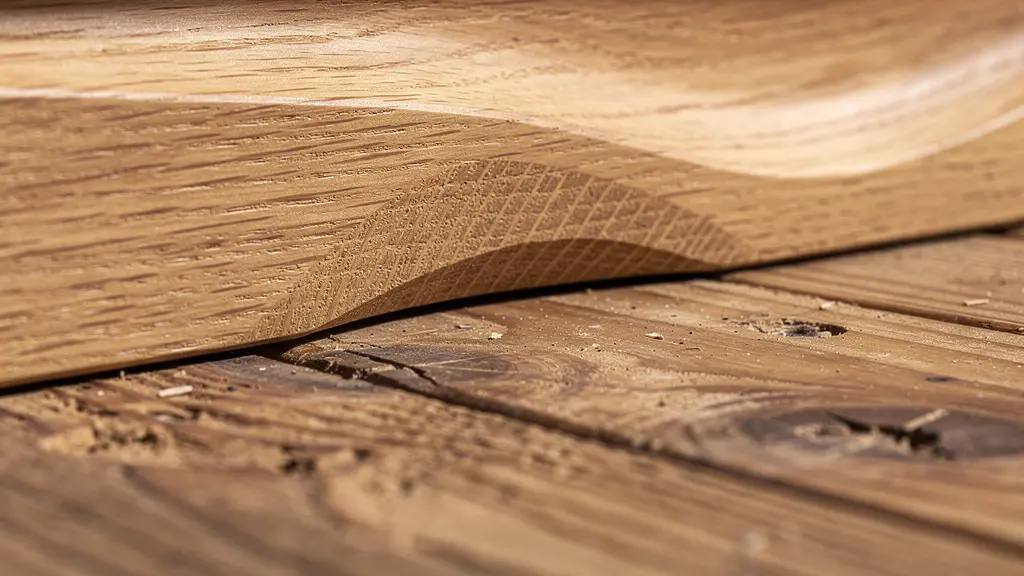
A professional quote may not always detail this process, but asking the question, “Do you scribe your plinths to the floor?” will immediately tell you the level of finish you can expect. This detail is the difference between cabinetry that looks like it belongs in the space and cabinetry that looks like it was just placed there.
Why Solid Oak Can Be Sanded and Refinished 10 Times Over?
The ability to be refinished is one of the most compelling arguments for investing in solid wood cabinetry. Styles change, accidents happen, and years of wear can take their toll. With a solid wood product, you have the option to bring it back to life. This is not the case for most veneered or laminated products. The key factor is the thickness of the wearable surface. A standard furniture veneer is often only 0.6mm thick—thinner than a credit card. Attempting to sand it will instantly burn through to the substrate underneath, permanently ruining the piece.
A solid oak cabinet door or worktop, on the other hand, is typically 19-22mm thick. This provides a massive amount of material to work with. A professional restoration sanding is a delicate process, not an aggressive one. In fact, a skilled professional refinishing removes less than 0.5mm of material per sanding. This means a solid wood surface can be fully sanded down, re-stained, and re-lacquered more than ten times over its life, potentially lasting for multiple generations.
This table clearly illustrates the stark difference in longevity and repairability between material types. It is a powerful argument for considering the total lifespan cost, not just the initial purchase price.
| Material Type | Thickness | Refinish Capability | Expected Lifespan |
|---|---|---|---|
| Standard Furniture Veneer | 0.6mm | Cannot be sanded | 10-15 years |
| Architectural Thick Veneer | 2.5mm+ | 1-2 light refinishes | 20-30 years |
| Solid Oak (Standard) | 19-22mm | 10+ full refinishes | Multi-generational |
When you choose solid wood, you are not just buying a product; you are investing in a repairable and renewable asset. It offers a level of sustainability and long-term value that disposable, veneer-based furniture simply cannot match. This is the essence of “buy it for life” quality.
Green Oak vs Glulam: Which Is More Stable for Large Spans?
When dealing with large structural elements in joinery, such as a fireplace mantel, a countertop, or a structural beam, the choice of wood goes beyond simple aesthetics and enters the realm of engineering. Green Oak and Glulam (Glued Laminated Timber) are two materials that may look similar at a glance but behave in fundamentally different ways. Understanding their properties is key to selecting the right one for the job.
The choice between them is a choice of intent, as a master craftsman explains:
Green Oak is chosen for its character; it will intentionally shrink, warp, and ‘check’ (crack) as it dries, which is integral to its rustic look. Glulam is an engineered product chosen for its dimensional stability and predictable strength, behaving more like steel.
– Ken DeCost, MT Copeland’s Introduction to Cabinetry Course
Green Oak is timber that has been recently felled and has not yet been seasoned or dried. It has a very high moisture content. As it dries over many years in situ, it will shrink, twist, and develop deep cracks, known as “checks.” This is not a defect; it is the desired aesthetic for traditional, rustic-style buildings and furniture. It is chosen for its character and evolving natural beauty. However, it is dimensionally unstable and not suitable for applications requiring precise, unchanging dimensions.
Glulam, by contrast, is an engineered wood product. It is created by gluing together multiple layers of smaller, kiln-dried timber pieces with the grain of all layers running parallel. This process creates a single, large, incredibly strong, and dimensionally stable beam. Because it’s made from dried timber and its laminations resist warping, it will not shrink or check like Green Oak. It is chosen for its predictable, steel-like performance and is the correct technical choice for large spans where stability and strength are paramount, such as a perfectly straight, modern countertop or a load-bearing beam that cannot be allowed to sag.
Key takeaways
- Dovetail joinery isn’t just a look; it provides a testable mechanical lock that resists thousands of pull-and-push cycles.
- The right material depends on the application. For large, painted doors, the dimensional stability of an engineered core is superior to solid wood.
- True quality is found in the details you can physically test: check for drawer runner deflection under load and test the adhesion of edge banding with your fingernail.
High-Gloss vs Matte Lacquer: Which Facade Finish Is Easier to Keep Clean?
The final finish on your cabinetry is what you will see and touch every day. The choice between a high-gloss and a matte (or satin) finish is often seen as purely aesthetic, but it has significant practical implications for cleaning and long-term maintenance. Neither is universally “better,” but they have distinct trade-offs that a good cabinet maker should explain.
A high-gloss finish is like a mirror. It is achieved by building up multiple layers of lacquer and polishing them to a perfectly smooth, reflective surface. Its main advantage is that it is non-porous. This makes it incredibly easy to wipe clean. Spills, oils, and dirt sit on the surface and can be removed with a simple wipe of a soft cloth. The downside is that this same reflective quality shows everything: every fingerprint, every speck of dust, and every tiny surface scratch. It requires frequent cleaning to look its best and is generally better suited for upper cabinets that are touched less often.
A matte or satin finish, on the other hand, has a low-sheen, non-reflective surface. For reference, the industry-standard satin finish provides a 15-25% sheen level, which is just enough to give the surface some life without being reflective. This finish is excellent at hiding fingerprints and dust, making it a much more practical choice for a busy family kitchen, especially on lower cabinets and high-touch areas. The microscopic texture that diffuses light, however, can make it slightly more challenging to clean certain substances. An oily fingerprint, for instance, might require a dedicated cleaner to remove completely, as it can settle into the fine texture of the finish.
Ultimately, the best choice is a balance. A satin finish often represents the sweet spot for most households, offering a good compromise between hiding everyday smudges and being relatively easy to clean. A truly discerning quote might even specify the sheen percentage, demonstrating a deep understanding of the final product’s real-world performance.
Armed with this knowledge, you are no longer just a client; you are an informed partner in the creation of your custom cabinetry. Scrutinize your next quote, ask these pointed questions, and use these physical tests to verify the quality for yourself. Invest with the confidence of a craftsman, and you will be rewarded with joinery that serves your family for generations.