
The excessive echo in your modern, open-plan home isn’t a design flaw you have to live with; it’s an engineering problem with a clear solution. This guide moves beyond simply adding rugs and curtains. It provides a technical framework for transforming your living space’s acoustics by strategically identifying and treating sound reflection points, choosing materials based on their scientific properties, and using your existing furniture as acoustic tools.
For families in modern, minimalist homes, the dream of a spacious, open-plan living area often comes with an unforeseen consequence: noise. The same clean lines, high ceilings, and hard surfaces that define a minimalist aesthetic create a perfect environment for sound waves to bounce uncontrollably, turning a conversation into a cacophony and a quiet evening into an echoing cavern. You’ve likely tried the common remedies—a plush rug here, a few extra cushions there—only to find the intrusive echo persists.
The conventional approach of simply adding soft furnishings is a shot in the dark. It fails to address the root cause of the problem, which lies in the physics of sound reflection. The truth is that effective acoustic control is not about randomly filling a space; it’s a calculated engineering exercise. It involves understanding how sound travels, identifying the specific paths it takes to create reverberation, and intercepting those paths with precision.
This is where the perspective shifts from interior decorating to residential acoustic engineering. The key isn’t just to absorb sound, but to do so strategically. This guide will deconstruct the problem of residential echo and provide a technical, solution-oriented roadmap. We will explore how to diagnose your room’s specific acoustic issues, select materials based on their tested performance, and implement solutions that are not only effective but can also be seamlessly integrated into your home’s decor.
This article provides a structured approach to solving your home’s acoustic challenges. Below, you will find a summary of the key areas we will cover, from diagnosing the problem to implementing advanced, decorative solutions.
Summary: An Engineer’s Guide to Taming Echo in Open-Plan Spaces
- Why Your Minimalist Decor Is Making Your Living Room Sound Like a Cafeteria?
- How to Position Acoustic Foam Behind Art to Hide It Completely?
- PET Felt vs Cork: Which Material Absorbs Speech Frequencies Better?
- The Ceiling Oversight That Ruins the Acoustics of High-Ceilinged Rooms
- How to Arrange Bookshelves to Act as Natural Sound Barriers?
- Why Wool Springs Back After Furniture Compression Unlike Synthetics?
- Why a Water Feature Is the Best Defense Against Traffic Noise?
- How to Position a Sectional Sofa Without Blocking Room Flow?
Why Your Minimalist Decor Is Making Your Living Room Sound Like a Cafeteria?
Your love for clean lines, hardwood floors, and expansive glass walls is, acoustically speaking, the root of the problem. These hard, non-porous surfaces are highly reflective to sound waves. When you speak, the sound doesn’t just travel to the listener; it hits these surfaces and bounces back into the room, creating multiple, delayed versions of the original sound. This phenomenon is called reverberation. In a room with many parallel hard surfaces, like opposing walls or a hard floor and ceiling, you get a more specific problem known as flutter echo—a rapid, distracting ringing sound you can often hear by clapping your hands.
Minimalist design, by its very nature, removes the soft, porous objects that would normally absorb these reflections. A traditional room filled with heavy drapes, upholstered furniture, and cluttered bookshelves naturally dampens sound. Your open-plan space, devoid of these absorbers, acts like an echo chamber. The key to fixing this is not to abandon your aesthetic but to introduce acoustically effective materials in a targeted way. This starts with identifying the most problematic areas: the first reflection points. These are the exact spots on your walls, ceiling, and floor where sound from your speakers or your voice bounces once before reaching your ears.
The effectiveness of an acoustic material is measured by its Noise Reduction Coefficient (NRC). A material with an NRC of 0 is perfectly reflective (like glass), while a material with an NRC of 1.0 is perfectly absorptive. Many professional acoustic treatments are engineered to have an NRC rating of up to 0.72 at speech frequencies, meaning they absorb 72% of the sound that hits them. By strategically placing materials with a high NRC at first reflection points, you can eliminate echo without cluttering your room.
Action Plan: Diagnose Your Room’s Acoustic Hotspots
- Identify First Reflection Points: Sit in your main listening position (e.g., your sofa). Have a friend slide a mirror along the walls. Any spot where you can see the reflection of a primary sound source (like a TV speaker or where a person would typically stand and talk) is a first reflection point that needs treatment.
- Target the Reflection-Free Zone: The most critical areas to treat are the walls to the left and right of your listening position, and the ceiling area directly above and slightly in front of you.
- Listen for Flutter Echo: Stand in the middle of your room and clap your hands sharply. If you hear a “zinging” or ringing echo, you have flutter echo between parallel walls. This confirms that these surfaces need treatment.
- Assess Ceiling Height: If your room has high ceilings, the ceiling is a major source of reflections. Consider this a primary zone for treatment, as sound has a long path to travel and reflect.
- Map Your Plan: Based on the points above, sketch a simple layout of your room and mark the primary, secondary, and tertiary zones for panel placement. This becomes your engineering blueprint.
How to Position Acoustic Foam Behind Art to Hide It Completely?
One of the most elegant solutions for integrating acoustic treatment into a home is to hide it in plain sight. Mounting acoustic material behind a canvas or framed artwork allows you to absorb sound reflections without adding any new visual elements to your wall. This method is particularly effective for treating the first reflection points you identified earlier, which are often at eye level where art is naturally placed. However, the success of this technique depends on a critical engineering detail: the air gap.
Simply pressing a piece of acoustic foam against the wall behind a painting will have a limited effect. To maximize performance, you must create a small space between the acoustic material and the wall. Sound waves that pass through the panel will reflect off the wall, travel back through the panel, and be absorbed a second time. Rigorous acoustic treatment testing shows that leaving a 1-inch air gap can nearly double a panel’s absorption effectiveness, especially for lower-mid frequencies which are common in human speech and music.
The implementation is straightforward. You can build a shallow wooden frame (1-2 inches deep) on the back of your artwork, fill it with a high-density acoustic material like Rockwool or rigid fiberglass, and then cover it with a breathable fabric. This entire assembly is then hung on the wall. For a non-permanent and flexible solution, using French cleats to mount the panels allows for easy removal and repositioning.
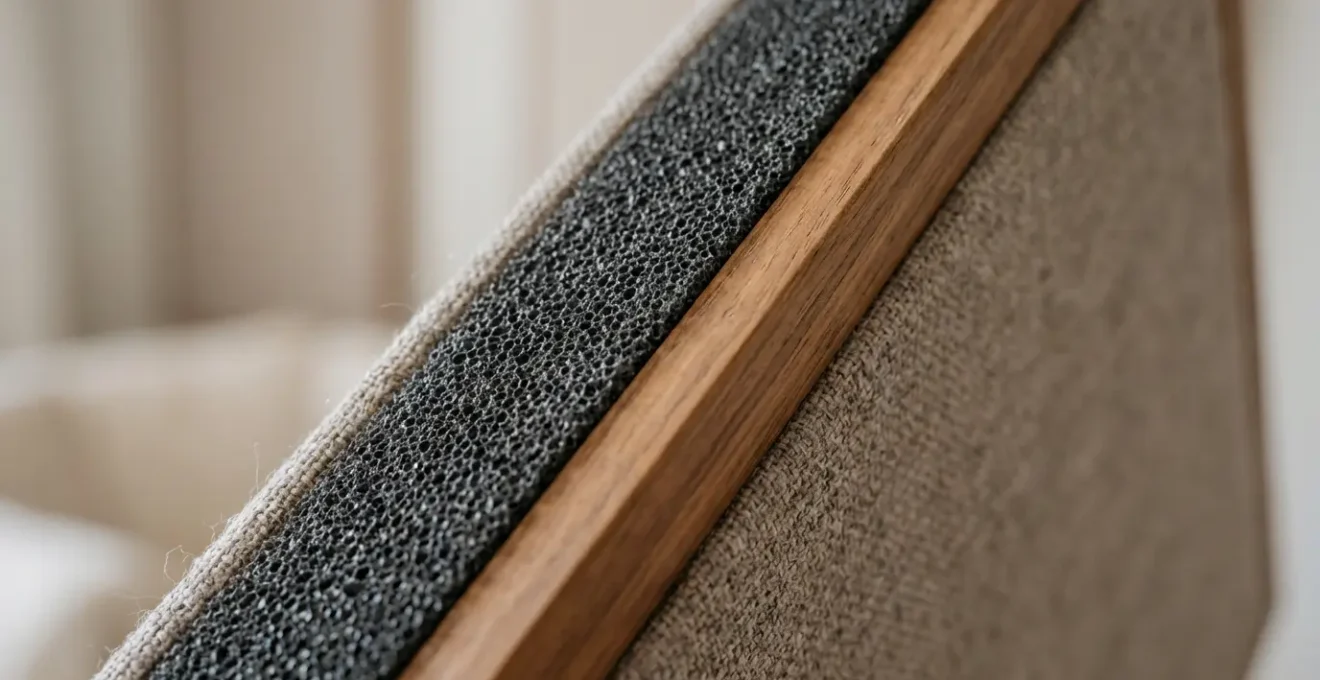
As the cross-section shows, the layers work in concert. The artwork provides the aesthetic, the acoustic core provides the absorption, and the engineered air gap behind it acts as a performance multiplier. This turns a decorative object into a high-performance acoustic device.
Case Study: DIY Hidden Acoustic Panels
A home workshop enthusiast documented the process of creating 12 discreet acoustic panels for under $20 each. By building simple wood frames, filling them with Rockwool insulation, and wrapping them in neutral fabric, they effectively treated a reverberant room. The panels were mounted using French cleats, which automatically created a 1-inch air gap from the wall. Before-and-after sound tests demonstrated a significant reduction in echo and a much clearer, more controlled acoustic environment, proving the efficacy of the air gap principle in a real-world application.
PET Felt vs Cork: Which Material Absorbs Speech Frequencies Better?
When choosing decorative acoustic materials, the decision goes beyond color and texture. From an engineering standpoint, you are choosing a material for its specific acoustic properties. Two of the most popular and sustainable options are PET felt and cork. While both offer sound-absorbing qualities, they perform differently across the frequency spectrum, making one potentially better than the other depending on your primary noise issue. Understanding their differences is key to making an informed choice.
PET (Polyethylene terephthalate) felt is a soft, fabric-like material made from recycled plastic bottles. It is lightweight and excels at absorbing mid-to-high frequencies. This makes it particularly effective at taming the sounds that contribute to poor speech intelligibility, such as the sharp ‘s’ and ‘t’ sounds in conversation, the clatter of cutlery, or the high-pitched ringing of a phone. Its lightweight nature makes it ideal for wall-mounted panels and ceiling applications.
Cork, on the other hand, is a denser, more rigid material harvested from the bark of cork oak trees. Its cellular structure is excellent at trapping sound and vibration. Cork performs best in the low-to-mid frequency range. This means it’s better at dampening the deeper, resonant tones of a voice, the hum of an appliance, or the low thud of footsteps. Its durability and natural, antimicrobial properties make it a great choice for lower wall applications, like wainscoting, where it might be subject to more wear and tear.
The following table, based on data from acoustic material specialists, breaks down the key differences:
| Property | PET Felt (9-25mm) | Cork |
|---|---|---|
| NRC Rating | 0.15-0.72 (thickness dependent) | 0.10-0.70 |
| Best Frequency Range | Mid to high frequencies (500-4000 Hz) | Low-mid frequencies |
| Durability | Prone to pilling/fading over time | Improves with age, develops patina |
| Sustainability | Made from 50-65% recycled PET bottles | 100% renewable, harvested bark |
| Installation Zones | Upper walls, ceilings | Lower walls, wainscoting height |
| Maintenance | Low maintenance, cleanable | Natural antimicrobial properties |
Cork is denser and better at dampening low-mid resonance, and its appearance can enrich over time. PET felt is lighter, often superior for higher frequencies (like ‘s’ and ‘t’ sounds), but can be prone to pilling or fading.
– ekko Acoustics Design Team, Acoustic Materials Explained Guide
The Ceiling Oversight That Ruins the Acoustics of High-Ceilinged Rooms
In rooms with high or vaulted ceilings, the ceiling itself is often the single largest, hardest, and most overlooked reflective surface. Sound waves travel upward, hit the expansive ceiling, and reflect back down into the living space, creating significant echo and a sense of cavernous, uncontrolled sound. Treating the walls alone in such a space is an incomplete solution. To truly master the acoustics of a high-ceilinged room, you must address this vertical dimension by bringing the treatment closer to the sound source.
The most effective engineering solution for this is the installation of suspended acoustic panels, often called acoustic clouds or baffles. These are fabric-wrapped panels that hang horizontally from the ceiling via cables, “floating” in the space. This approach has two major acoustic advantages. First, it allows both sides of the panel to absorb sound—the initial wave traveling up and the reflected wave bouncing off the ceiling deck. Second, by lowering the absorptive surface, it reduces the time it takes for sound to be controlled. This is known as the proximity effect: the closer the acoustic treatment is to the source of the noise, the more effective it is.
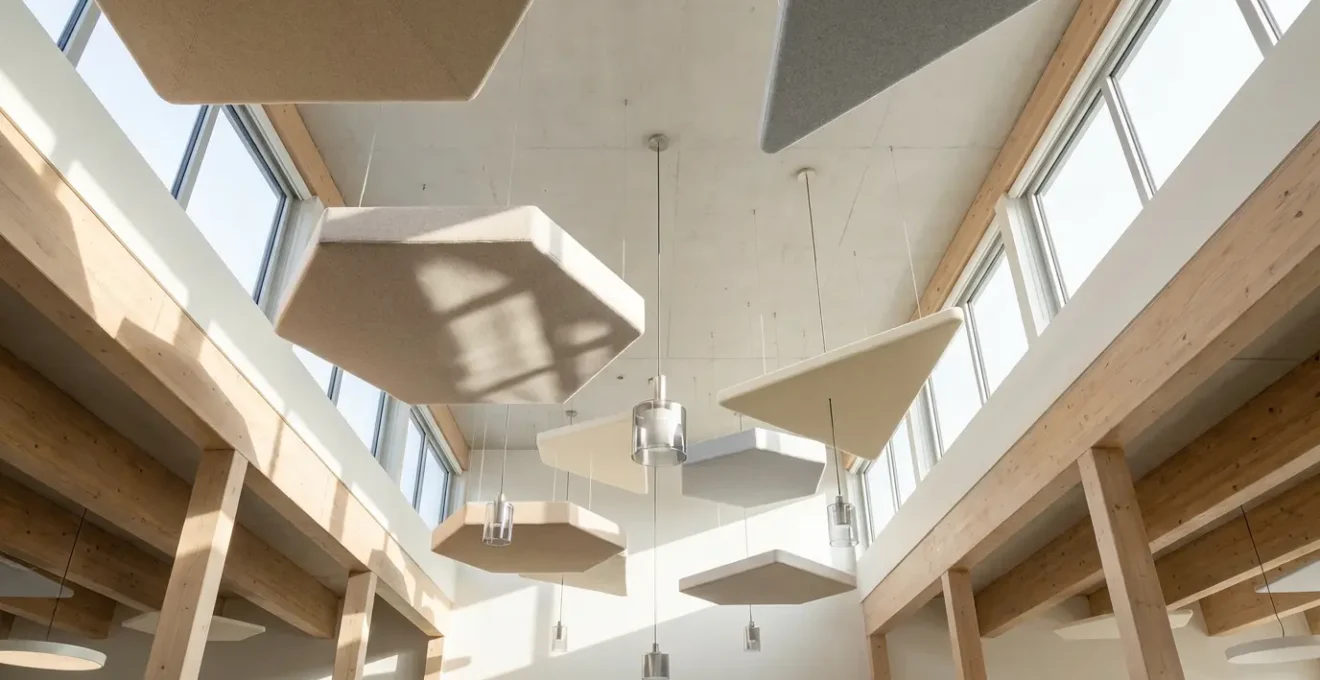
These clouds can be arranged as individual geometric shapes or in arrays to create a visually striking architectural feature. They integrate seamlessly with modern pendant lighting and can transform the perceived scale of a room, making it feel more intimate and acoustically comfortable. The strategy is not to cover the entire ceiling, but to place clouds strategically over the areas where most of the sound is generated, such as above a dining table or a central conversation area.
Case Study: The Royal Albert Hall’s Acoustic Solution
One of the most famous examples of suspended acoustic treatment is found in London’s Royal Albert Hall. To combat the hall’s infamous echo, large, convex fibreglass “mushrooms” were suspended from the ceiling. These reflectors, as detailed in an analysis by acoustic solution provider Sound Zero, are positioned at various heights to intercept and diffuse sound waves before they can create problematic reverberation. This large-scale project demonstrates the core principle that in a voluminous space, bringing the acoustic treatment down from the boundary surfaces is critical for achieving world-class sound quality.
How to Arrange Bookshelves to Act as Natural Sound Barriers?
Bookshelves are often suggested as an easy way to improve room acoustics, but simply placing a bookshelf against a wall is a missed opportunity. To transform a standard piece of furniture into a powerful acoustic tool, you must think like a sound engineer and leverage two different principles: absorption and diffusion. While absorption traps sound energy, diffusion scatters it in many different directions, breaking up strong, coherent reflections into smaller, less perceptible ones.
A bookshelf can be optimized to do both. The key is in how you arrange its contents. * For absorption, the goal is to create a porous mass. This is best achieved with soft, mass-market paperbacks. Packing them tightly together on a shelf creates a surface that can effectively absorb mid-frequency sound energy, much like a dedicated acoustic panel. * For diffusion, the goal is to create an irregular, varied surface. This is done with hard-cover books of different sizes and depths. By arranging them with some spines flush and others recessed, and by interspersing decorative objects of various shapes and materials (ceramic, wood, metal), you create a complex surface that scatters sound waves effectively.
A highly effective strategy is the “checkerboard” pattern, where you alternate shelf types: one packed with paperbacks for absorption, the next arranged with varied hardcovers and objects for diffusion, and perhaps a third left half-empty to create more depth variation. Furthermore, the position of the bookshelf itself matters. An open-backed bookshelf placed perpendicular to a wall can act as a room divider, physically breaking up a long, open space and preventing sound from traveling across it.
A shelf packed tightly with mass-market paperbacks acts as a porous mid-frequency absorber. A shelf with varied-size hardcovers, placed at different depths, with objects interspersed, acts as a powerful diffuser.
– Acoustic Design Specialist, Home Studio Acoustic Treatment Guide
By applying these techniques, your bookshelf is no longer just storage; it becomes an active, dual-function acoustic treatment system that both absorbs and diffuses sound, all while being a natural part of your decor.
Why Wool Springs Back After Furniture Compression Unlike Synthetics?
When considering acoustic furniture and panels, the long-term performance of the material is a crucial factor. While many synthetic materials like polyester or foam offer good initial sound absorption, they can degrade over time. Compression from furniture use, cleaning, or simple gravity can cause their internal structure to collapse, reducing their acoustic effectiveness. This is where a natural material like wool demonstrates its superior engineering.
The secret to wool’s remarkable resilience lies in its microscopic structure. Each wool fiber has a natural, three-dimensional helical “crimp,” like a tiny spring. A wool felt panel is composed of millions of these crimped fibers, which create a network of tiny air pockets. These air pockets are what trap sound energy, giving wool its excellent acoustic properties. When wool is compressed, these natural springs bend but do not break. Once the pressure is released, the fibers spring back to their original shape, restoring the air pockets and, consequently, the material’s full acoustic performance.
Synthetic fibers, in contrast, are typically smooth and straight. They rely on a manufactured loft for their acoustic properties. Over time, under compression, these fibers can become permanently matted down, and the air pockets are lost for good. This is why a synthetic sofa cushion flattens over time, while a wool-filled one retains its bounce. This natural resilience is why acoustic material testing demonstrates that 100% wool felt can maintain a Class A acoustic rating over many years of use, outperforming many synthetic alternatives in durability.
Case Study: Long-Term Acoustic Performance in Commercial Spaces
A study on commercial installations compared the long-term performance of different acoustic panel compositions. It found that dual-layer panels combining a wool felt face with a cork or polyester backing showed superior, sustained sound absorption over years of use compared to panels made only of synthetic materials. The study concluded that the wool component’s ability to resist compression was the key factor. Its natural crimp structure allowed it to consistently spring back, preserving the critical air pockets necessary for high-performance sound absorption, even in a high-traffic environment.
Why a Water Feature Is the Best Defense Against Traffic Noise?
So far, we have focused on absorption and diffusion—methods to control sound *within* a room. But what about intrusive noise from *outside*, such as traffic? While sealing windows and doors helps, some low-frequency sound will inevitably penetrate. In these cases, a different acoustic strategy is often more effective: sound masking. Instead of trying to eliminate the unwanted noise, you introduce a more pleasant, constant, and broadband sound to cover it up.
The human brain is excellent at tuning out constant, non-threatening background noise. A water feature, such as a small indoor fountain or a wall-mounted waterfall, is an ideal sound-masking device for a home environment. The gentle, randomized sound of flowing or bubbling water is psychologically pleasing and contains a wide range of frequencies. This “white noise” effectively raises the ambient sound floor of the room. As a result, the peaks of intrusive noise, like a passing truck or a distant siren, become less noticeable because the difference between the background noise and the intrusive noise is smaller. Your brain is less likely to be startled or distracted by them.
The key is that the masking sound must be spectrally appropriate for the noise you want to cover. The lower, gurgling sounds of a stream are better for masking low-frequency rumbles, while the higher-frequency splashing of a fountain is better for masking distant chatter or higher-pitched traffic sounds. It’s a form of acoustic camouflage, distracting your brain from the undesirable sound with a more agreeable one.
Case Study: The Sheffield Railway Station Fountain
To combat the noise from traffic and crowds in a public square, designers at a railway station in Sheffield, UK, installed a large water feature. A comprehensive scientific study on soundscapes analyzed its effectiveness. The research showed that the presence of the water sounds significantly increased visitors’ subjective comfort levels and positive assessment of the soundscape. While the effectiveness varied based on the type of water sound and the specific traffic noise, it confirmed that a well-designed water feature can successfully mask unwanted urban noise and improve the perceived quality of an acoustic environment.
Key Takeaways
- Minimalist design’s hard surfaces create echo; the solution is targeted treatment, not just adding clutter.
- Strategic placement at “first reflection points” is more important than the quantity of acoustic panels.
- An air gap behind a panel can double its effectiveness, turning hidden art into a high-performance acoustic device.
- Different materials (PET Felt, Cork, Wool) are engineered to absorb different sound frequencies; choose based on your specific noise problem.
- For external noise, sound masking (e.g., a water feature) can be more effective than absorption.
How to Position a Sectional Sofa Without Blocking Room Flow?
The largest piece of furniture in your living room, the sectional sofa, is also your most powerful and underutilized acoustic tool. Its sheer mass and soft, porous upholstery make it a formidable sound absorber, particularly for low-frequency (bass) sounds that are difficult to control with thin panels. However, its placement is often dictated by habit—pushed against a wall or into a corner. By applying acoustic engineering principles, you can position your sectional to dramatically improve your room’s sound and flow simultaneously.
The most effective single technique is to “float” the sectional away from the walls. Pulling it even a foot or two into the room creates a dedicated, acoustically controlled conversation zone. This has several benefits. First, it allows people to circulate easily behind the sofa, defining a clear traffic path and improving room flow. Second, the sofa itself acts as a massive, room-center bass absorber, tackling low-frequency issues far more effectively than wall-mounted panels. Finally, by moving the primary seating area away from reflective walls, you reduce the immediate impact of first reflections on listeners.
For even greater control, angle the entire sectional slightly (5-10 degrees) so that its longest back is not perfectly parallel to the opposing wall. This small shift is enough to break up the standing waves and flutter echo that occur between large parallel surfaces. Alternatively, pushing a large sectional deep into a corner can turn that corner into a highly effective super corner bass trap, absorbing the low-frequency energy that naturally builds up in the corners of a room. Your sofa is not just for sitting; it is an active component in your room’s acoustic system.
By ‘floating’ the sectional away from the walls, you create a dedicated, acoustically-controlled conversation zone. The traffic ‘flows’ around this intentional zone, and the sofa itself acts as a massive bass absorber for the entire room.
– Interior Acoustic Designer, Acoustic Panel Placement Guide
By systematically applying these engineering principles—diagnosing reflection points, selecting appropriate materials, treating all five surfaces, and using your furniture strategically—you can transform a reverberant, noisy space into one that is calm, clear, and comfortable. Begin today by applying these technical strategies to reclaim the tranquility of your open-plan home.