The greatest returns in landscaping come not from expensive cosmetic upgrades, but from strategic investments in living assets and functional design that solve problems.
- Mature trees offer significantly higher long-term value and energy savings compared to hardscaping like pavers.
- Solving structural issues like poor drainage with aesthetic solutions like rain gardens provides a dual return on investment.
Recommendation: Shift your mindset from “decorating” your yard to managing a portfolio of landscape assets, prioritizing long-term growth and problem-solving over short-term trends.
For most homeowners, landscaping is about aesthetics—a splash of color here, a neat lawn there. This approach often leads to spending thousands on improvements that feel good but add little to the bottom line when it’s time to sell. From a real estate appraiser’s perspective, this is a missed opportunity. The most common advice focuses on generic “curb appeal,” urging you to plant annuals or install trendy pavers, but rarely delves into the financial mechanics of what truly drives value.
The truth is, your property’s exterior is a dynamic financial asset. Every decision—from the type of tree you plant to the way you manage water runoff—carries a potential return or a hidden liability. Thinking like an appraiser means looking beyond the surface and evaluating landscaping choices based on their long-term impact on property value, usability, and maintenance costs. It’s about understanding that a well-placed tree is an appreciating asset, while a poorly planned patio can be a depreciating one.
But what if the key to a 20% value increase wasn’t about adding more, but about choosing smarter? What if a $5,000 investment in a single mature tree could outperform a $15,000 patio? This guide will break down landscaping decisions through that strategic, value-driven lens. We will analyze the ROI of specific choices, uncover the costly mistakes that devalue a property, and provide a framework for turning your yard into a high-performing asset.
This article will guide you through the critical decisions that transform your outdoor space into a significant value driver. We will explore everything from the tangible returns of mature trees to the strategic zoning of a small patio, giving you the tools to make investments that truly pay off.
Summary: An Appraiser’s View on High-Value Landscaping
- Why Spending $5,000 on Mature Trees Offers Better Returns Than Fancy Pavers?
- How to Fix a Waterlogged Yard Without Ruining Your Garden Aesthetics?
- Native Species or Exotics: Which Requires Less Water in Dry Climates?
- The Tree Planting Error That Can Crack Your Foundation in 10 Years
- When to Install Outdoor Lighting: Before or After Hardscaping Completion?
- Why Your North-Facing Patio Stays Damp and Unused 9 Months a Year?
- Why a Flat Lawn Makes Your Property Look Smaller Than It Actually Is?
- How to Zone a 50m² Patio for Dining and Lounging Without Crowding?
Why Spending $5,000 on Mature Trees Offers Better Returns Than Fancy Pavers?
When considering high-impact upgrades, homeowners often gravitate towards hardscaping like elaborate stone patios or walkways. While visually appealing, these are often depreciating assets with high initial costs. From an investment standpoint, a mature tree is a superior choice. It is a living asset that appreciates over time, not just in beauty but in measurable financial contributions. Unlike pavers, a large tree provides shade, character, and a sense of establishment that buyers value highly.
The financial returns are twofold. First, there’s the direct impact on property value. A Virginia Tech study revealed that plant size and design sophistication are critical factors; well-placed focal points can increase a home’s value by up to 42 percent. A mature tree is the ultimate focal point. Second, there are tangible energy savings. A single tree strategically placed on the west side of a home can reduce its energy bills by 3% in five years and 12% by year 15. This recurring saving is a powerful selling point that a patio cannot offer.
The key is strategic investment. Spending $5,000 on a single, well-established 15-foot oak or maple provides immediate impact and begins compounding in value from day one. In contrast, the same amount spent on pavers adds a feature that starts to weather and date itself immediately. The perceived value of a mature tree far outweighs its cost, creating an emotional and financial anchor for the property that buyers are willing to pay a premium for.
How to Fix a Waterlogged Yard Without Ruining Your Garden Aesthetics?
A soggy, unusable yard is a significant liability that screams “drainage problems” to potential buyers. The conventional fix often involves ugly French drains or disruptive, expensive re-grading. However, a strategic approach turns this problem into a high-value feature. The goal is to manage water not by hiding it, but by celebrating it through beautiful, functional landscape design.
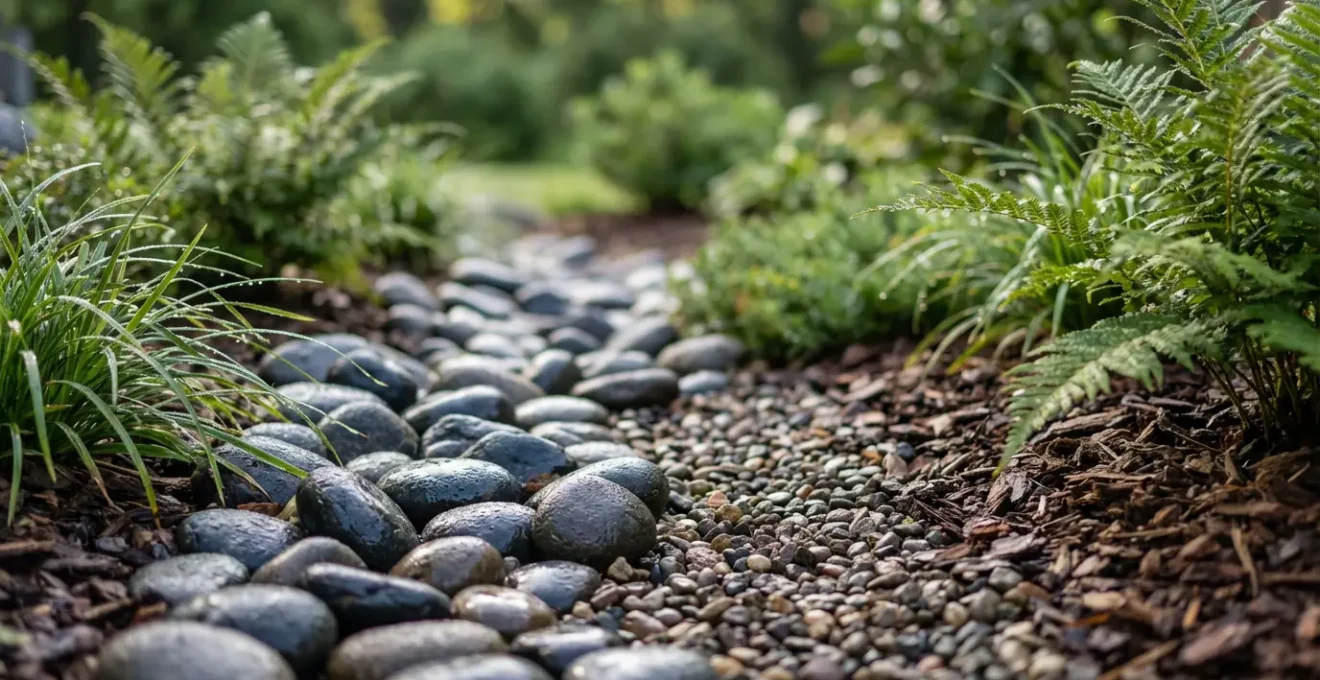
The most elegant solution is the creation of a rain garden or a dry creek bed. These are shallow depressions filled with water-loving native plants and decorative stones that capture and slowly absorb rainwater. Instead of a muddy patch, you create a beautiful, low-maintenance garden feature that adds texture and visual interest. This solution is not just aesthetic; it’s a powerful demonstration of thoughtful, sustainable design that resonates with modern buyers.
This image showcases how a drainage issue can be transformed into a stunning landscape feature that is both functional and beautiful.
Furthermore, integrating permeable surfaces is another key strategy. Replacing impermeable concrete with natural flagstone or permeable pavers allows water to seep into the ground naturally, reducing runoff and sogginess. When paired with other landscape elements, these functional hardscapes can deliver an impressive return. The key is to see water management not as a plumbing issue, but as a design opportunity to enhance your property’s overall appeal and value.
Native Species or Exotics: Which Requires Less Water in Dry Climates?
In any climate, but especially in dry regions, water usage is a major factor in a landscape’s long-term cost and appeal. The choice between native plants and water-thirsty exotics is a critical financial decision. While exotic plants can offer dramatic flair, they often require constant irrigation, fertilization, and pest control, making them a high-maintenance liability. Buyers are increasingly savvy about these hidden costs.
Native plants are the clear winner for ROI. Having evolved in the local environment, they are naturally adapted to the soil, rainfall patterns, and temperature extremes. Once established, they require minimal watering and maintenance, which translates directly into significant cost savings. A compelling analysis shows it costs about $3,000 to maintain an acre of native plants over a 20-year period, compared to $20,000 for an equivalent area of non-native turf grass. That $17,000 saving is pure value added to the property.
Beyond the direct cost savings, a landscape designed with native species signals a sophisticated, environmentally conscious approach. It creates a sense of place and authenticity that generic, high-maintenance gardens lack. For a potential buyer, this translates to a property that is not only beautiful but also intelligent, sustainable, and less expensive to own.
The following table breaks down the core differences from an investment perspective, highlighting why native plants are the superior long-term asset.
| Factor | Native Plants | Exotic Plants |
|---|---|---|
| Water Requirements | Minimal after establishment | Continuous irrigation needed |
| Maintenance Cost (20 years/acre) | $3,000 | $20,000 |
| Property Value Impact | Provides shade, reduces cooling costs, improves curb appeal | Visual appeal only |
| Buyer Perception | Sophisticated, authentic design | Generic, high-maintenance |
| Long-term ROI | 25% – 400% when combined with other features | Variable, often negative |
The Tree Planting Error That Can Crack Your Foundation in 10 Years
While a mature tree is a prime landscape asset, the wrong tree in the wrong place is one of the most destructive liabilities a homeowner can create. The single most catastrophic and common error is planting a large tree species too close to the house. Homeowners are often tempted by the idea of immediate shade or curb appeal, ignoring the long-term consequences of aggressive root systems.
Species like willows, silver maples, and poplars have notoriously invasive roots that seek out water and can travel far beyond the tree’s canopy. When planted within 15-20 feet of a home, these roots can infiltrate sewer lines, buckle driveways, and, most devastatingly, exert enough pressure to crack the building’s foundation. What began as a beautification project can become a structural nightmare costing tens of thousands of dollars to repair, completely erasing any value the tree might have added.
Case Study: The $8,000 Willow Tree
A homeowner in Fairfax, Virginia, planted a beautiful willow tree just 12 feet from their house for its fast growth and graceful appearance. Within a decade, the water-seeking roots began to lift and crack the home’s foundation. The cost to remove the tree and repair the foundation damage totaled $8,000. That “valuable” tree ended up being an extremely expensive liability, a stark reminder of the importance of strategic placement.
To avoid this, a simple rule of thumb is to plant large-growing trees a distance from the foundation that is at least equal to half of their mature canopy spread. For most large shade trees, this means a minimum of 20-25 feet. Consulting an arborist or a landscape architect before planting is not a luxury; it’s essential risk management to protect your home’s structural integrity and ensure your landscape investments remain assets, not liabilities.
When to Install Outdoor Lighting: Before or After Hardscaping Completion?
Outdoor lighting is a powerful tool for increasing property value. It enhances security, extends the usability of outdoor spaces into the evening, and creates dramatic curb appeal. However, the ROI of your lighting system is heavily dependent on one critical factor: sequencing. The decision of when to install it—before or after hardscaping like patios and walkways—can be the difference between a cost-effective, integrated system and an expensive, logistical nightmare.
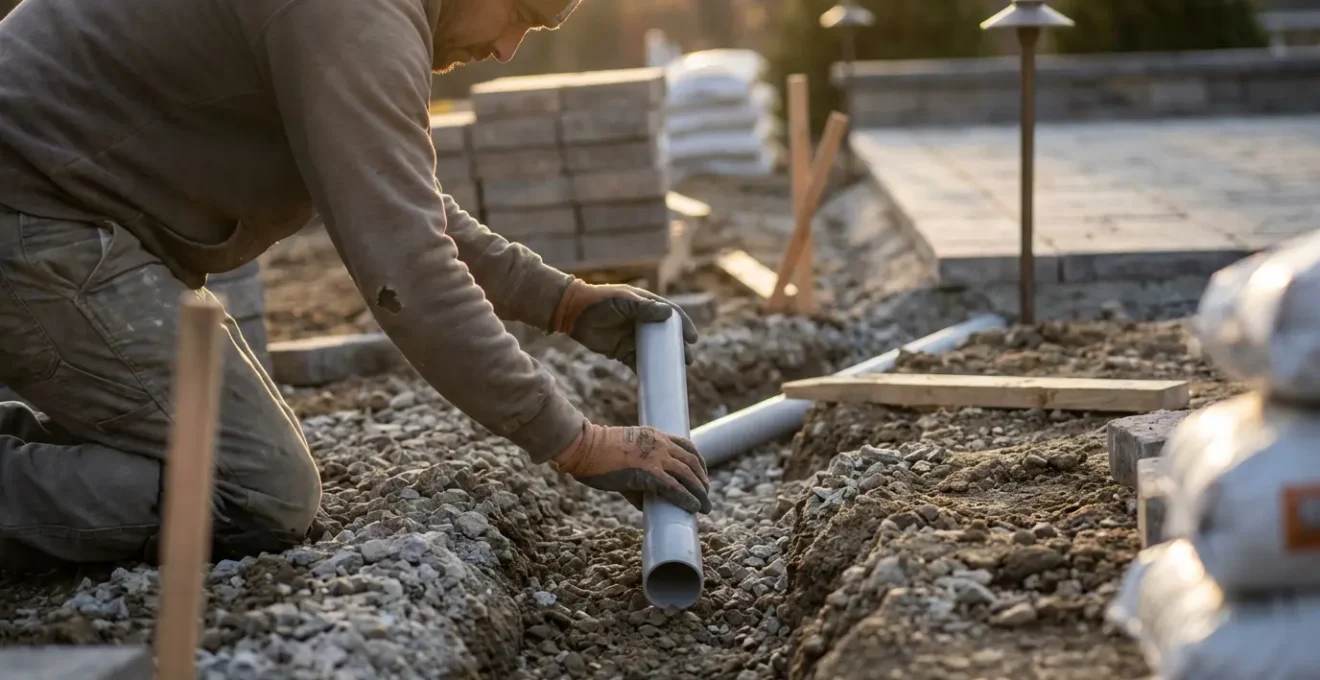
The answer is unequivocal: lighting infrastructure must be planned and installed *before* or *during* the hardscaping process. This involves laying down durable PVC conduit (sleeves) in trenches before any concrete is poured or pavers are set. This forethought allows you to run low-voltage wiring to any point in the landscape with ease, now or in the future. Trying to add lighting after the fact means cutting into expensive new stonework, tunneling under walkways, or running unsightly surface-level wires—all of which are costly, damaging, and produce an inferior result.
This image perfectly captures the foresight required, showing a professional laying conduit before the final hardscape is installed, ensuring a seamless and future-proof system.
Planning for lighting from the start is a hallmark of high-end landscape design. Even if you don’t install the fixtures immediately, spending a few hundred dollars on conduit is a negligible cost that preserves your ability to add a full system later. This strategic sequencing not only saves thousands in potential retrofit costs but also results in a cleaner, more professional installation that maximizes the return on your investment. According to the National Association of Realtors, a well-executed lighting project can add around $2,500 to your home value with an average 59% ROI, an outcome best achieved through proper planning.
Why Your North-Facing Patio Stays Damp and Unused 9 Months a Year?
A north-facing patio is a classic example of a landscape feature that often fails to deliver on its promise. Shielded from direct sunlight for most of the day and year, these spaces can remain perpetually damp, chilly, and prone to moss or mildew. Many homeowners see this as a flaw to be fought, but from a strategic standpoint, the key is not to fight the environment but to rebrand the asset. Instead of a failed “sun deck,” you have a perfect “cool summer retreat.”
The first step is to lean into its natural characteristics. Use light-colored materials for the patio surface and surrounding walls to maximize reflected ambient light. This can make the space feel significantly brighter and more inviting. Incorporating evergreen climbing plants like ivy or certain clematis varieties on a trellis can add year-round greenery without relying on sunlight-hungry flowers. The goal is to create a lush, serene, and intentionally shady oasis.
Next, address the “chilly” factor to extend its usability. Installing a gas fire pit or discreet radiant heaters can transform the space into a cozy evening destination, even in cooler months. This single feature dramatically increases the patio’s functional square footage and perceived value. By focusing on what a north-facing space does well—offering a cool escape from summer heat—and mitigating its primary drawback, you turn a neglected area into a sought-after feature.
Action Plan: Revitalizing a North-Facing Patio
- Rebrand the Space: Market it as a “cool summer retreat” or “serene grotto” rather than a failed sun patio.
- Install a Heat Source: Add a gas fire pit or radiant heaters to make it a go-to spot for both warm and cool months.
- Use Reflective Materials: Choose light-colored pavers or stone to bounce ambient light and brighten the area.
- Add Vertical Greenery: Plant shade-tolerant, evergreen climbing plants on walls or trellises for year-round visual interest.
- Improve Airflow and Light: Trim the lower branches of nearby trees to create a “high canopy,” allowing more low-angle sunlight and air circulation to aid drying.
Why a Flat Lawn Makes Your Property Look Smaller Than It Actually Is?
A vast, perfectly flat lawn is often seen as a desirable landscape feature. However, from a design and appraisal perspective, it’s a missed opportunity. A completely flat expanse provides no visual mystery or depth; the eye sees everything at once, which can paradoxically make the property feel smaller and less interesting. The key to maximizing perceived space and value is to introduce subtle changes in elevation and texture.
Creating gentle, rolling berms (low, mounded hills of earth) is a highly effective technique. These berms do more than just break up the monotony; they create a sense of foreground, mid-ground, and background, forcing the eye to travel through the landscape. This creates an illusion of depth and makes the yard feel larger and more dynamic. Planting shrubs or a small tree on a berm further enhances this effect, adding verticality and a focal point.
Case Study: The Minneapolis Depth Illusion
A home in Minneapolis was visually lost behind overgrown, flat landscaping. The property felt cramped and uninviting. By redesigning the front with a circular driveway and introducing low garden walls to frame the entry and plant beds, the landscape was transformed. These subtle level changes created distinct visual zones, adding depth and drawing the eye towards the home. The property immediately appeared larger, more stately, and had significantly more curb appeal.
Other techniques work in concert with elevation. A meandering path that disappears behind a cluster of shrubs invites curiosity and suggests more space beyond what is immediately visible. Layering plants—with taller species in the back and shorter ones in the front—also builds a sense of depth. Even simply varying ground textures, such as transitioning from a lush lawn to a gravel seating area, helps to define “outdoor rooms” and breaks up a flat plane. These are sophisticated design principles that signal a high-quality, custom landscape to potential buyers.
Key takeaways
- Prioritize appreciating assets like mature trees over depreciating hardscaping for the best long-term ROI.
- Solve functional problems like drainage with beautiful design solutions to add measurable value.
- Strategic sequencing, like installing lighting conduit before patios, is crucial for minimizing costs and maximizing quality.
How to Zone a 50m² Patio for Dining and Lounging Without Crowding?
A patio is no longer just a slab of concrete; it’s an extension of the home’s living space. On a modest 50m² (approx. 540 sq ft) patio, the challenge is to create distinct functional zones for dining and lounging without making the area feel cluttered. The solution lies in creating clear visual and physical boundaries, a technique known as functional zoning. This elevates a simple patio into a multi-purpose outdoor room, significantly boosting its usability and value.
One of the most effective methods is using subtle changes in elevation or material. For example, building a slightly raised wooden deck platform for the lounging area immediately separates it from the stone-paved dining section. This creates two distinct “rooms” without erecting any walls. A change in flooring material—such as an inset of composite decking within a paver patio—can achieve a similar effect with less construction. These physical cues clearly define the purpose of each space.
Overhead elements are another powerful zoning tool. A pergola built over the dining area creates a sense of enclosure and intimacy, defining it as the “dining room.” The lounging area can be left open to the sky or defined with a large outdoor rug and strategic furniture placement. Composite decking is an excellent choice for raised platforms or material insets, as it is a durable material that buyers appreciate. It can last 25 to 30 years at $30 to $50 per square foot, representing a solid long-term investment in the patio’s structure and appeal.
The table below compares different zoning strategies, outlining their relative cost, impact, and ROI potential for a small patio space.
| Zoning Method | Cost per Sq Ft | Visual Impact | ROI Potential |
|---|---|---|---|
| Elevation Changes (Deck Platform) | $30-$50 | High – Creates distinct levels | Strong – adds dimension |
| Material Changes (Stone/Wood) | $25-$50 for pavers | Medium – Subtle definition | Up to 80% ROI |
| Overhead Elements (Pergola) | $40-$60 | High – Defines from above | Excellent for small spaces |
| Furniture Placement Only | $0 (repositioning) | Low – Temporary | Minimal long-term value |
To effectively apply these principles, your next step should be to develop a strategic landscape master plan. Assess your property’s unique assets and liabilities to prioritize the investments that promise the highest, most certain return.