
A truly personal home isn’t built by collecting things you love; it’s orchestrated by first defining a strategic design identity that filters every choice.
- Translate digital inspiration into a physical ‘Reality Box’ of core materials, textures, and finishes.
- Prioritize timeless, quality pieces over fleeting trends to ensure both aesthetic longevity and financial value.
Recommendation: Start by deconstructing your inspiration to find your core sensory signature, not by browsing for more items.
The endless scroll through Pinterest and Instagram promises a world of aesthetic perfection. You save images of sun-drenched minimalist living rooms, moody academic libraries, and vibrant bohemian patios. You love them all. But when you try to translate this digital scrapbook into your own home, the result is often a dissonant chorus of conflicting styles rather than a harmonious symphony. This overwhelming feeling isn’t a failure of taste; it’s a failure of strategy. Most advice encourages you to find inspiration, but falls short of teaching you the crucial next step: how to build a foundational design identity.
The common approach is to buy individual pieces you are drawn to, hoping they will magically coalesce into a cohesive whole. This path almost invariably leads to a home that feels more like a storage unit for disconnected ideas than a true sanctuary. It creates a subtle but persistent layer of visual noise and functional friction. Living in a space that doesn’t reflect the core of who you are can be surprisingly draining. It becomes a place you simply exist in, rather than a place that actively restores and energizes you. The secret isn’t to accumulate more, but to curate with intention.
But what if the key wasn’t about choosing a pre-defined “style” from a quiz, but about creating your own personal design narrative? This guide offers a different perspective. It’s a framework for acting as the creative director of your own life, moving beyond collecting inspiration to building a robust and personal design identity. We will explore how to translate abstract feelings into a concrete material palette, how to discern timeless quality from disposable trends, and how to make choices that not only look good but feel fundamentally right. This is about crafting a home that is an authentic extension of your being.
This article provides a complete framework for this process. We will begin by understanding the psychological impact of your environment, then move to the practical steps of building a material palette, and finally, we will look at specific choices that bring your design identity to life, ensuring every corner of your home tells a coherent story.
Summary: A Strategic Guide to Crafting Your Home’s Cohesive Identity
- Why Living in a Home That Doesn’t Match Your Personality Increases Stress?
- How to Translate Digital Inspiration into a Physical Material Palette?
- Trendy vs Timeless: Which Decor Style Holds Its Value for Resale?
- The “Collector’s Trap” That Turns Personal Identity into visual Chaos
- When to Refresh Your Decor: The 7-Year Cycle of Interior Fatigue?
- Why Sectional Sofas Encourage More Family Interaction Than Separate Sofas?
- Why Dovetail Drawers Last 50 Years Longer Than Glued Joints?
- How to Increase the Utility of Dead Corners to Gain 5m² of Storage?
Why Living in a Home That Doesn’t Match Your Personality Increases Stress?
Your home is more than a container for your life; it is an active participant in your mental and emotional well-being. When the environment around you is in conflict with your internal world—your preferences, your needs, your very personality—it creates a low-grade, chronic state of stress. This isn’t just a feeling; it’s a measurable psychological phenomenon. The constant visual clutter of mismatched items, the discomfort of a chair that looks better than it feels, or lighting that is perpetually too harsh or too dim forces your brain into a state of continuous adaptation. This is your sensory signature being ignored.
This discord can manifest in subtle ways. You might feel a constant, nagging urge to “fix” a room without knowing where to start, or experience a sense of restlessness and an inability to truly relax in your own space. This is because a home that lacks a cohesive identity fails to provide the psychological safety and predictability that our brains crave. According to research from the American Society of Interior Designers, a mismatch between visual appeal and sensory inputs causes measurable discomfort and mental distress. Your home should be the one place where you don’t have to put up a front, where the environment supports you effortlessly.
As place and architecture psychologist Michal Matlon explains, this connection between our surroundings and our mental state is often underestimated. He notes:
While people traditionally think of mental health as working on internal thoughts and feelings, a lot of what shapes how people navigate the day is their exterior world. One of the largest external factors — often overlooked — is the environment in which people exist.
– Michal Matlon, Venetian Letter
Building a home with a clear design identity is an act of self-care. It’s about creating a space that works in harmony with your nervous system, reducing cognitive load and providing a foundation of calm and order. It turns your home from a source of stress into a tool for restoration.
How to Translate Digital Inspiration into a Physical Material Palette?
An overflowing Pinterest board is not a design plan; it is raw, unrefined data. The visionary work begins when you stop collecting images and start deconstructing them to unearth your true design narrative. The goal is to move from a vague feeling of “I like this” to a concrete understanding of the specific elements that resonate with you. This process involves identifying recurring patterns in lighting, line, and scale across your favorite saved images. Are you consistently drawn to bright, airy spaces or dark, moody ones? Do you prefer the clean, straight lines of modernism or the soft curves of organic design?
Once you’ve identified these high-level patterns, the next step is to translate them into a tangible vocabulary of materials. This is where you create your foundational Material Trio: one primary wood or metal, one primary fabric, and one accent texture. For example, your trio might be White Oak, Natural Linen, and Travertine. This simple palette becomes your curatorial filter, a guiding framework that ensures every new item you consider—from a sofa to a picture frame—contributes to a cohesive whole rather than adding to the chaos.
The most critical step, however, is to bridge the gap between the screen and your reality. Digital images are notoriously deceptive, altered by professional lighting and editing. You must create a “Reality Box” by ordering physical samples of your chosen materials. This collection of paint swatches, fabric remnants, wood finishes, and metal hardware is your most important design tool.
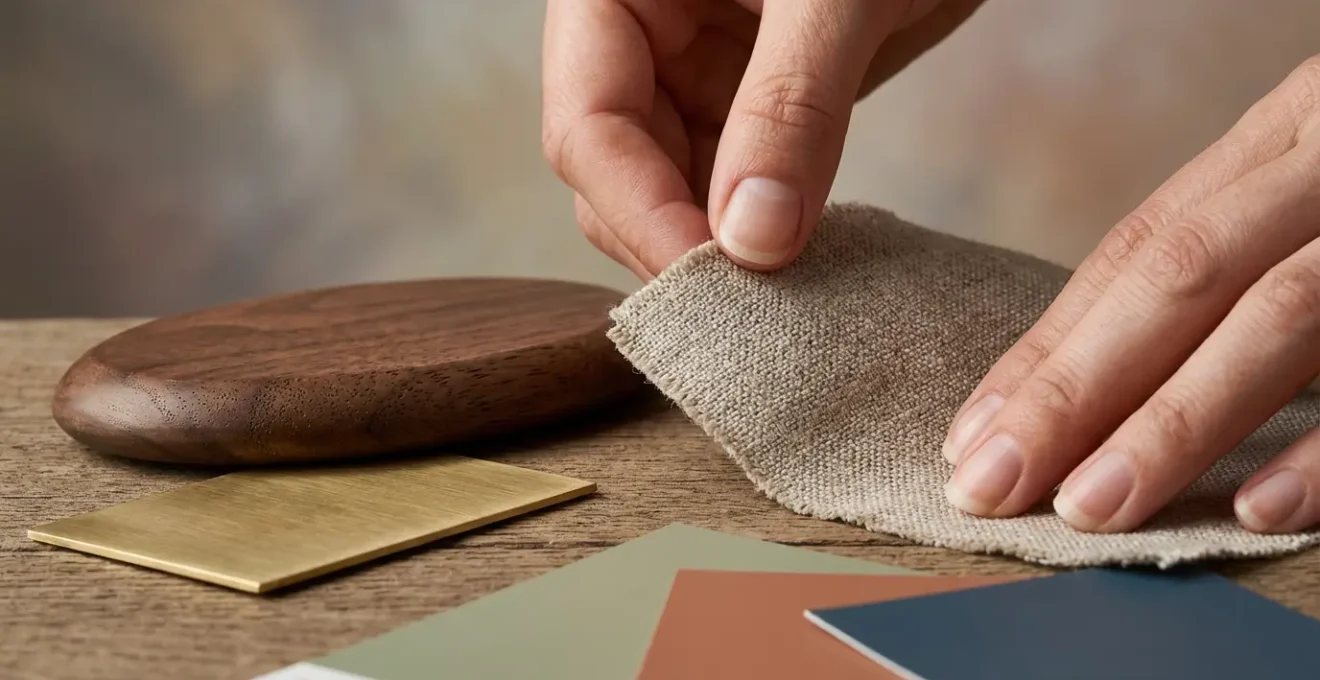
Test your Reality Box in different rooms of your house at various times of day. Observe how the natural light interacts with the textures and colors. A paint chip that looks perfect online may appear completely different under the warm afternoon sun in your living room. This tactile, real-world testing process is non-negotiable. It is the only way to ensure your design identity will translate from a digital dream into a beautiful, physical reality.
Trendy vs Timeless: Which Decor Style Holds Its Value for Resale?
In a world of fast-fashion furniture and rapidly changing micro-trends, it’s easy to get caught up in what’s popular right now. However, building a home’s identity is an investment, both emotionally and financially. With the projected U.S. home decor market value reaching $203.1 billion by 2033, the choices you make have significant economic weight. The distinction between what is trendy and what is timeless is crucial for anyone concerned with long-term value and sustainability.
Trendy items are often defined by specific, easily identifiable motifs that are heavily promoted for a season—think bouclé everything, wavy mirrors, or specific “it” colors. While fun in small doses, building your core decor around these fleeting fashions is a recipe for quick obsolescence. A room that feels perfectly current today can feel dated and undesirable in just a few years, negatively impacting your home’s resale appeal. Potential buyers may be deterred by the prospect of having to immediately renovate a space that is a time capsule of a past trend.
Timeless design, on the other hand, is rooted in quality, proportion, and classic materials that have proven their staying power for decades, if not centuries. This means investing in foundational pieces made of solid hardwood, natural stone, and well-crafted metals. These materials not only last longer but also gain character over time. A home built on a timeless foundation provides a neutral, high-quality canvas that is attractive to a broader range of buyers. It communicates quality and care, which are always in style.
The following table, based on material analysis, illustrates how different materials perform over time in terms of durability and value retention, a key consideration for savvy homeowners.
| Material Type | Average Lifespan | Value Retention | Resale Impact |
|---|---|---|---|
| Solid Hardwood | 50+ years | High (80-90%) | Increases home value |
| Natural Stone | 100+ years | Very High (90-95%) | Premium appeal |
| Solid Brass Fittings | 40+ years | High (75-85%) | Quality indicator |
| Trendy Laminates | 5-10 years | Low (20-30%) | May deter buyers |
| Fast Fashion Textiles | 2-5 years | Very Low (10-20%) | Neutral to negative |
The “Collector’s Trap” That Turns Personal Identity into visual Chaos
One of the most common pitfalls in defining a home’s identity is the “Collector’s Trap.” This happens when the well-intentioned desire to surround yourself with meaningful objects—souvenirs from travels, family heirlooms, art from local makers—results in visual chaos. The problem isn’t the objects themselves, but the lack of a unifying framework to connect them. Each piece tells a story, but without a coherent narrative structure, the stories shout over one another, creating a cacophony instead of a conversation.
The psychology behind this is simple: our environment is a reflection of how we see ourselves. As researchers M.A. Wilson and N.E. Mackenzie found, “People’s interactions with the environment are determined by the meanings they attribute to it.” When every object has a strong, independent meaning but no shared context, the overall meaning of the space becomes muddled and stressful. Instead of a home that tells your story, you have a home that tells hundreds of disconnected micro-stories simultaneously. This is where a strong design identity acts as your curatorial filter.
The solution is not to get rid of your cherished possessions, but to curate them strategically. The “Narrative Thread Curation Method” offers a powerful approach to unifying disparate collections. This involves grouping items by the story they tell or the feeling they evoke, rather than by their type or origin. This method is brilliantly demonstrated in the work of leading design studios.
Case Study: The Narrative Thread Curation Method
Studio McGee, in their recent projects, successfully implemented the ‘Narrative Thread’ approach. In one renovation, a diverse collection of travel souvenirs from Southeast Asia, which could have easily become clutter, were unified through a consistent color palette of deep greens and natural wood tones. They were then displayed using the ‘Anchor, Bridge, Accent’ method: a large piece of art acted as the anchor, a series of smaller objects formed a visual bridge across a console table, and a few metallic pieces served as sparkling accents. This transformed potential chaos into a cohesive and sophisticated design statement that enhanced the room’s identity.
When to Refresh Your Decor: The 7-Year Cycle of Interior Fatigue?
The idea of a “7-year itch” for interior design is a common trope, suggesting a fixed cycle for major home updates. While there’s some truth to the concept of design fatigue, reality is more nuanced. Your home is a living space that should evolve with your life, not according to a rigid calendar. Rather than a single 7-year overhaul, a more strategic and sustainable approach involves a two-tiered system of updates that aligns with both material lifecycles and your personal journey.
Industry data reveals that most U.S. consumers undertake renovation projects every 3-5 years, which points to a preference for more frequent, manageable refreshes rather than massive, infrequent renovations. This aligns perfectly with a strategic approach to maintaining a home’s vitality. The key is to distinguish between foundational elements and accessory layers. Foundational pieces like your sofa, flooring, and major casegoods are long-term investments. Accessories, on the other hand, are the expressive, easily changeable elements that keep a space feeling fresh and current.
Adopting a structured framework allows you to plan for these changes financially and logistically, preventing both design stagnation and impulsive, trend-driven purchases. Consider implementing this strategic cycle:
- Foundational Cycle (7-10 years): This is the time to assess and update major, high-wear items. This includes repainting walls, refinishing floors, or investing in new primary furniture. These choices should be guided by your timeless design identity.
- Accessory Cycle (1-2 years): This is your opportunity for play and personality. Refreshing textiles like throw pillows and rugs, swapping out art, or introducing new decorative objects can dramatically change the feel of a room with minimal investment.
– Life Stage Triggers: The most meaningful refreshes are often prompted by life changes—a new job, a growing family, or children leaving home. These moments are natural opportunities to reassess if your home’s layout and function still serve your current needs. – Budget Allocation: A smart rule of thumb is to allocate 80% of your decor budget to timeless foundational pieces and 20% to more trend-aware accessories.
Why Sectional Sofas Encourage More Family Interaction Than Separate Sofas?
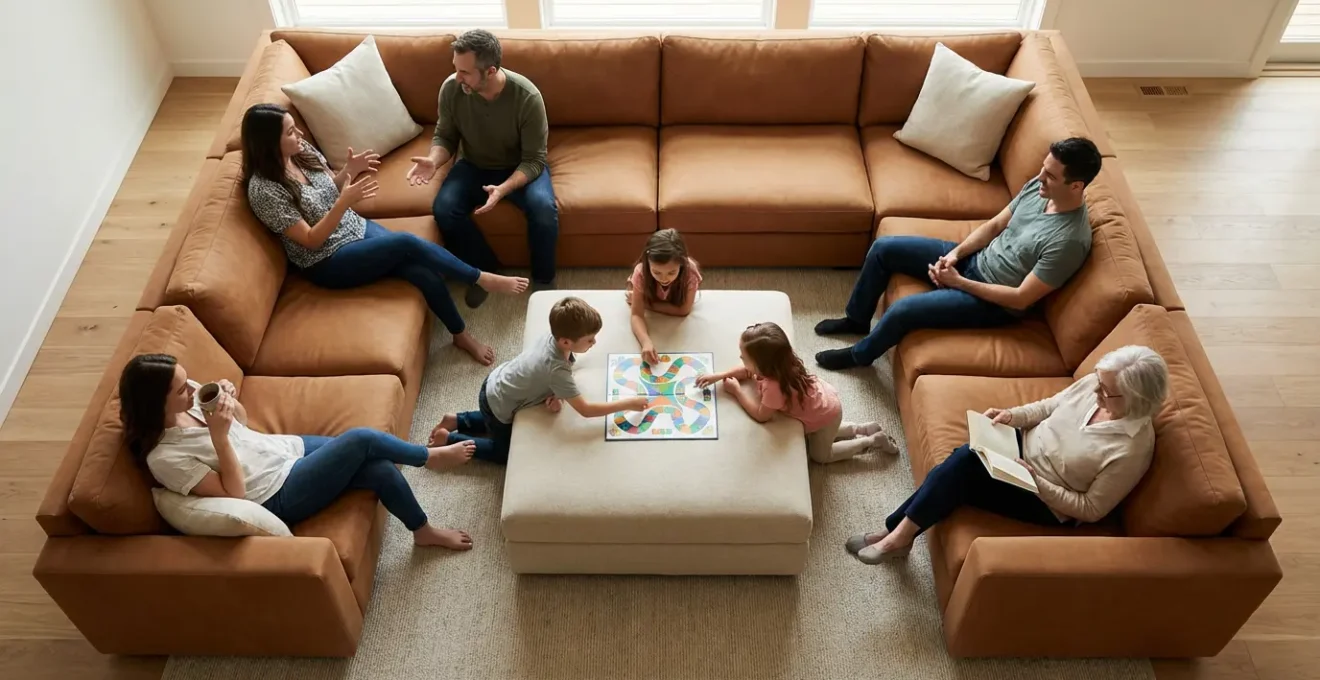
The choice between a sectional sofa and a combination of separate sofas and chairs may seem purely aesthetic, but it has profound implications for how a family interacts within a space. The design of a sectional sofa inherently fosters closeness and shared experience through the principles of proxemics—the study of how people use space. Unlike separate seating, which creates individual “islands,” a sectional creates a single, unified “social territory.”
This unified zone psychologically lowers the barrier to casual physical contact and shared activities. On a sectional, it’s natural for one person to be reading in a corner, another lounging in the middle, and children playing on the floor at their feet, all while remaining part of a single cohesive group. This shared space promotes a sense of togetherness even when individuals are engaged in separate, quiet activities. It allows for simultaneous, connected pursuits in a way that scattered seating arrangements do not.
The layout of the sectional itself plays a role in directing social energy. L-shaped and U-shaped configurations are particularly effective at creating a sense of enclosure and encouraging face-to-face communication, a phenomenon often referred to as the “campfire effect.”
Case Study: The Proxemics of Sectional Seating
A 2026 evaluation of sectional sofas highlighted their powerful social dynamics. It found that U-shaped configurations instinctively draw people’s focus inward, mimicking the ancient human behavior of gathering around a campfire. This layout naturally encourages conversation and group activities. Families participating in the study reported that the single, continuous seating area of a sectional made them feel more connected. It created a designated “family zone” that promoted effortless togetherness, turning the living room into a true hub of interaction rather than just a collection of seats.
Why Dovetail Drawers Last 50 Years Longer Than Glued Joints?
When selecting furniture that embodies a timeless design identity, the invisible details are often more important than the visible ones. The method of joinery—how different pieces of wood are connected—is a primary indicator of a piece’s quality, durability, and longevity. Among the various techniques, the dovetail joint stands as the undisputed hallmark of superior craftsmanship. While a simple glued or stapled joint may look fine on the showroom floor, it is destined to fail under the daily stress of use.
The strength of a dovetail joint lies in its brilliant mechanical design. A series of interlocking “pins” and “tails” are precisely cut to fit into one another, creating a bond that is incredibly resistant to being pulled apart. This interlocking nature means the joint holds itself together even without glue. When adhesive is added, the bond becomes virtually indestructible. In contrast, a simple butt joint relies entirely on the strength of the glue, which will inevitably degrade over time, causing the drawer to wobble and eventually fall apart. As craftsmanship studies show, properly executed dovetail joints can withstand generations of use, often lasting for centuries.
This commitment to quality construction is a core tenet of investing in timeless pieces. It is the difference between buying a disposable item and investing in a future heirloom. While the initial cost may be higher, the lifetime value is exponentially greater. A piece with dovetail joinery will not need to be replaced in 5 or 10 years, making it both a more sustainable and a more economical choice in the long run.
The following comparison breaks down the relative strength and expected lifespan of common woodworking joints, making it clear why traditional methods offer unparalleled durability.
| Joint Type | Tensile Strength | Expected Lifespan | Cost Factor |
|---|---|---|---|
| Dovetail (Hand-cut) | Excellent – Interlocking design | 100+ years | Premium (+40-60%) |
| Mortise & Tenon | Very Good | 50-75 years | High (+30-40%) |
| Dowel Joint | Good with glue | 20-30 years | Moderate (+15-20%) |
| Butt Joint (Glued only) | Poor – Relies solely on adhesive | 5-10 years | Budget (baseline) |
| Stapled Joint | Fair when combined with glue | 10-15 years | Low (+5-10%) |
Key Takeaways
- Your home’s design should be a strategic identity, not a random collection of likes, to reduce stress and improve well-being.
- Translate digital inspiration into a physical ‘Reality Box’ of materials to ensure your vision works in your actual space and light.
- Invest in timeless materials and quality craftsmanship (like dovetail joints) over fleeting trends for better long-term financial and aesthetic value.
How to Increase the Utility of Dead Corners to Gain 5m² of Storage?
In the quest for a home that is both beautiful and functional, every square meter counts. “Dead corners” are one of the most common and frustrating sources of wasted space in any home. These awkward areas often become magnets for clutter or are left completely empty, representing a significant loss of potential. However, with a strategic approach, these forgotten zones can be transformed into some of the most useful and character-filled spots in a room, effectively adding valuable functional space without moving a single wall. This focus on efficiency is increasingly important, as market analysis shows that the rising demand for space-saving solutions is a major driver in the home organization market.
The key to reclaiming these corners is to think vertically and diagonally. Instead of seeing a corner as a two-dimensional problem on the floor, view it as a three-dimensional volume of opportunity extending from floor to ceiling. A simple yet transformative strategy is to install floor-to-ceiling corner shelving, which immediately draws the eye upward and provides an immense amount of storage or display space. Another powerful technique is to break the tyranny of the 90-degree angle by placing a key piece of furniture, like a statement armchair or a small desk, diagonally.
By reimagining these underutilized areas, you not only gain storage but also add depth and interest to your room’s layout. A corner can become a dedicated activity nook—a cozy reading spot, a compact home office, or a stylish bar station. These solutions are not just about cramming more stuff in; they are about making your home work smarter for the life you live, aligning perfectly with a design identity that values both form and function.
Your Action Plan: Auditing Your Home’s Dead Corners
- Identify & Map: Walk through your home and list every unused or underused corner. Note its location and the adjacent room’s primary function.
- Assess Potential: For each corner, determine its primary potential. Is it best for storage (e.g., in a kitchen), seating (in a living room), or a workspace (in a quiet area)?
- Measure & Constrain: Take precise measurements (width, depth, and vertical height). Note any constraints like windows, outlets, or traffic flow patterns.
- Match Solution to Need: Based on your assessment, match a specific solution to each corner (e.g., floating shelves for display, a corner bench for seating and storage, a diagonal chair for a reading nook).
- Plan Integration: Create a simple sketch or plan for how the new corner solution will integrate with the existing furniture and flow of the room, ensuring it enhances the overall design identity.
Now that you have the complete framework, from psychological foundations to practical applications, the next step is to begin the process. Start not by shopping, but by thinking. Define your narrative, build your Reality Box, and commit to a curated, intentional approach. Your home is the most important canvas you have; it’s time to create your masterpiece.