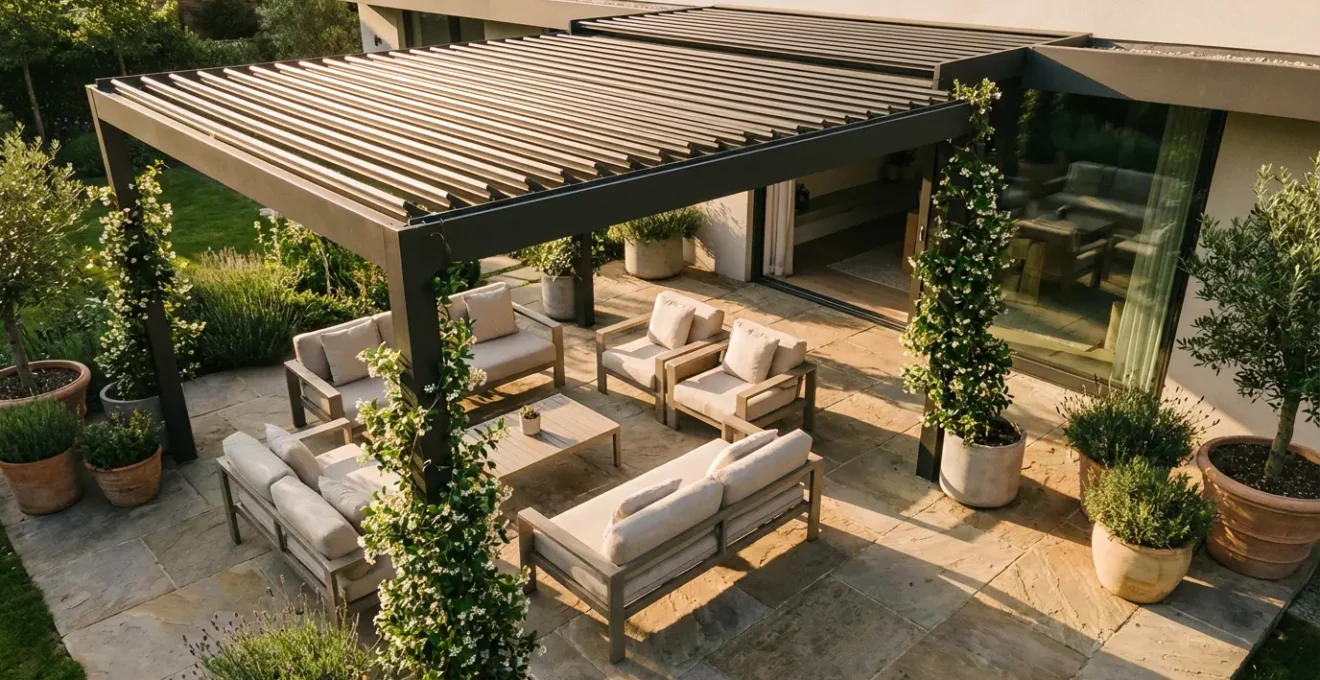
The common approach of adding umbrellas or fixed awnings to a south-facing garden is a strategic failure; it trades a clear view for inadequate, unreliable protection.
- Effective shade is not an add-on, but an engineered system that masters sun paths, wind dynamics, and thermal comfort.
- Dynamic solutions like louvered pergolas offer superior protection and adaptability, justifying their cost through dramatically increased usability and property value.
Recommendation: Stop thinking about “adding shade.” Start engineering a versatile outdoor living space by analyzing your garden’s specific needs before choosing any structure.
Owning a south-facing garden is a double-edged sword. You are blessed with abundant sunlight, perfect for vibrant flowerbeds and long, sun-drenched afternoons. Yet, this constant exposure can quickly turn your idyllic retreat into an unusable heat island, with intense midday sun making relaxation impossible and posing a significant health risk. The conventional response is often reactive and clumsy: a flimsy parasol that takes flight with the first gust of wind, or a fixed awning that plunges your adjacent indoor rooms into perpetual gloom while obstructing the very landscape you cherish.
This approach is fundamentally flawed. It treats shade as a decorative afterthought rather than a critical component of your home’s functional design. Most advice focuses on generic lists of options—pergolas, sails, trees—without addressing the non-negotiable requirements of a discerning homeowner: uncompromising effectiveness, structural resilience, and the preservation of an open, panoramic view. The crucial questions are not about which structure to buy, but how that structure will perform under pressure.
But what if the solution wasn’t about simply blocking the sun, but about strategically manipulating light and air? This guide adopts an uncompromising, specialist perspective. We will move beyond superficial suggestions to explore the physics of effective solar protection. The true key lies not in obstructing your view with a static barrier, but in engineering a dynamic, responsive comfort zone. It’s about mastering the sun’s path, understanding aerodynamic stability, and calculating the long-term value of a truly adaptable system.
We will deconstruct this process, from the non-negotiable health imperatives to the precise calculations that justify a premium investment. This is not a catalog of ideas; it is a strategic blueprint for reclaiming your south-facing garden without compromise.
This article provides a detailed roadmap for making an informed, strategic decision. Follow along as we break down each critical stage, from initial analysis to final investment justification, to help you design the perfect shade solution.
Summary: A Strategic Guide to Shading South-Facing Gardens
- Why 15 Minutes of Midday Sun in Your Garden Can Cause Long-Term Skin Damage?
- How to Track Shadows in Your Garden to Pinpoint the Perfect Lounge Spot?
- Shade Sails vs Cantilever Umbrellas: Which Handles Sudden Wind Gusts Better?
- The Over-Shading Error That Kills Your Prize-Winning Rose Bushes
- How to Lower the Temperature in Your Shade Zone by 5°C Using Misting Systems?
- How to Angle Louvers to Create a Cooling Venturi Effect on Hot Days?
- How to Angle Remote Solar Panels to Capture Low Winter Sun?
- How to Justify the Cost of a Motorized Pergola Compared to a Fixed Roof?
Why 15 Minutes of Midday Sun in Your Garden Can Cause Long-Term Skin Damage?
The desire for shade is not merely about comfort; it is a critical health imperative. The relentless sun in a south-facing garden exposes you to peak levels of ultraviolet (UV) radiation, particularly between 10 a.m. and 4 p.m. This is not a trivial matter. Just 15 minutes of unprotected exposure to this intense sun can be enough to cause DNA damage to skin cells, damage that accumulates over time and significantly increases the risk of skin cancer. The statistics are a stark reminder of the stakes: globally, excessive UV exposure is responsible for an estimated 1.2 million new non-melanoma skin cancers and 325,000 cases of malignant melanoma each year.
Many homeowners believe that sitting under a basic umbrella or a leafy tree provides adequate protection. This is a dangerous misconception. As the World Health Organization explicitly warns, these common solutions are not a complete defense. As they state in their guidance on sun protection:
Shade structures such as trees, umbrellas or canopies do not offer complete UV protection.
– World Health Organization, Radiation: Protecting against skin cancer
Factors like the angle of the sun, reflection from surfaces like patios and water, and the weave of a fabric all determine the actual level of UV radiation reaching your skin. A standard garden parasol may only offer a Sun Protection Factor (SPF) of 7, which is grossly insufficient. Effective solar protection, therefore, must be engineered to provide a high UV protection rating (UPF 50+ is the standard for high-quality fabrics), creating a sanctuary that is genuinely safe, not just seemingly shaded.
How to Track Shadows in Your Garden to Pinpoint the Perfect Lounge Spot?
Before investing in any shade structure, the first strategic step is to conduct a thorough audit of your garden’s solar dynamics. Purchasing a solution without understanding precisely where and when you need shade is like navigating without a map—inefficient and destined for failure. The goal is to perform what we call shadow engineering: a methodical process of tracking the sun’s path across your property to identify the optimal zones for creating shade. This ensures your investment serves its purpose exactly where it’s needed most, without casting unwanted shadows on sun-loving plants or plunging your home’s interior into darkness.
This process reveals the “heat maps” and “cool zones” of your garden throughout the day and across seasons. It allows you to pinpoint the perfect spot for a morning coffee, a sheltered lunch, or an evening lounge area, all while preserving the view. This foundational analysis is the most critical step in designing a functional and integrated outdoor space.
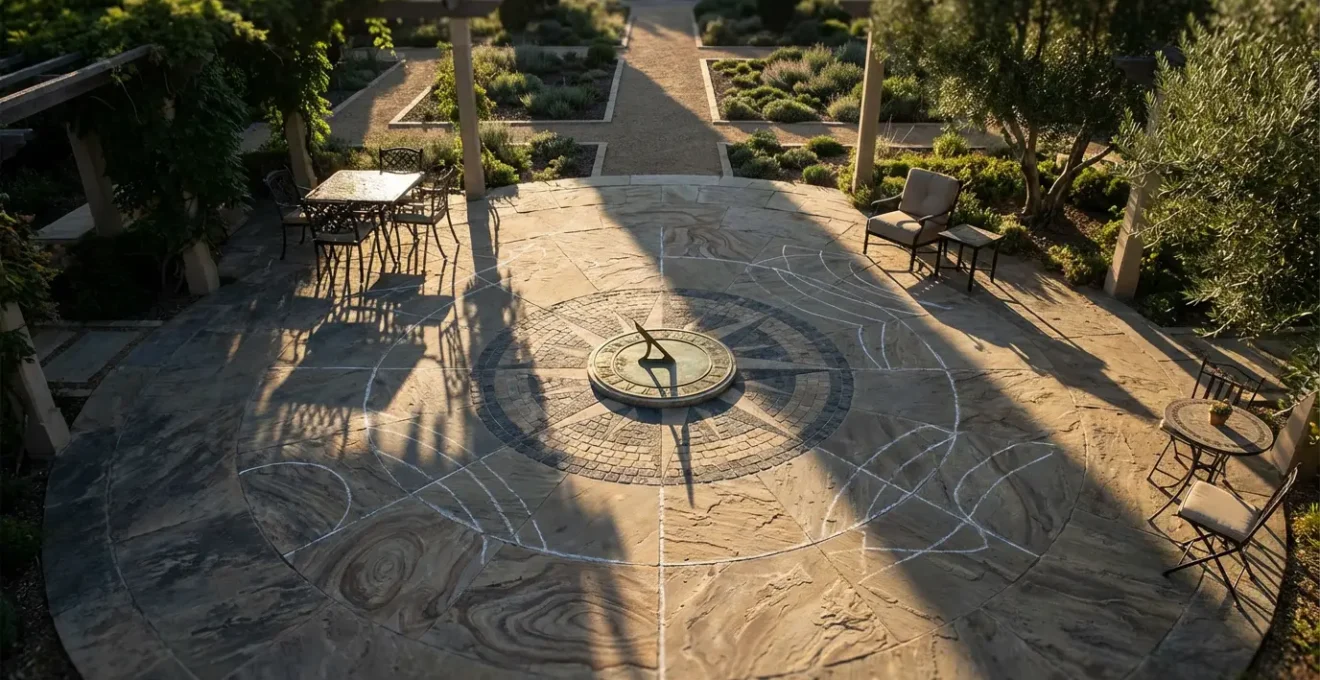
The visual above illustrates how different areas receive varying degrees of light. By mapping these patterns, you can make an informed decision, placing permanent or dynamic shade structures with surgical precision. This avoids the common error of placing a large, fixed structure in a location that only requires shade for two hours a day. The following checklist provides a simple yet effective method for conducting your own shadow audit.
Your Action Plan for Strategic Shadow Engineering
- Select Audit Day: Choose a clear, sunny day to ensure shadows are sharp and well-defined for your audit.
- Sketch the Layout: Create a simple map of your garden, noting key elements like your house, existing trees, patios, and main open areas.
- Mark Shadow Positions: At four key times—9 AM, 12 PM (midday), 3 PM, and 6 PM—go outside and mark the exact edges of the shadows cast by all objects on your sketch.
- Analyze Shadow Dynamics: Note how shadows are longest in the morning and evening (when the sun is low) and shortest at midday. This identifies the areas of most intense, prolonged sun exposure.
- Identify Prime Zones: Use your map to pinpoint the areas that are consistently overexposed, especially during the hours you most want to use the garden. These are your priority targets for a shade solution.
Shade Sails vs Cantilever Umbrellas: Which Handles Sudden Wind Gusts Better?
Once you’ve identified your target shade zone, the next decision is structural. For homeowners who refuse to compromise on their view, two popular solutions are shade sails and cantilever umbrellas. However, their performance in windy conditions—a critical factor in open, south-facing gardens—is drastically different. A cantilever umbrella, despite its convenience, presents a large, solid surface to the wind. This creates significant lift, acting like a sail on a boat and placing immense strain on its single anchor point. In a sudden gust, it can become unstable or even dangerous.
Shade sails, when professionally installed, offer superior aerodynamic stability. The key is their design and anchoring. A high-quality shade sail is not a flat sheet of fabric; it is installed with a hyperbolic paraboloid or “hypar” twist. This curved, tensioned shape is not just for aesthetics; it allows the sail to slice through the wind and deflect gusts rather than catching them like a wall. Furthermore, its stability is distributed across multiple, robust anchor points fixed to permanent structures or deeply set posts, making it far more resilient than a single, weighted base.
The choice of material also plays a crucial role. While cantilever umbrellas typically use solid canopies, shade sails are often made from a permeable, high-density polyethylene (HDPE) mesh. This fabric allows hot air to escape upwards and lets some breeze pass through, further reducing wind load while still blocking up to 90% of harmful UV rays. The following table breaks down the key differences in wind management.
| Feature | Shade Sails | Cantilever Umbrellas |
|---|---|---|
| Wind Resistance | High (hypar curved shape deflects wind) | Moderate (acts as solid wall, creates lift) |
| Anchoring System | Multiple fixed points, chemical anchors | Single weighted base (typically 100+ lbs) |
| Permeability Option | Yes – mesh fabrics allow 90% UV protection | Limited – mostly solid canopies |
| Flexibility | Fixed installation | Adjustable position and angle |
| Typical Coverage | Large areas (triangular/square) | Circular zones, rotatable |
Ultimately, for a permanent, large-scale, and wind-safe solution that preserves an open feel, a professionally installed shade sail is structurally superior. An analysis of wind resistance confirms that tensioned, curved structures are inherently more stable in dynamic weather conditions than top-heavy, single-post designs.
The Over-Shading Error That Kills Your Prize-Winning Rose Bushes
In the pursuit of human comfort, a common and devastating error is committed: over-shading. Placing a large, opaque, and permanent shade structure can create a light-deficit zone that is catastrophic for sun-loving plants. Prize-winning roses, vibrant lavender, and most fruit-bearing plants depend on at least six hours of direct daily sunlight for photosynthesis. Deprive them of this, and you will see weak growth, a lack of flowers, and increased susceptibility to pests and diseases. A fixed roof or a densely woven, dark-colored shade sail installed in the wrong place can effectively sentence your most cherished plants to a slow decline.
The strategic solution is not to eliminate shade, but to implement *dynamic* shade. This means choosing systems that can be adjusted or retracted based on the time of day and the season. The goal is to provide targeted shade for human activity areas while allowing full sun to reach plant beds when needed. This is where modern technology offers an uncompromising advantage over static solutions like planting a fast-growing but ultimately uncontrollable tree.
Instead of a one-size-fits-all approach, consider a zoned and adaptable system. This allows you to create a microclimate that serves both your comfort and your garden’s health. Here are several ways to achieve plant-friendly dynamic shade:
- Louvered Pergolas: These are the ultimate in dynamic shade. The louvers can be angled to block the harsh midday sun but opened in the morning and late afternoon to let light reach plants.
- Retractable Awnings or Sails: Position these systems to cover patios or decks for peak-sun hours, but retract them to expose garden beds to the morning or evening sun.
- Deciduous Climbers: Use climbing plants like wisteria or grapevines on a pergola. They provide dense shade in summer but lose their leaves in winter, allowing precious low sun to reach your house and garden.
- Zoned Systems: Rather than one massive structure, consider using multiple smaller, adjustable solutions to create different shade levels in different parts of the garden.
By thinking dynamically, you transform shade from a potential problem into a versatile tool for garden management, ensuring both you and your plants can thrive.
How to Lower the Temperature in Your Shade Zone by 5°C Using Misting Systems?
Creating shade is the first step. Engineering true comfort is the next. On the most scorching days in a south-facing garden, even a shaded area can feel oppressive due to high ambient temperatures. To achieve a significant drop in temperature, you must move beyond passive shading and into active cooling. The most effective method for this is a high-pressure misting system integrated into your shade structure. This technology creates a tangible thermal downdraft, capable of lowering the perceived temperature in your shade zone by as much as 5-10°C.
This is not the same as the low-pressure garden hose misters that leave surfaces damp and humid. A professional system uses a high-pressure pump to atomize water into micro-droplets. These droplets are so fine that they “flash evaporate” the instant they hit the hot, dry air. This process of evaporation draws thermal energy from the surrounding atmosphere, actively cooling the air without making you or your furniture wet. To be effective, this requires a specific level of engineering; experts confirm that professional misting systems require 750-1000 PSI pressure to create the fine atomization necessary for flash evaporation.
Integrating these systems into a pergola or along the edge of an awning is the ideal application. The structure provides the shaded containment area, while the misters create a curtain of cool air that significantly enhances comfort, turning an otherwise sweltering patio into a refreshing oasis.
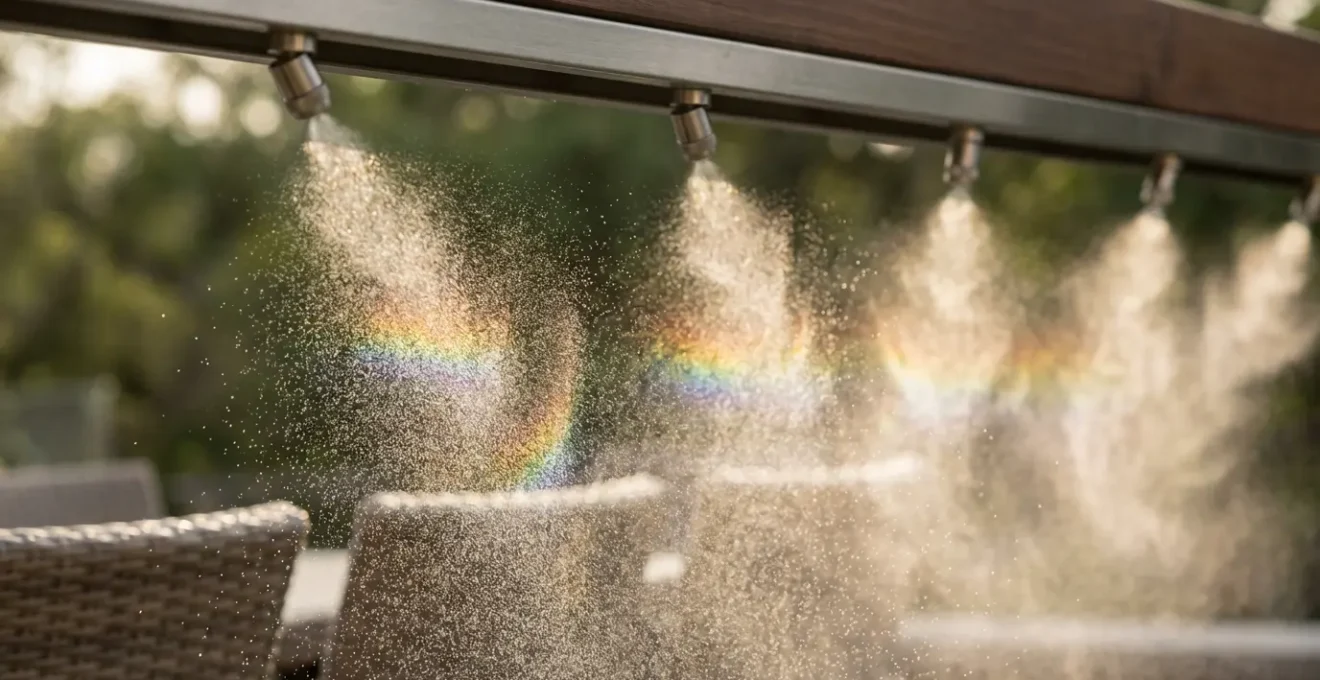
As shown, the nozzles can be discretely installed along the beams of a pergola, becoming a nearly invisible feature that delivers a powerful cooling effect. This combination of shade and active cooling is the hallmark of a truly luxurious and functional outdoor space, allowing you to enjoy your garden even on the hottest summer days. It’s an investment in usability, extending the hours and days you can comfortably spend outdoors.
How to Angle Louvers to Create a Cooling Venturi Effect on Hot Days?
A motorized louvered pergola offers a level of environmental control that static structures cannot match. Its true strategic value lies not just in its ability to open and close, but in the precise angling of its louvers. On a hot, still day, a closed roof can trap heat. However, by angling the louvers correctly, you can create a cooling airflow through a principle known as the Venturi effect. This phenomenon occurs when air is forced to pass through a constricted opening, causing it to accelerate and its pressure to drop, which creates a cooling sensation.
To achieve this, you don’t fully close the louvers. Instead, you angle them to be almost vertical, creating narrow gaps between each blade while still blocking the high-angle sun. As hot air rises from your patio, it is drawn up and channeled through these gaps at an increased speed. This continuous airflow prevents the space from becoming a stagnant “greenhouse” and provides a gentle, consistent breeze, even on a day with little wind. This is a far more sophisticated approach than simply providing a block of shade.
This ability to “play with light and shade” is what defines a modern outdoor living space. It’s about having an open-air alfresco feel one moment and a sheltered, ventilated refuge the next. The key is maintaining airflow even when seeking shelter from the sun. An advanced louvered system is designed with this in mind, ensuring that even when the roof is “closed” for shade, small gaps can be maintained to ensure the space remains cool and comfortable, not stuffy. This micro-management of light and air is what elevates a simple patio cover into a high-performance, all-weather living area.
This level of control allows you to react to changing weather in real-time. A sudden downpour? Close the louvers completely for a watertight seal. Sun getting too intense? Angle them for maximum shade and ventilation. The sun has passed? Open them fully to enjoy the open sky. This adaptability is the core of its value.
How to Angle Remote Solar Panels to Capture Low Winter Sun?
Motorized pergolas, misting systems, and integrated lighting all require power. Running unsightly cables across your lawn or patio completely undermines the clean aesthetic you’re trying to achieve. The most elegant and sustainable solution is to power these systems with solar panels. However, placing a bulky solar panel directly on top of your sleek pergola roof is an aesthetic compromise. The strategic approach is to mount the panels remotely, on a less conspicuous structure like a shed roof or a discreet frame at the garden’s edge.
This remote placement requires a crucial calculation: the panel’s tilt angle. To maximize year-round energy generation, especially during the winter when the sun is low in the sky, the angle must be optimized. A panel lying flat will be inefficient in winter. The optimal angle is not a guess; it is a function of your geographic latitude. For winter, when solar power is most scarce, the tilt needs to be steeper to catch the low-hanging sun.
While a general rule is to add 15° to your latitude, a more precise formula provides superior results. According to solar energy experts, the precise formula for calculating winter solar panel tilt is Latitude × 0.9 + 29°. For a location at 51° latitude (like London), this would mean an optimal winter angle of approximately 75° (51 * 0.9 + 29 = 74.9°). Adjusting the angle seasonally ensures you are capturing the maximum available energy. Here is a simple guide:
- Winter (December to February): Your steepest angle. Use the formula: (Latitude * 0.9) + 29°.
- Summer (June to August): Your shallowest angle. Use the formula: (Latitude * 0.9) – 23.5°.
- Spring/Autumn: A balanced angle. A simple and effective setting is Latitude minus 2.5°.
By using an adjustable mounting bracket and making these small seasonal changes, you ensure your outdoor living systems remain powered efficiently and self-sufficiently, all without compromising on the clean lines and open views of your garden design.
Key Takeaways
- Strategy First: Never buy a shade structure before mapping your garden’s specific sun and shadow patterns. Shadow engineering is non-negotiable.
- Performance Over Appearance: For windy areas, the aerodynamic stability of a tensioned shade sail or a robust louvered pergola far outweighs the convenience of a cantilever umbrella.
- Dynamic is Superior: Static shade kills sun-loving plants and can make your home darker. Choose adjustable solutions like louvered or retractable systems to balance human comfort and garden health.
How to Justify the Cost of a Motorized Pergola Compared to a Fixed Roof?
The initial investment for a motorized louvered pergola is undeniably higher than that of a simple fixed roof or a manual shade sail. This often leads to a moment of hesitation. However, framing the decision solely on upfront cost is a strategic mistake. The correct way to evaluate this is through an investment justification matrix, comparing not just the price, but the total value delivered over the lifespan of the structure. A fixed roof offers a single, static function. A motorized pergola provides a dynamic, all-weather living space that fundamentally changes how you use your property.
The primary justification is a dramatic increase in usable hours. A fixed roof makes the patio underneath it too dark and cold to be enjoyable in winter, and it can block precious natural light from entering your home. A motorized pergola, with its louvers open, allows full winter sun to warm both your patio and your interior rooms, reducing heating and lighting costs. In summer, it provides adaptable shade and rain protection, making the space usable in conditions where you would otherwise be forced indoors. This can add hundreds of hours of functional outdoor living to your year.
Furthermore, the impact on property value is different. A standard fixed roof is a basic addition. A high-quality motorized pergola is a “wow factor” feature that signals luxury, modern design, and enhanced lifestyle potential. It creates a premium appeal that can command a higher resale value. The following table provides a clear value analysis, moving the conversation from “cost” to “return on investment.”
| Factor | Motorized Pergola | Fixed Roof |
|---|---|---|
| Usable Hours/Year | Adds hundreds of hours | Limited in winter (too dark/cold) |
| Weather Adaptability | Adjustable for rain/sun/wind | Single configuration only |
| Property Value Impact | ‘Wow factor’ premium appeal | Standard value addition |
| Winter Light Access | Maintains natural light indoors | Creates light deficit, increases electricity use |
| Maintenance | Aluminum: minimal upkeep | Depends on material |
When you factor in adaptability, year-round usability, energy savings, and premium aesthetic appeal, the higher initial cost of a motorized system is not just justifiable; it is a logical investment in your property and your lifestyle. A recent analysis of motorized pergola value clearly concludes that when usability and aesthetics are prioritized, adaptable systems provide superior long-term returns.
To translate these principles into a concrete plan, evaluating a tailored solution for your specific landscape is the next logical step. Assessing factors like wind load, foundation requirements, and optimal placement is essential for a successful, long-lasting installation.