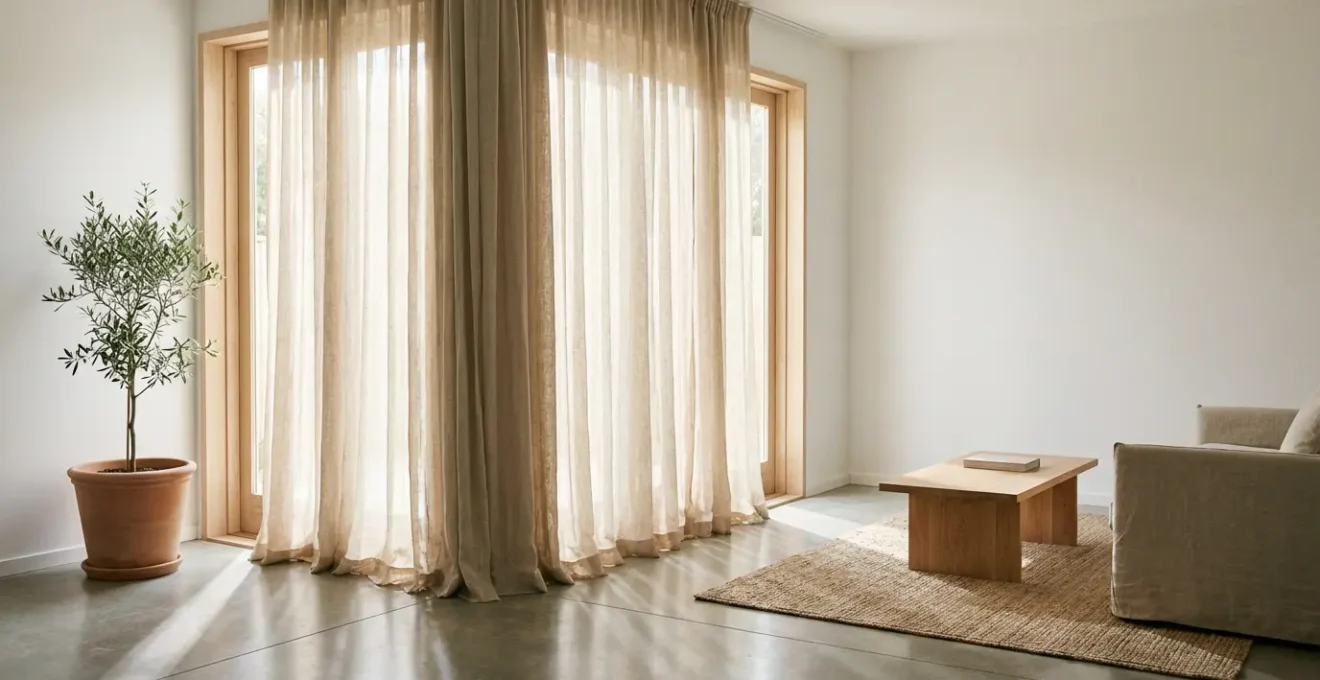
The solution to the privacy-versus-light dilemma isn’t about choosing one or the other, but engineering a system that transforms harsh daylight into a soft, private glow.
- The fabric’s weave density (GSM), not just its color, dictates the level of light diffusion and privacy.
- Mounting the curtain rod high and wide creates a “light funnel” effect, maximizing daylight when curtains are open and providing full coverage when closed.
Recommendation: Think beyond the fabric and design a complete window treatment system—combining the right linen, hardware, and mounting strategy—for a professional and functional result.
For homeowners in ground-floor apartments, the daily dilemma is all too familiar: open the curtains for that much-needed sunlight and feel exposed, or close them for privacy and plunge the room into darkness. The common advice—to simply use sheer curtains—often fails at night, offering little more than a suggestion of seclusion. Many believe the only real solution is to layer heavy, light-blocking drapes, sacrificing the very brightness they crave. This binary choice between a fishbowl existence and a cave-like atmosphere is a constant source of frustration.
But what if the answer wasn’t about blocking light, but about mastering its diffusion? The true secret to achieving a space that is both private and luminous lies not in a single curtain, but in a strategic approach to the entire window. It’s a system that considers fabric texture, weave density, mounting height, and intelligent layering. This perspective transforms a simple window covering into a tool for atmospheric engineering, allowing you to sculpt light, control temperature, and even improve acoustics.
This guide will deconstruct that system. We will explore how linen’s natural properties can be leveraged for more than just aesthetics, from its surprising cooling efficiency to its ability to protect your furniture from sun damage. We will move beyond generic advice to provide the specific measurements, mounting techniques, and care instructions that specialists use to create spaces that feel both open and intimately secure.
This article breaks down the essential elements for creating the perfect balance of light and privacy. Explore the topics below to master every aspect of your window treatment system, from function and form to long-term care and unexpected benefits.
Summary: How to Choose Linen Curtains That Offer Privacy Without Blocking Daylight?
- Why Linen Curtains Keep Rooms Cooler in Summer Than Synthetics?
- How to Measure Curtain Width for That Perfect “Puddled” Look?
- Blackout Lined vs Unlined: Which Is Better for a North-Facing Bedroom?
- The Washing Mistake That Shrinks Linen Curtains by 10% Instantly
- Where to Mount the Rod: Ceiling or Frame Height for Maximum Drama?
- The Invisible Ray That Fades Your Sofa Fabric in 6 Months
- How to Lower Your HVAC Load by 25% With Strategic Thermal Blinds?
- How to Eliminate Echo in Open-Plan Homes Using Decorative Acoustic Panels?
Why Linen Curtains Keep Rooms Cooler in Summer Than Synthetics?
While often chosen for its airy, relaxed aesthetic, linen possesses a remarkable functional advantage over synthetic fabrics like polyester: its natural ability to regulate temperature. The unique cellular structure of the flax fiber from which linen is made allows it to be highly breathable. This breathability prevents heat from getting trapped between the curtain and the window, a common issue with non-porous synthetic materials that act like a plastic barrier, radiating heat back into the room.
Furthermore, linen is naturally hygroscopic, meaning it can absorb a significant amount of moisture—up to 20% of its own weight—without feeling damp. In humid summer conditions, it wicks moisture away from the window area, contributing to a cooler, less stuffy indoor environment. When paired with light colors like white, ivory, or natural beige, linen curtains reflect a high percentage of solar radiation away from the window. This combination of breathability, moisture management, and reflectivity makes it a powerful tool for passive cooling. In fact, studies show that effective window treatments can have a significant impact on home energy use, with one residential study confirming a potential 25-35% reduction in air conditioning runtime.
To maximize this cooling effect, consider these strategic choices:
- Color: Choose light-colored linen (white, ivory, beige) to reflect up to 70% of the sun’s heat.
- Weave Density: Select a weave density between 120-280 GSM (grams per square meter) based on your climate; a slightly denser weave offers more thermal protection without sacrificing breathability.
- Installation: Mount curtains 6-12 inches above and beyond the window frame for an insulating seal around the edges.
- Layering: For extreme heat, layer sheer linen with a separate thermal backing for an additional heat reduction of up to 28%.
- Usage: Keep curtains closed during peak sun hours (typically 10 a.m. to 4 p.m.) on south and west-facing windows to block the most intense solar gain.
By implementing these strategies, your linen curtains transition from a purely decorative element to an active part of your home’s climate control system, reducing energy costs while enhancing comfort.
How to Measure Curtain Width for That Perfect “Puddled” Look?
Achieving a high-end, designer look with curtains isn’t just about the fabric; it’s about mastering the proportions. The two key measurements that separate an amateur installation from a professional one are fullness and puddle. Fullness refers to how much fabric is gathered across the curtain rod, creating luxurious folds even when the curtains are closed. A common mistake is buying panels that only match the window’s width, resulting in a flat, sheet-like appearance.
The correct fullness ratio depends on the weight and transparency of your linen. Sheer, lightweight linens look best with a generous fullness of 2.5 to 3 times the rod width, creating an ethereal, billowy effect. In contrast, heavy, opaque linens require less fabric—a 1.5 times ratio is often sufficient—to create structured, formal pleats. A medium-weight linen, the most common choice for balancing privacy and light, typically calls for a 2x fullness ratio.
The “puddle” refers to the extra length that allows the curtain to pool elegantly on the floor. Interior designers use three main styles: a subtle “trouser break” adds just one inch of extra length for a tailored look, while a dramatic puddle break can add 2 to 6 inches of fabric that pools on the floor. This technique works especially well with heavier linens that hold their shape. To calculate the final length, measure from the bottom of the curtain ring to the floor, then add your desired puddle amount. This intentional excess of fabric adds a sense of luxury and softness to a room.
This table provides a clear guide for choosing the right fullness based on your specific linen fabric, ensuring a perfect drape every time.
| Linen Weight | Recommended Fullness | Panel Width Calculation | Visual Effect |
|---|---|---|---|
| Sheer/Light (120-150 GSM) | 2.5x-3x | Rod width × 3 | Airy, ethereal drape |
| Medium Weight (200-250 GSM) | 2x | Rod width × 2 | Classic, balanced fullness |
| Heavy Weight (280+ GSM) | 1.5x | Rod width × 1.5 | Structured, minimal gathering |
By combining the right fullness with a deliberate puddle, you transform your curtains from simple window coverings into a defining architectural feature of the room.
Blackout Lined vs Unlined: Which Is Better for a North-Facing Bedroom?
The choice between lined and unlined linen curtains becomes particularly nuanced in a north-facing bedroom. These rooms receive no direct sunlight, only soft, ambient light throughout the day. While this light is beautiful, it’s also less intense, making the preservation of every bit of it a top priority. This is where the standard advice to use blackout curtains for bedrooms can be counterproductive. A full blackout lining, while excellent for sleep, can make a north-facing room feel dark and cave-like during waking hours, even when the curtains are open, as the opaque material blocks light from the sides.
For this specific scenario, the most sophisticated solution is neither a simple unlined sheer nor a heavy blackout curtain, but a dual-layered system. This approach provides the best of both worlds: light during the day and darkness at night. The ideal setup involves a double curtain rod. On the front rod (closest to the room), you hang beautiful, unlined sheer linen curtains. These can remain closed during the day, offering “textural privacy”—obscuring direct views from the outside while diffusing the precious ambient light to create a soft, luminous glow throughout the room.
On the back rod (closest to the window), you hang a set of functional blackout or heavy thermal curtains. These remain hidden and stacked to the sides during the day, completely out of sight. At night, they can be drawn closed behind the linen sheers for complete darkness and added insulation. This “day and night” system is the ultimate tool for light modulation, giving you precise control over your environment.
Here is how to properly install a dual-rod system for maximum function and style:
- Install the Hardware: Mount a double curtain rod bracket, ensuring the back rod sits 2-3 inches behind the front rod to allow for easy movement of both layers.
- Hang the Layers: Place your sheer unlined linen curtains on the front rod for daytime elegance and light filtering.
- Add the Functional Layer: Hang your blackout or thermal curtains on the back rod for nighttime privacy and light-blocking.
- Ensure Easy Adjustment: Use clip rings on both sets of curtains to allow them to glide independently along the rods.
- Create Visual Depth: Consider choosing contrasting textures, such as a smooth sheer linen with a more textured blackout panel, to add richness.
This layered approach respects the unique quality of light in a north-facing room, enhancing its natural brightness while providing the absolute privacy and darkness required for restful sleep.
The Washing Mistake That Shrinks Linen Curtains by 10% Instantly
Linen is a natural fiber renowned for its durability, but it has one notorious characteristic: its tendency to shrink when not handled correctly. The single biggest mistake homeowners make is washing their linen curtains in hot water or putting them in a high-heat tumble dryer. This thermal shock can cause the flax fibers to contract suddenly, resulting in shrinkage of up to 10% or more in a single wash. For floor-length drapes, this can mean losing several inches in length, completely ruining the intended “puddled” or “floor-kissing” effect.
To avoid this costly error, always check if your curtains are labeled as “pre-shrunk” or “pre-washed.” High-quality manufacturers often perform this step, and as a result, these pre-washed linen curtains show less than 3% shrinkage when cared for properly. If your curtains are not pre-shrunk, it’s crucial to treat them with care. The golden rule is to always use cold water (maximum 40°C/104°F) on a gentle cycle. Use a mild detergent free of optical brighteners, which can alter the fabric’s natural color over time.
The drying process is equally critical. Never put linen curtains in a machine dryer. The best method is to remove them from the washer immediately to prevent deep wrinkles from setting in, and hang them directly back on the curtain rod while still damp. The weight of the damp fabric will naturally pull out most of the wrinkles as they air dry, helping to restore their original length and drape. For any remaining creases, a steam iron used on a medium setting while the fabric is still slightly damp will smooth them out perfectly, restoring the curtain’s beautiful, soft texture.
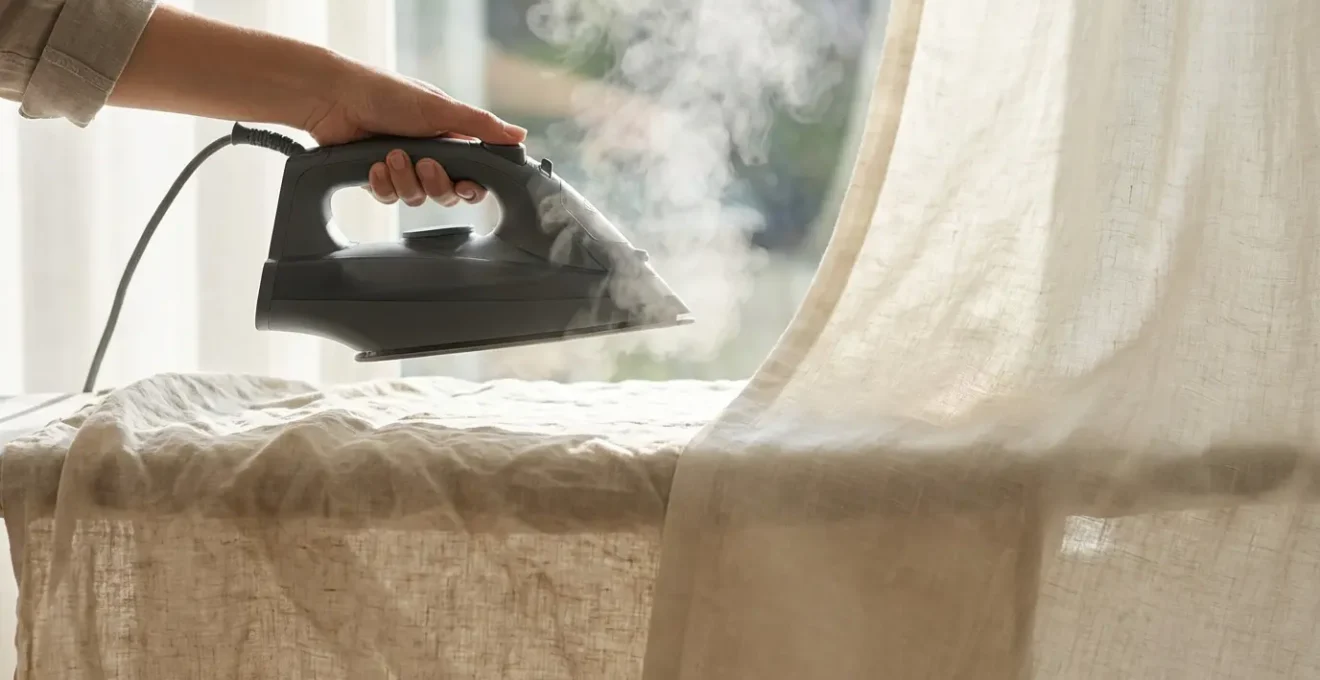
Proper care is essential to preserving the beauty and longevity of your investment. Following a precise post-wash routine will keep your linen looking its best for years.
Your Action Plan: Post-Wash Drape Restoration
- Wash Cold: Use a gentle cycle with cold water only (max 40°C/104°F) and a mild detergent.
- Remove Promptly: Take curtains out of the washer immediately after the cycle finishes to minimize deep-set wrinkles.
- Hang to Dry: Re-hang the damp curtains directly onto their curtain rod. Gravity will help pull out creases naturally.
- Steam for Perfection: While the curtains are still slightly damp, use a steamer or an iron on a medium-heat steam setting to remove any remaining wrinkles.
- Test First: If your curtains are not explicitly labeled as pre-shrunk, always test your washing method on a small, inconspicuous area or a fabric swatch first.
By treating your linen curtains with this gentle approach, you avoid the dreaded shrinkage and ensure they maintain their intended size and elegant drape for their entire lifespan.
Where to Mount the Rod: Ceiling or Frame Height for Maximum Drama?
The placement of your curtain rod is one of the most impactful design decisions you can make, with the power to completely transform the perceived height and size of a room. Mounting the rod directly on the window frame is a common mistake that visually shortens the window and can make a room feel smaller. To create a sense of drama and elegance, interior designers employ a technique known as “visual expansion” by mounting the rod significantly higher and wider than the frame itself.
The standard professional practice is to mount the curtain rod 6 to 10 inches above the top of the window frame. This technique creates what designers call the “light funnel” effect. By drawing the eye upward, it makes the window—and therefore the ceiling—appear much taller. For an even more dramatic effect, especially in rooms with lower ceilings, a ceiling mount is the ultimate solution. Attaching the rod directly to the ceiling creates an uninterrupted vertical line from floor to ceiling, lending a sense of grandeur and height to any space.
Equally important is the width. The rod should extend 6 to 15 inches beyond the window frame on each side. This provides ample “stackback” space—the area where the open curtains rest. When the curtains are pulled open, they should ideally sit entirely against the wall, not covering any part of the glass. This simple trick maximizes the amount of natural light entering the room and makes the window itself appear wider and more prominent. Choosing a mounting position is a trade-off between style and light control, and understanding the options is key.
This table breaks down the impact of each mounting choice on the room’s light and overall aesthetic.
| Mounting Position | Height Above Frame | Light Control | Best For |
|---|---|---|---|
| Frame Mount | 0-2 inches | Limited stackback, some light blockage | Highlighting architectural trim |
| Standard Mount | 6-10 inches | Good stackback, balanced light | Most residential applications |
| Ceiling Mount | At ceiling | Maximum light funnel effect | Small rooms, dramatic height |
By going high and wide with your curtain rod placement, you are not just hanging curtains; you are actively redesigning the architecture of your room to feel more spacious, bright, and dramatic.
The Invisible Ray That Fades Your Sofa Fabric in 6 Months
One of the most overlooked functions of window treatments is their role in protecting your home’s interior from long-term damage. The “invisible ray” responsible for fading your sofa, bleaching your hardwood floors, and deteriorating your artwork is ultraviolet (UV) radiation. While natural light is desirable, sunlight contains powerful UV rays that break down the chemical bonds in dyes and fibers over time, causing irreversible fading and weakening of materials. A south-facing room with an expensive new sofa can show noticeable signs of fading in as little as six months of direct sun exposure.
While no fabric can block 100% of UV rays on its own, linen offers a surprising degree of protection. The effectiveness depends heavily on the fabric’s construction. According to fabric specialists, the density of the weave is the most critical factor, with different weaves offering varying levels of defense. In general, linen curtains provide from 30% to 70% UV protection, with heavier, more tightly woven linens offering the highest level of shielding. This “textural” protection is often enough to significantly slow down the fading process for everyday furnishings.
However, for protecting truly valuable items like antique furniture, fine art, or delicate textiles, a more robust strategy is required. Interior protection specialists recommend a dual approach that combines aesthetics with maximum security. This involves pairing your decorative linen curtains with a professionally installed, high-quality UV-blocking window film. These modern films are virtually invisible and can block up to 99.9% of harmful UV rays without significantly reducing the amount of visible light entering the room. This allows you to enjoy the soft, diffused light filtered through your beautiful linen curtains, safe in the knowledge that your valuable interiors are fully protected from the damaging effects of the sun.
This combined system represents the pinnacle of atmospheric engineering, preserving both the light you love and the possessions you cherish.
How to Lower Your HVAC Load by 25% With Strategic Thermal Blinds?
While linen curtains are excellent for managing summer heat, a truly comprehensive energy-efficiency strategy involves a hybrid system that pairs them with dedicated thermal treatments. The U.S. Department of Energy has highlighted the significant impact of window treatments on a home’s energy consumption, noting that smart management can result in substantial savings. In fact, for an average home, the Department of Energy estimates savings of up to $100 per year in heating and cooling costs by using appropriate window coverings.
The most effective thermal treatments are cellular shades, also known as honeycomb blinds. Their unique, pocket-like structure is specifically designed to trap air, creating a powerful insulating barrier against both heat loss in winter and heat gain in summer. A high-quality cellular shade can have an R-value (a measure of thermal resistance) of 3.5 or higher. By installing these blinds behind your decorative linen curtains, you create a dynamic, all-season system that dramatically reduces the load on your HVAC unit.
The key to maximizing savings with this hybrid system is to operate it seasonally. In winter, you raise the thermal blinds on sunny days to allow passive solar gain through the linen, warming the room for free. At night, you lower the blinds to trap that heat inside. In summer, the strategy is reversed: the thermal blinds are kept down during the hottest parts of the day to block solar gain, then raised in the cooler evenings to release any accumulated heat. When automated with a smart home system, these adjustments can happen automatically based on time of day or indoor temperature thresholds, optimizing your home’s energy performance without any manual effort.
A seasonal strategy for this hybrid system would look like this:
- Winter Morning: Raise thermal blinds to allow passive solar heating through your linen curtains.
- Winter Night: Lower thermal blinds behind the linen for maximum insulation, trapping heat inside.
- Summer Day: Keep thermal blinds lowered during peak heat (10 a.m. – 4 p.m.) to block solar gain.
- Summer Evening: Raise the blinds to ventilate the space and release trapped heat.
- Automation: For ultimate efficiency, program smart blinds to adjust based on indoor temperature sensors.
In this system, the linen curtains remain the primary aesthetic element, providing diffuse light and style, while the cellular shades work unseen as the functional powerhouse of your home’s energy-saving strategy.
Key Takeaways
- System Over Single Product: The best results come from a complete window treatment system (fabric, hardware, mounting) rather than just choosing a curtain.
- Control, Don’t Block: The goal is to modulate and diffuse light for privacy, not to eliminate it. Strategic layering with unlined linen is key.
- Function Beyond Aesthetics: Linen curtains contribute to passive cooling, UV protection, and even acoustics, making them a functional part of your home’s environment.
How to Eliminate Echo in Open-Plan Homes Using Decorative Acoustic Panels?
Open-plan living spaces, with their high ceilings and hard surfaces like hardwood floors and large windows, are notoriously prone to poor acoustics. Sound waves bounce freely off these surfaces, creating an unpleasant “flutter echo” that can make conversations difficult and rooms feel cold and cavernous. While many people turn to specialized acoustic panels to solve this problem, they often overlook one of the most effective and decorative solutions already at their disposal: their curtains.
Heavyweight linen curtains are surprisingly effective at sound absorption. Acoustic specialists point out that linen’s natural composition gives it an edge. The fiber’s unique “pectin oblique flat hole structure” creates a capillary effect, while the irregular, slubby texture of the weave works to trap and break up sound waves. When made with a generous fullness, these curtains present a large, soft, and uneven surface area that is particularly good at absorbing the mid-to-high frequency sounds responsible for echo.
To maximize the acoustic benefits, the rule is simple: more fabric equals more sound absorption. This is where the concept of fullness, discussed earlier for aesthetics, plays a crucial functional role. For a living room with significant echo, a fullness ratio of 2.5 to 3 times the window width is recommended. This creates deep, dense folds that act as a highly effective sound trap. In a home office where clarity of sound for calls is important, a 2x fullness might suffice. The key is to see your curtains not just as a window covering, but as a large, vertical acoustic panel that also adds beauty and warmth to the space.
This table offers general guidelines for using curtain fullness to improve room acoustics.
| Room Type | Recommended Fullness | Acoustic Benefit | Additional Soft Elements Needed |
|---|---|---|---|
| Open Living Room | 2.5-3x | Significant echo reduction | Area rug, upholstered furniture |
| Home Office | 2x | Improved voice clarity | Fabric wall art, bookshelf |
| Bedroom | 2-2.5x | Enhanced sound dampening | Carpet, fabric headboard |
When combined with other soft materials like area rugs, upholstered furniture, and throw pillows, heavyweight linen curtains become a cornerstone of your home’s acoustic design, transforming a noisy, echoing space into a calm, quiet, and comfortable sanctuary.