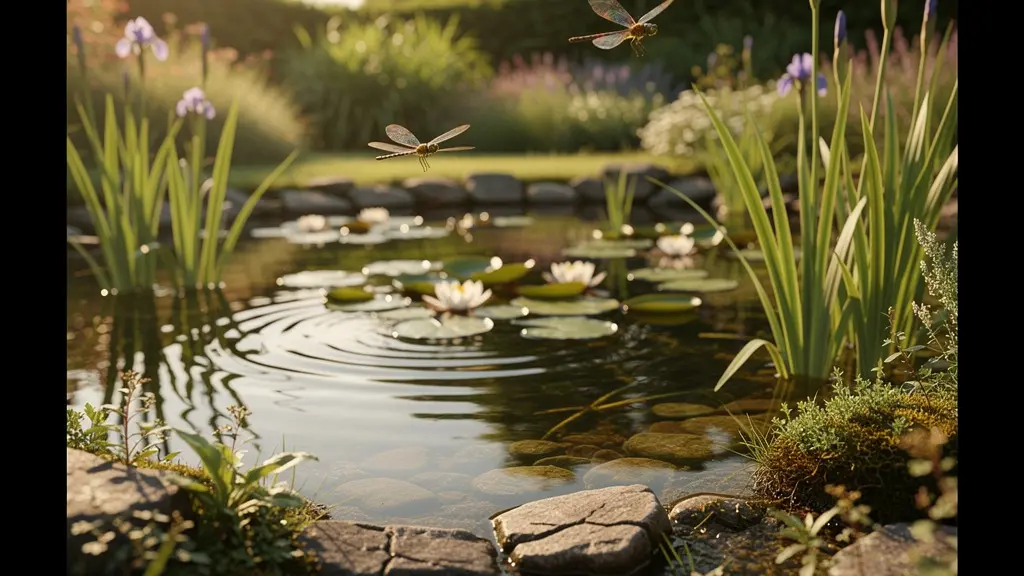
The secret to a thriving dragonfly pond isn’t advanced pumps or crystal-clear water; it’s creating a self-sustaining, slightly ‘messy’ ecosystem that supports their entire life cycle.
- A balanced pond requires no pumps or filters, as these remove the microscopic life that dragonfly nymphs feed on.
- Strategic planting with diverse “plant guilds”—submerged, floating, and emergent—provides oxygen, shelter, and launch pads.
- The pond’s physical shape, with varied depths and natural stone, is a form of ecological architecture designed for wildlife.
Recommendation: Prioritise creating habitat zones (deep water, shallow shelves, boggy edges) over achieving a sterile, manicured look. This “engineered neglect” is the fastest path to a vibrant dragonfly habitat.
For many nature-loving gardeners, the sight of a dragonfly—a shimmering jewel of acrobatic flight—is a sign of a healthy, vibrant garden. The desire to attract these magnificent insects often leads to one conclusion: build a pond. But this is where a common misunderstanding begins. The conventional approach to ornamental ponds, focused on powerful pumps, chemical treatments, and crystal-clear water, creates a beautiful but sterile environment. It’s the aquatic equivalent of a pristine lawn: visually pleasing, but ecologically barren.
This approach fundamentally misses what dragonflies need. They don’t just need water; they require a complex, living ecosystem. They need a place for every stage of their life cycle: submerged plants for their nymphs to hunt among, emergent stalks to climb for their final moult, and a rich soup of microorganisms to feed on during their two-to-five years spent underwater. A “clean” pond is a food desert for a young dragonfly.
So, what if the key wasn’t more technology, but less? This guide turns the traditional pond-building advice on its head. We will explore the principles of ecological architecture and “engineered neglect.” Forget about calculating complex filter capacities and fighting algae with chemicals. Instead, you will learn how to build a self-sustaining dragonfly sanctuary from the ground up—a living system where every stone, plant, and contoured edge works in partnership with nature. We will delve into designing for life, not just for looks, ensuring your pond becomes a bustling hub of biodiversity.
To guide you through this ecological creation process, we have structured this article to cover every critical decision, from the foundational plant life to the very materials you choose. Explore the sections below to master the art of building a pond that truly welcomes nature.
Summary: Your Guide to Building a Living Pond Ecosystem
- Why You Need Underwater Plants to Keep Your Pond Clear?
- How to Calculate Liner Size Including Overlap and Depth?
- Preformed Shell vs Flexible Liner: Which Allows for More Natural Shapes?
- The Capillary Action Wick That Drains Your Pond Overnight
- How to Size Your Pump to Cycle the Total Volume Every 2 Hours?
- The Location Error That Turns Your Water Feature Green in a Week
- The Red Spider Mite Explosion That Happens in Dry Winter Gardens
- Cast Stone vs Natural Stone Fountains: Which Survives Freeze-Thaw Cycles Best?
Why You Need Underwater Plants to Keep Your Pond Clear?
The common belief is that clear water equals a healthy pond. For a dragonfly habitat, this is a misconception. Health comes from balance, and that balance is driven by plants. Instead of a mechanical filter, a wildlife pond relies on a living one composed of carefully chosen plant guilds. These are not just decorative; they are the functional organs of your pond’s ecosystem, performing distinct roles to maintain water quality and provide habitat.
The first guild consists of oxygenators like Hornwort or Cabomba. These submerged plants act as the pond’s lungs, releasing oxygen directly into the water. Critically, they also compete with algae for dissolved nutrients, naturally suppressing the “green water” blooms that plague many new ponds. The second guild, floating-leaved plants like water lilies, provides essential shade. By covering 30-40% of the surface, they limit the sunlight that fuels algae growth while offering shelter for aquatic life below. The third and most visible guild is the emergent plants—species like irises and arrowhead that root in the shallows with stems rising above the water. These are the crucial final stage for a dragonfly’s life cycle, providing the “launching pads” nymphs climb to emerge as adults. As RHS Youth Ambassador George has shown in his successful pond projects, establishing these plant guilds is directly linked to increased dragonfly diversity.
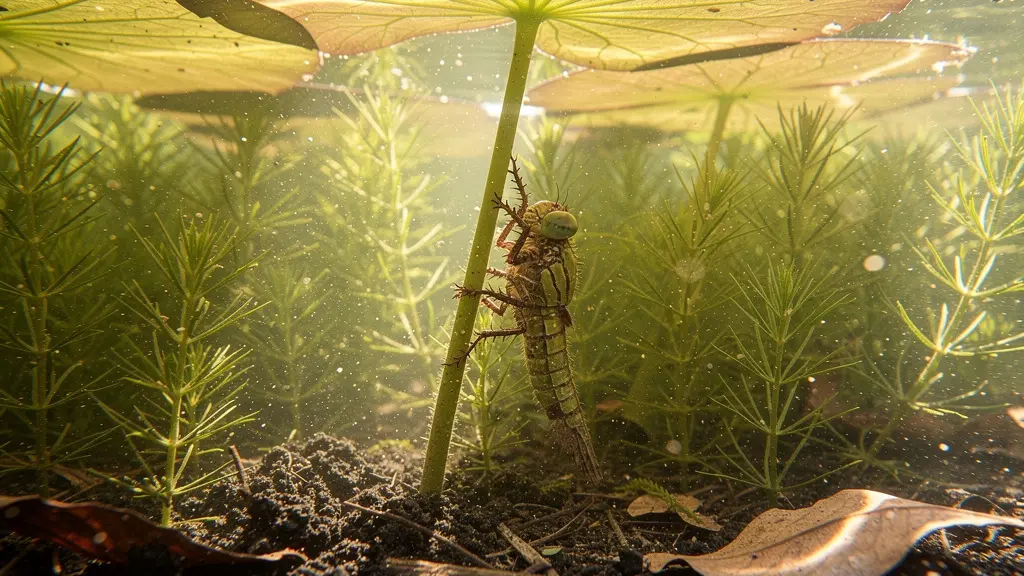
This layered approach, as seen in the diagram, creates a three-dimensional habitat. The bottom layer of decomposing leaves, or detritus, becomes a rich feeding ground for the microorganisms that dragonfly nymphs prey upon. The dense underwater forests of oxygenators provide hunting grounds and refuge, while the surface plants offer cover. Together, these guilds form a self-regulating system that clarifies water not by stripping it of life, but by filling it with the right kinds of life.
How to Calculate Liner Size Including Overlap and Depth?
Calculating the liner size for a wildlife pond is less about simple geometry and more about ecological architecture. You are not just lining a hole; you are creating a complex underwater topography with distinct habitat zones. The standard formula (Length + 2x Depth + Overlap) is only a starting point. A true dragonfly pond requires varied depths to support different stages of life, and each depth zone has its own impact on the final liner dimensions.
The most critical zone is the deep section, which acts as a thermal refuge. This area, ideally 24 to 48 inches deep, provides a stable, warmer layer of water where nymphs and other aquatic life can survive the winter, safe from freezing surface temperatures. To accommodate this, you must add significantly more to your liner calculation. Furthermore, the design should include multiple shelves at different depths. A mid-shelf (12-18 inches) provides a prime hunting ground for nymphs, while a shallow plant shelf (6-8 inches) is essential for rooting emergent plants. Each of these shelves adds steps to your excavation, which in turn requires more liner material to cover the contours.
The Royal Horticultural Society confirms the importance of this structure, recommending a 20-60cm (8in-2ft) depth variation to create a range of thermal conditions and habitats. This variation is the key to a resilient and diverse pond. The table below breaks down how each ecological zone affects your liner calculation, transforming it from a simple measurement task into a thoughtful design process.
| Zone Type | Depth | Width | Wildlife Function | Calculation Addition |
|---|---|---|---|---|
| Deep Zone (Thermal Refuge) | 24-48 inches | Min. 3 feet | Overwinter survival for nymphs | +4 feet to liner length/width |
| Mid-Shelf | 12-18 inches | 18-24 inches | Hunting grounds for nymphs | +3 feet per shelf |
| Plant Shelf | 6-8 inches | 12-18 inches | Emergent plant zone | +2 feet per shelf |
| Beach/Bog Area | 0-6 inches | 24+ inches | Dragonfly emergence zone | +3 feet for slope |
Preformed Shell vs Flexible Liner: Which Allows for More Natural Shapes?
When choosing the foundation of your pond, the debate between a preformed plastic shell and a flexible liner is a critical one. For a gardener focused on aesthetics, a preformed shell offers a quick, predictable shape. For the wildlife ecologist, however, the choice is clear: the flexible liner is vastly superior. Its adaptability is the key to creating the complex, naturalistic micro-topography that a thriving dragonfly population requires.
Preformed shells are rigid and uniform, often with steep sides and a lack of varied depth. This is the antithesis of a natural pond. A flexible liner, by contrast, frees you to be an ecological architect. You can sculpt the earth to create an environment that mimics nature, complete with gentle slopes for wildlife access, shallow beach areas for bathing birds, and small coves and bays that create sheltered micro-habitats. This irregularity is not a flaw; it is a feature. As one case study on dragonfly pond installation notes, a flexible liner is what allows for the creation of distinct zones for submerged, floating, and emergent plants—all essential for the dragonfly’s different life-cycle staging areas.
The ability to create shelves at precise depths (e.g., 6, 12, and 24 inches) is something a preformed shell simply cannot offer. These shelves are not just ledges; they are different worlds for aquatic creatures. Furthermore, a flexible liner allows you to add a crucial layer of sand or gravel substrate over the top, providing a natural rooting medium for plants and a more hospitable surface for invertebrates. This moves your pond from a plastic tub of water to a genuine, functioning ecosystem bed. The liner becomes an invisible waterproof layer beneath a living landscape, rather than the defining structure itself.
The Capillary Action Wick That Drains Your Pond Overnight
One of the most frustrating and insidious problems a pond owner can face is mysterious water loss. You top up the pond, and the next morning the level has dropped again, with no obvious leak. The culprit is often not a puncture, but a silent, physical process known as capillary action. This occurs when porous materials, such as surrounding soil, folded liner creases, or even the fabric underlay itself, touch the water and extend over the pond’s edge. Like a wick in an oil lamp, this material draws water up and out of the pond, silently draining it into the surrounding ground.
Simply hiding the liner’s edge with soil or turf is one of the biggest mistakes, as it creates a perfect wick. The solution is to engineer a definitive capillary break—an impassable barrier that physically separates the pond water from the surrounding porous soil. This is not about simply folding the liner neatly; it requires a specific construction technique at the pond’s edge. The most effective method involves creating an anchor trench set back from the water’s edge and using non-porous materials like slate or granite as the immediate border.
This ensures that any moisture-wicking soil or plant roots are kept a safe distance from the water itself. A pebble beach is another excellent technique, as the gaps between the stones prevent a continuous path for water to travel. By mastering this non-wicking edge, you conserve water, maintain a stable habitat for your pond life, and save yourself endless frustration.
Your Action Plan: The Wildlife-Friendly Non-Wicking Edge Masterclass
- Dig an anchor trench 6 inches deep around the pond perimeter, positioned approximately 12 inches away from the intended water’s edge.
- Lay the flexible liner into the pond and then securely into the trench, using large, smooth rocks or paving slabs to weigh it down and create the capillary break.
- Use non-porous, waterproof stones like granite or slate for the immediate waterline edging, ensuring they rest on the liner, not the soil.
- Construct a pebble beach on any sloping sides by layering 2-4 inch river rocks over the liner to hide it and disrupt the wicking path.
- Maintain a clear buffer zone by keeping turf and soil at least 6 inches away from the pond’s final stone edge to prevent grass roots from growing towards the water and acting as wicks.
How to Size Your Pump to Cycle the Total Volume Every 2 Hours?
This question represents the single greatest philosophical divide between a conventional ornamental pond and a true wildlife pond. The standard advice is to install a pump and filter system powerful enough to circulate the entire volume of water every one to two hours. The goal is sterility. For a dragonfly sanctuary, the answer to “How do I size my pump?” is revolutionary: you don’t use one. This is the heart of the “engineered neglect” philosophy.
Pumps and filters are designed to create crystal-clear water by removing two things: suspended particles and living microorganisms. But that “cloudy” water is a rich soup of life—algae, protozoa, and tiny invertebrates that form the very base of the food web. Dragonfly nymphs are voracious predators, and by “cleaning” the water, you are systematically starving them. Natural ponds without filters and pumps work better for dragonflies because they encourage the very pond life their nymphs need to eat. A powerful pump creates a sterile environment hostile to the dragonfly’s larval stage.
So how is water quality maintained? Through the balanced ecosystem you’ve already designed. The oxygenating plants (H2-1) provide oxygen, the floating plants prevent algae overgrowth (H2-6), and the natural decomposition on the pond floor fuels the food web. Experience from numerous wildlife gardeners has shown that once the right combination of plants is established, wildlife ponds achieve a balanced state mimicking nature with very little maintenance. The system sustains itself.
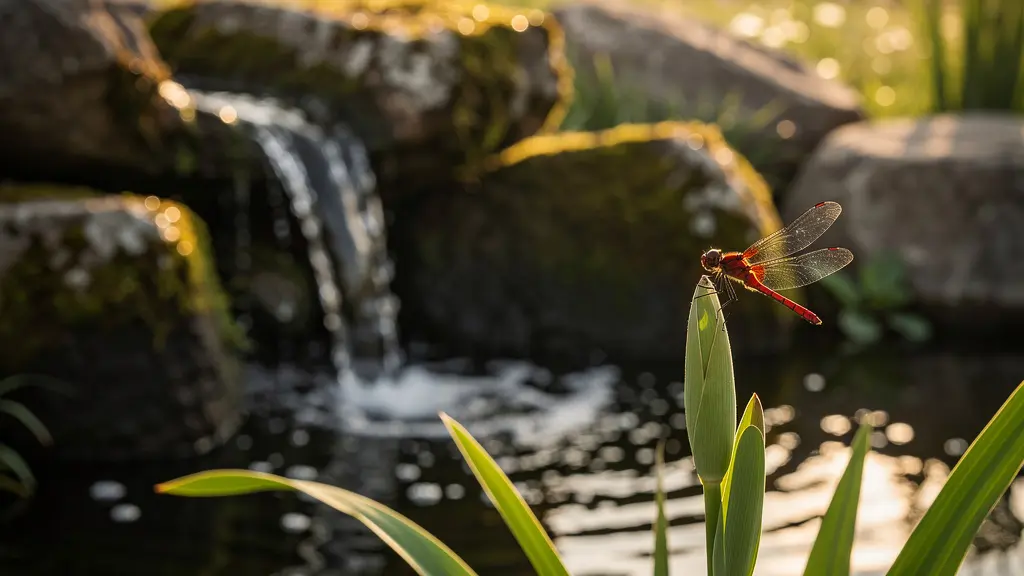
If you desire the sound of moving water, the solution is not a high-volume filter pump. Instead, consider a very small, low-power pump to create a gentle trickle or a tiny waterfall. This provides aeration and sound without creating a disruptive current or filtering out the essential life that makes your pond a true habitat.
The Location Error That Turns Your Water Feature Green in a Week
The placement of your pond is the most important decision you will make, and it’s one you can’t easily change later. The primary factor to consider is sunlight. Many assume that full, all-day sun is best, but this is a critical error that will almost certainly lead to an explosion of green algae. Algae, like any plant, thrive on sunlight and nutrients. Blasting a pond with 10-12 hours of direct sun, especially in the heat of the afternoon, is an open invitation for an algae bloom that can choke out other life.
The goal is to find a balanced location. Your pond needs enough sun to support healthy growth in your flowering aquatic plants and to warm the water, which encourages dragonfly activity. However, it also needs periods of shade to keep water temperatures from soaring and to limit the energy available for algae. The ideal placement is a spot that receives 5-6 hours of direct sunlight daily, ideally in the morning. Providing shade on the west side of the pond, from a small tree, a fence, or tall garden plants, is particularly beneficial as it blocks the most intense, hottest sun of the late afternoon.
Another common location error is placing the pond at the bottom of a slope, especially near a manicured lawn. Every time it rains, or you water your garden, any fertilizers, pesticides, and excess nutrients from your lawn will wash directly into the pond. This massive influx of nutrients is a feast for algae, leading to sudden, uncontrollable blooms. To prevent this, ensure your pond is sited on level ground or create a small berm (a raised bank of earth) around the edge to divert surface runoff away from the water. Proper siting is a preventative measure that is far more effective than any reactive chemical treatment.
The Red Spider Mite Explosion That Happens in Dry Winter Gardens
A wildlife pond is more than just a self-contained feature; it is the engine of biodiversity for your entire garden. Its influence extends far beyond its banks, creating a hub for an integrated pest management (IPM) system that can help control pests like spider mites, aphids, and mosquitoes. Pests like red spider mites thrive in dry, stressed conditions. By introducing a pond, you increase local humidity through evaporation, creating a less hospitable environment for them while simultaneously fostering their natural predators.
Dragonflies are chief among these predators. From the moment they arrive at your pond, documented observations confirm that dragonflies immediately begin eating mosquitoes and other flying insect pests. But they are not alone. A well-designed pond attracts a whole army of beneficial insects. Frogs and toads will lay their eggs in the water and patrol the garden for slugs and snails. Hoverflies and predatory wasps will visit the marginal plants for nectar, and their larvae will consume aphids by the hundreds. Birds will come to drink and bathe, picking off caterpillars and other pests while they’re there.
To maximize this benefit, you must think of your pond as a support system for predators. This means providing not just water, but the full suite of resources they need to thrive year-round. Key strategies include:
- Including a diverse range of native marginal plants to attract beneficial insects like lacewings and hoverflies.
- Creating overwintering habitats around the pond’s edge with log piles, rockeries, and leaf litter for frogs, toads, and beneficial insects to shelter in.
- Maintaining water levels year-round to support the continuous life cycles of these predator populations.
- Designing shallow “beach” areas where birds can safely access the water to drink, bathe, and hunt for garden pests.
This transforms your pond from a simple water feature into the cornerstone of a resilient, low-maintenance garden ecosystem that polices itself.
Key Takeaways
- Embrace the Ecosystem, Not the Object: A dragonfly pond is a living system. Prioritise habitat creation (varied depths, plant guilds) over aesthetics like sterile water.
- Less is More (Engineered Neglect): A balanced wildlife pond requires no pumps or filters. These devices remove the food source for dragonfly nymphs and disrupt the natural food web.
- Materials Matter Ecologically: Your choice of stone and liner is part of the habitat design. Natural, textured materials provide grip and shelter for wildlife, while flexible liners allow for naturalistic shapes.
Cast Stone vs Natural Stone Fountains: Which Survives Freeze-Thaw Cycles Best?
The final touches of your pond, the stones used for edging and waterfalls, are often chosen for durability and appearance. The question of whether cast stone or natural stone better withstands freeze-thaw cycles is a practical one, but for a wildlife pond, it misses the larger ecological point. The best material is not just the one that survives winter, but the one that contributes most to the life of the pond. In this regard, natural stone is unequivocally superior.
Cast concrete and some types of limestone can actively harm your pond’s delicate chemistry. As they weather, they can leach lime, raising the pH of the water to levels that are stressful or even fatal for many aquatic invertebrates and amphibians. Natural, inert stones like granite, slate, and quartzite have a neutral pH and will not alter your water chemistry. This chemical stability is vital for a healthy ecosystem.
Beyond chemistry, there is the crucial factor of texture. The smooth, uniform surface of cast stone offers poor grip for wildlife. A dragonfly nymph climbing out of the water to moult, or a young frog trying to exit the pond, will struggle on a slippery concrete edge. The rough, textured, and layered surfaces of natural stone provide excellent grip and countless tiny crevices for shelter. These surfaces are also ideal for the development of biofilm—a thin layer of algae and microorganisms that is a key food source for many small aquatic creatures. Natural stone becomes part of the living habitat, while cast stone remains an inert, alien object.
This comparative analysis shows the clear ecological advantages of choosing natural, inert stone for your wildlife pond. It is not merely a decorative choice but a foundational one for habitat creation.
| Stone Type | pH Impact | Texture for Wildlife | Freeze-Thaw Resistance | Biofilm Development |
|---|---|---|---|---|
| Granite | Inert/Neutral | Rough, excellent grip | Excellent | Moderate |
| Slate | Inert/Neutral | Layered, good shelter | Good | Good |
| Quartzite | Inert/Neutral | Textured surface | Excellent | Moderate |
| Cast Concrete | Raises pH initially | Smooth, poor grip | Poor to moderate | Slow to establish |
| Limestone | Raises pH significantly | Porous, good grip | Poor | Excellent |
Now that you understand the ecological principles, from the living water to the very stones you choose, you are equipped to create more than just a pond. You are ready to build a sanctuary. The next step is to take these concepts and begin sketching out the ecological architecture for your own garden, creating a life-giving feature that will reward you with the flash of dragonfly wings for years to come.