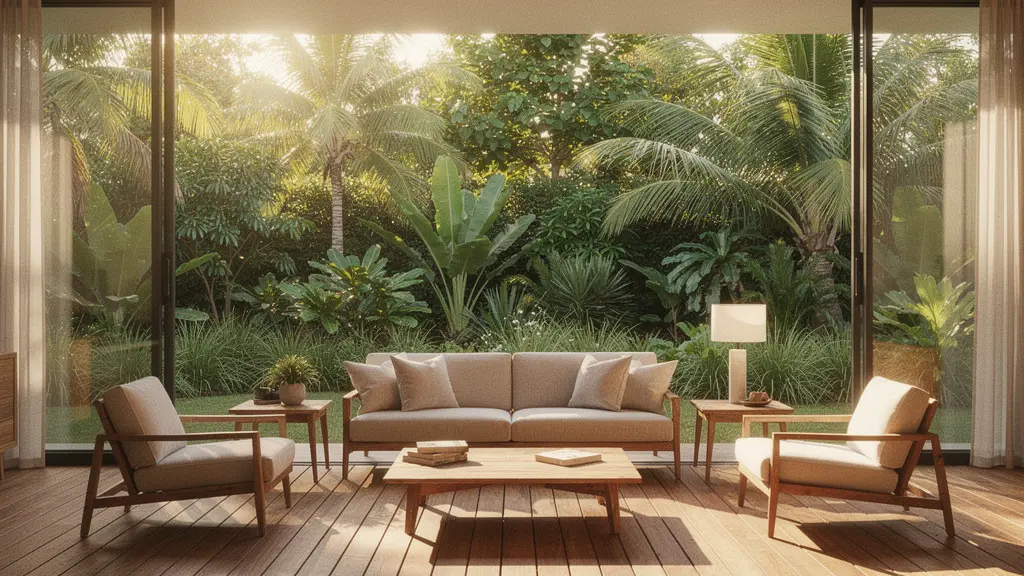
Achieving a true ‘resort’ feel is not about adding features, but about systematically dissolving the psychological and physical barriers between inside and out.
- Architectural choices like flush thresholds and floor-to-ceiling glass are more critical than decorative elements.
- The goal is to create a single, expansive living space that extends into nature, which positively impacts well-being by reducing stress.
Recommendation: Prioritize structural integration and material continuity from the start to create a genuine sense of flow, rather than simply placing a living room next to a garden.
The dream of a home that feels like a permanent vacation—a private resort where stress melts away—is a common aspiration. We often try to achieve this by placing a comfortable sofa near a window or adding a few potted plants to the living room. But these are merely gestures. The true essence of resort-style living, that seamless flow between a serene interior and a lush garden, is not born from decoration. It is an act of architectural intention.
Creating this cohesive lifestyle experience is about erasing boundaries. It’s about tricking the eye and the body into perceiving one unified, expansive space. This goes far beyond simply installing large doors; it involves a holistic approach that considers the science of well-being, the engineering of transitions, and the psychology of space. The goal is to dissolve the very concept of a wall, transforming it from a hard stop into a permeable, fluid membrane. This is where design transcends aesthetics and becomes a tool for enhancing our quality of life.
This guide moves beyond surface-level tips. As a biophilic architect, I will walk you through the foundational principles and technical details that allow you to truly merge your living room and garden. We will explore the science of how nature calms the mind, the engineering required for a flawless transition, and the design choices that make this connection feel both exhilarating in summer and cozy in winter.
To navigate this architectural journey, we have structured the key concepts into a clear path. The following summary outlines the steps we will take to dissolve the boundaries of your home and invite the landscape inside.
Summary: How to Dissolve the Barrier Between Home and Garden for a Resort-Like Flow
- Why Visual Connection to Greenery Lowers Cortisol Levels?
- How to Achieve a Flush Threshold Between Timber Floor and Exterior Decking?
- Sliding vs Bifold Doors: Which Creates a Better Indoor-Outdoor Connection?
- The Security Upgrade You Need When Installing Large Glass Walls
- How to Design an Indoor-Outdoor Space That Is Cozy in Winter?
- Why Using the Same Tile Inside and Out Makes Your Room Look 30% Bigger?
- Why Spending 1 Hour in a Sunroom Can Alleviate Winter Blues?
- Why Floor-to-Ceiling Glass Walls Transform Small Rooms into Open Spaces?
Why Visual Connection to Greenery Lowers Cortisol Levels?
Before we lay a single floorboard, we must understand the fundamental ‘why’. The aspirational ‘resort’ feeling is not just a marketing term; it’s a physiological response. Our brains are hardwired to feel calmer and safer when we are connected to nature. This is the core principle of biophilic design. When you gaze out at your garden, you are not just seeing a pleasant view; you are engaging in an activity that actively lowers your body’s stress indicators. The visual stimulus of natural greenery, with its fractal patterns and organic forms, sends a signal to your nervous system to relax.
This isn’t just theory; it’s measurable science. The stress hormone, cortisol, is a key marker of our physiological state. High levels are linked to anxiety and a host of health issues. Research consistently shows that exposure to natural environments leads to a significant reduction in these levels. In fact, one study found that a nature experience can lead to a 21.3% per hour drop in cortisol. By dissolving the barrier between your home and your garden, you are essentially creating an environment where this stress-reducing effect is constantly available, not just something you seek out on a walk.
Introducing elements of biophilic design into indoor spaces has been linked to calming effects on occupants, including reductions in physiological measures related to stress, such as heart rate, blood pressure, electrodermal activity, and cortisol levels.
– Scientific Reports, Nature Journal – Biophilic Interventions Study
This biophilic response is the foundation of indoor-outdoor living. Every design choice that follows—from the type of glass you choose to the texture of your flooring—is ultimately in service of enhancing this primal connection. By maximizing visual access to greenery, you are building a home that functions as a sanctuary, actively contributing to your well-being by keeping stress at bay. It transforms your home from a mere shelter into a restorative environment.
How to Achieve a Flush Threshold Between Timber Floor and Exterior Decking?
The single most important detail in dissolving the boundary between inside and out is the one you shouldn’t see or feel: the threshold. A traditional step-down or a raised weather bar acts as a physical and psychological barrier. It says, “Here, the inside ends, and the outside begins.” To achieve true psychological flow, this transition must be completely flush, creating an uninterrupted plane that draws the eye—and the body—outward. Achieving this seamlessness, especially between an interior timber floor and an exterior deck, is a feat of careful engineering.
The primary challenges are water management and material stability. You must prevent water from entering while allowing two different materials, which expand and contract at different rates, to coexist. The solution lies in a combination of sophisticated drainage and material science. A concealed linear drainage system, installed directly at the threshold, is non-negotiable. This hidden channel captures any water before it can reach the interior, making a zero-height transition possible. The choice of exterior timber is equally crucial; thermally modified timber or high-stability composites are essential as they minimize movement and decay.
This close-up view demonstrates the precision required. The interior wood grain flows almost imperceptibly into the exterior decking, with only a subtle, integrated drainage channel marking the junction. This is the essence of dissolving boundaries.

The result is a feeling of an endless floor, a single surface that flows from the warmth of the living room to the open air of the garden. This sensory continuity is profoundly powerful. It removes hesitation and creates an effortless invitation to move between the two spaces. It’s a subtle detail that has a massive impact on how the entire space is perceived and used.
Your Action Plan: Achieving a Seamless Floor Transition
- Waterproofing First: Install a concealed linear drainage system at the threshold to manage water and enable a flush finish.
- Material Selection: Choose thermally modified timber or high-stability composite decking to match the minimal expansion rates of interior hardwood.
- Climate Consideration: Ensure the expansion and contraction rates of both your interior and exterior materials are suitable for your local climate.
- Eliminate the Step: Design the sub-floor and joist structure to create a perfectly level transition, removing any physical or visual barrier.
- Define with Light: Add recessed LED strips along the floor line as a soft visual guide, defining the space at night without creating a hard boundary.
Sliding vs Bifold Doors: Which Creates a Better Indoor-Outdoor Connection?
The largest moving part of your indoor-outdoor connection will be the glass wall system. The two primary contenders are sliding doors and bifold doors, and the choice between them profoundly impacts the feeling of flow. While bifolds are often praised for their ability to open up an entire wall, the decision is more nuanced when viewed through the lens of dissolving boundaries, a state which must exist whether the doors are open or closed.
When open, bifold doors can clear up to 95% of an opening, which is impressive. However, they do so by collecting in a bulky stack at one or both ends, creating a physical and visual obstruction on your patio or deck. Sliding doors, by contrast, glide away into pockets within the wall or stack neatly behind one another, leaving a cleaner opening. More importantly, sliding doors offer far superior control for partial ventilation, allowing you to open them just a few inches—a feat that is often awkward or impossible with a bifold system.
However, the most critical difference for achieving a constant state of connection is the view when the doors are closed. Bifold systems are composed of multiple, narrower panels. This means that even in the closed position, your view is interrupted by a series of vertical frames. Large-format sliding doors, on the other hand, can offer vast, uninterrupted panes of glass, preserving a panoramic, cinematic view of the landscape. This is essential for maintaining psychological flow and the “borrowed landscape” effect throughout the year, not just on days when the weather allows the doors to be fully open.
The following table, based on insights from industry experts, breaks down these key differences. It clarifies how each system serves the ultimate goal of a seamless connection, as highlighted in a comparative analysis by home improvement specialists.
| Feature | Sliding Doors | Bifold Doors |
|---|---|---|
| View When Closed | Uninterrupted panoramic view | Vertical frames create divisions |
| Opening Style | Panels stack or pocket | Accordion-style folding |
| Partial Opening | Excellent – open few inches for ventilation | Limited – typically all or nothing |
| Stack Space | Panels overlap discretely | Creates bulky stack on patio |
| Maximum Opening | Up to 67% of wall | Up to 95% of wall |
The Security Upgrade You Need When Installing Large Glass Walls
The idea of replacing a solid wall with a vast expanse of glass naturally raises a question of security. It’s a valid concern that must be addressed with modern engineering, not compromise on design. Creating a sense of openness should never come at the expense of feeling safe. Fortunately, the technology in glass wall systems has advanced to a point where they can be even more secure than traditional doors and windows, provided you specify the right features from the outset.
Your first line of defense is the glass itself. Standard tempered glass shatters into small, relatively harmless pieces. Laminated security glass, however, is constructed with a tough polymer interlayer (like PVB). When this glass breaks, the fragments adhere to the interlayer, maintaining a barrier against entry and weather. This single upgrade is the most important security decision you can make. It dramatically increases the time and effort required for a potential intruder to breach the opening.
Beyond the glass, the locking mechanism is critical. A single lock on a large door is a significant vulnerability. A multi-point locking system is the architectural standard. This mechanism secures the door panel to the frame at multiple points—typically at the top, bottom, and several places along the side—with the turn of a single handle. This distributes force evenly and makes it exponentially more difficult to pry the door open. When combined with smart technology, your glass walls become an active part of your home’s security ecosystem.
To ensure peace of mind, consider these essential security upgrades, often recommended by leading manufacturers of moving glass walls:
- Upgrade to Laminated Glass: Specify glass with a security interlayer that holds fragments together when shattered, preventing easy entry.
- Install Multi-Point Locking: Insist on systems that secure the panels at multiple points along the frame, not just at the handle.
- Embed Shock Sensors: Add sensors that integrate with your home security system to trigger an alert on impact, before a break-in occurs.
- Consider Switchable Privacy Glass: For ultimate control, elect for glass that can turn from clear to opaque with the flick of a switch.
- Integrate Smart Monitoring: Connect your glass wall system to your smart home platform for motion detection, remote status checks, and instant alerts.
How to Design an Indoor-Outdoor Space That Is Cozy in Winter?
A common misconception is that a seamless indoor-outdoor space is only for warm climates and summer days. The true measure of a successful design is its ability to provide comfort and connection year-round. The goal in winter is not to seal the outside away, but to reframe the relationship. It’s about creating a cozy, protected vantage point from which to enjoy the stark beauty of the winter garden. This requires a focus on shelter, warmth, and texture.
The key is to create a “transitional zone”—a covered patio, a glass-enclosed terrace, or a deep overhang. This space acts as an intermediary, protecting you from the elements while still feeling connected to the outdoors. A roof is essential, as is a source of warmth. A built-in gas fireplace or a stylish fire pit becomes the focal point, drawing people out and creating a primal sense of comfort. Warm, layered lighting from recessed LEDs, uplights on trees, and even candles is critical for creating a welcoming ambiance against the early dark of winter evenings.
This evening view of a covered terrace demonstrates how layers of texture and warm light create a haven of coziness, even on a cold night. The fire pit provides a focal point, while textiles and soft lighting make the space irresistibly inviting.
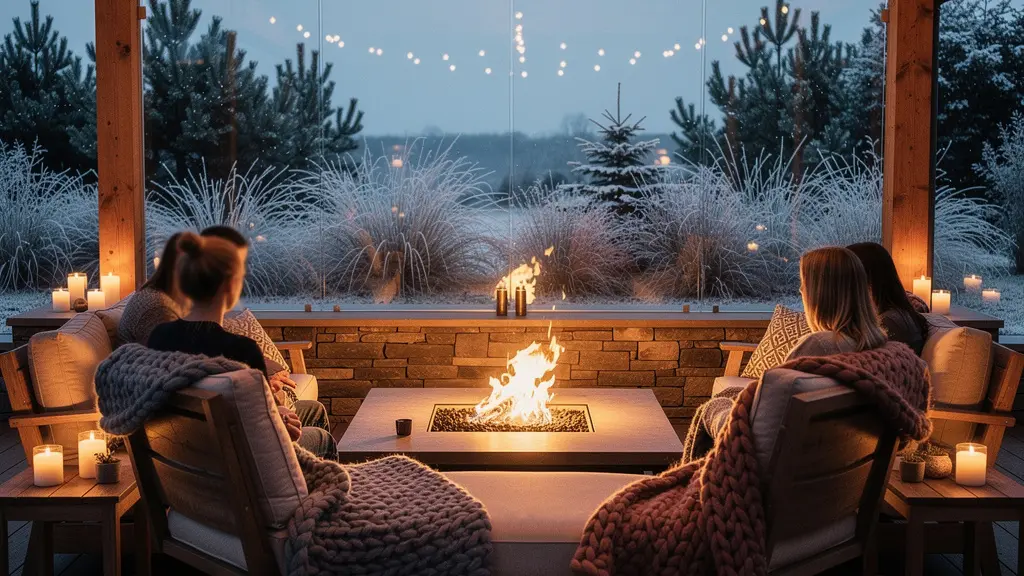
Finally, sensory continuity is achieved through materials. Chunky knit throws, outdoor rugs, and plush cushions add a layer of tactile warmth that invites you to linger. Using materials like wood and stone in this transitional zone further blurs the line between the built and natural environments. The result is a space that doesn’t shut down in winter but transforms, offering a different kind of restorative experience—a warm, glowing sanctuary from which to watch the snow fall.
Case Study: Climate-Adapted Year-Round Design
As noted by design experts at Studio Hinton, the strategy for year-round enjoyment must be adapted to the local climate. In sun-drenched Mediterranean climates, deep pergolas with retractable awnings provide essential shade in the summer, while still allowing low winter sun to penetrate indoors. Conversely, in colder Nordic regions, the focus shifts to creating fully-enclosed but glass-heavy terraces or “winter gardens.” These spaces often feature radiant floor heating and robust weather sealing, allowing them to be used comfortably as an extension of the living area, even amidst snow.
Why Using the Same Tile Inside and Out Makes Your Room Look 30% Bigger?
While a flush threshold removes the vertical barrier, achieving sensory continuity on the horizontal plane is just as crucial for dissolving boundaries. The most effective way to do this is by using the same flooring material inside and out. When your interior flooring flows uninterrupted onto your exterior patio or terrace, the eye no longer registers a demarcation line. The brain perceives the two areas as a single, unified surface, dramatically expanding the perceived size of your living space.
This isn’t just a subjective feeling; design research indicates that this technique can have a quantifiable impact. Studies on spatial perception suggest that creating continuous flooring can make spaces appear up to 30% larger than they actually are. This visual trick works because it eliminates the ‘visual stop’ that a change in material or color creates. The brain follows the continuous lines and patterns outwards, effectively ‘claiming’ the outdoor square footage as part of the interior room.
To execute this successfully, you must use porcelain or stone tiles that are specifically designed for this purpose. Manufacturers offer collections that include the same visual design in multiple finishes. You would typically use a polished or matte finish for the interior space and a corresponding high slip-rating (R11+ or higher) grip finish for the exterior. This ensures safety in wet conditions without sacrificing visual consistency. Furthermore, opting for large-format tiles is key. Fewer grout lines mean fewer visual interruptions, reinforcing the illusion of a single, monolithic surface and maximizing the sense of spaciousness and flow.
Why Spending 1 Hour in a Sunroom Can Alleviate Winter Blues?
In the quest for year-round connection to the outdoors, the sunroom—or conservatory—emerges as a powerful architectural tool. It is more than just a room with many windows; it is a purpose-built space designed to maximize exposure to natural light, especially during the darker months of the year. This intense dose of light has a profound, scientifically-backed effect on our mood and physiology, making the sunroom a potent antidote to the “winter blues,” or Seasonal Affective Disorder (SAD).
The key is light intensity, measured in lux. A typical, well-lit indoor room might provide 300-500 lux. In stark contrast, light therapy for SAD often requires exposure to 10,00-0 lux. A modern sunroom, with its floor-to-ceiling glass and glazed roof, acts as a light-capturing machine. Even on overcast days, sunrooms can provide levels of 2,000-10,000 lux, an intensity that is simply unattainable in a standard room. This exposure helps regulate our circadian rhythms, boost serotonin production, and improve mood.
Spending just an hour in this environment in the morning can be as effective as a dedicated light therapy session. You are essentially bathing in the full spectrum of natural light while being protected from the elements. This creates the ideal hybrid space: the comfort and warmth of the indoors combined with the most vital element of the outdoors. It’s a space that not only provides a visual connection to the winter garden but also delivers a therapeutic dose of the daylight our bodies crave, actively improving our well-being when we need it most.
Key Takeaways
- True indoor-outdoor living is an architectural philosophy focused on dissolving boundaries, not just adding glass doors.
- Material and visual continuity (flush thresholds, consistent flooring) are critical for tricking the brain into perceiving a larger, unified space.
- The benefits are physiological, including measurable stress reduction from visual access to nature and mood elevation from increased light exposure.
Why Floor-to-Ceiling Glass Walls Transform Small Rooms into Open Spaces?
The ultimate expression of dissolving boundaries is the floor-to-ceiling glass wall. This is not merely a window, but the removal of a wall in its entirety and its replacement with a transparent membrane. The psychological impact of this move is profound. A standard window acts like a picture frame; it presents a contained, curated view of the outside world. You are an observer looking at a landscape. A floor-to-ceiling glass wall, however, removes the frame entirely. You are no longer an observer; you become a participant in the landscape itself.
This concept is deeply rooted in the Japanese architectural principle of Shakkei, or “borrowed landscape.” The idea is to incorporate the surrounding environment into the design of the home, making the garden, the sky, and the distant trees part of the interior composition. A floor-to-ceiling glass wall is the most powerful tool for achieving Shakkei in a modern context. It dissolves the corners of a room, erases the hard line between floor and ground, and pours natural light deep into the home, creating a feeling of infinite space and brightness.
This transformation from an observer to a participant has a significant psychological effect. The claustrophobia of a small room vanishes as the eye is drawn outward, across the garden and to the horizon. The changing light, the movement of clouds, and the seasonal shifts in the garden become part of your daily domestic life. This active engagement with the environment is the very essence of the resort lifestyle, where your living space is not confined by four walls but extends to encompass the natural world around you.
| Aspect | Standard Windows | Floor-to-Ceiling Glass |
|---|---|---|
| Visual Experience | Framed view like a picture | Immersive landscape experience |
| Light Penetration | Limited to window area | Maximum natural light throughout |
| Spatial Perception | Defined room boundaries | Dissolved corners and boundaries |
| Connection to Nature | Passive viewing | Active engagement with environment |
| Psychological Impact | Observer perspective | Part of landscape feeling |
By embracing this philosophy of dissolving boundaries, you can begin to architect a home that not only looks more expansive but actively contributes to a more serene and connected way of life.