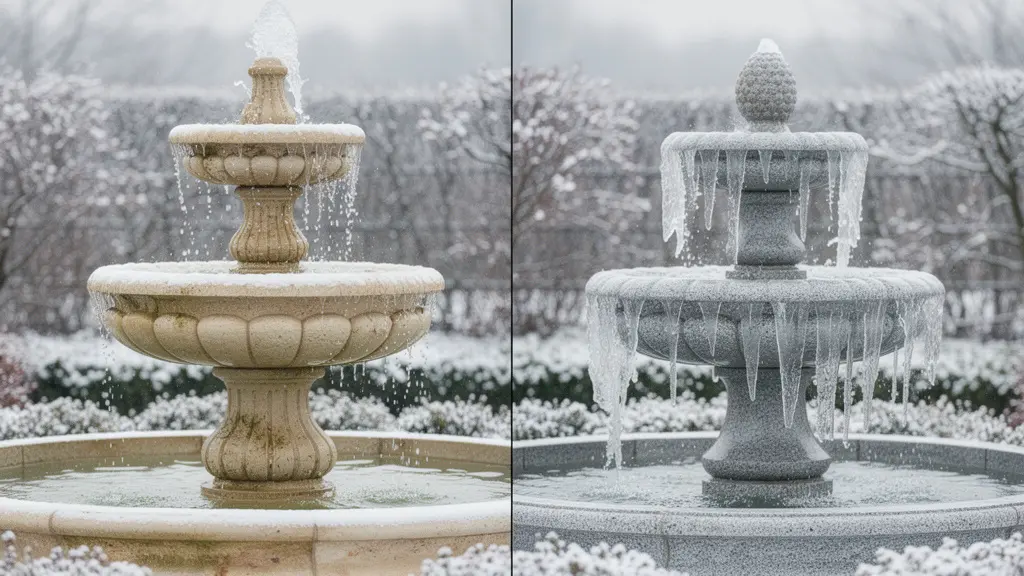
The long-term survival of a stone fountain in freezing climates depends less on the choice between cast or natural stone and more on a complete structural system designed to manage water and pressure.
- A solid foundation is non-negotiable to counteract ground heave pressure, which can exceed the strength of any material.
- Durability is determined by how effectively you can prevent water from being trapped within the stone’s microscopic pores during a freeze.
Recommendation: Shift your focus from a simple material comparison to a holistic evaluation of your site’s geology, the fountain’s installation, and your winterization discipline.
When selecting a stone fountain as the centerpiece for a classic garden in a northern climate, the primary concern transcends mere aesthetics. It becomes a question of geological endurance. The annual battle between freezing and thawing is an immense force of nature, and the central debate often simplifies to cast stone versus natural stone. Many will advise that natural stone is inherently superior or that cast stone offers a budget-friendly alternative with a shorter lifespan. This perspective, however, overlooks the fundamental physics at play.
The truth is, no stone is inherently “freeze-proof.” Both materials are porous and can hold water. The key to longevity is not found in the material alone, but in a holistic structural system. This system encompasses everything from the unseen foundation buried in the soil to the choice of pump and the discipline of your maintenance routine. The most resilient fountain is one where every component works in concert to mitigate the primary threat: the incredible hydrostatic pressure of expanding ice trapped within the stone’s material matrix.
Thinking of your fountain as an integrated system rather than a standalone object is the crucial shift in mindset. It moves the conversation beyond a simple product comparison and into the realm of proper engineering and geological awareness. This is how you ensure a timeless feature that withstands decades of harsh winters, rather than a costly repair job after the first deep freeze.
This guide will deconstruct the critical elements of this system. We will explore the forces at work beneath the surface, compare the functional components that keep water moving, and establish the essential maintenance practices required to protect your investment from the inevitable cycle of ice and thaw, ensuring your garden’s centerpiece remains a source of beauty for years to come.
Summary: Cast Stone vs Natural Stone Fountains: Which Survives Freeze-Thaw Cycles Best?
- Why You Need a Concrete Pad for Fountains Over 100kg?
- How to Level a Stone Fountain on Uneven Garden Ground?
- Solar vs Mains Pump: Is Solar Powerful Enough for a 3-Tier Fountain?
- The Hard Water Problem That Clogs Stone Pores and Pumps
- When to Scrub Algae: The Maintenance Routine to Keep Stone Pristine?
- Natural Stone vs Porcelain: Which Stays Cooler Under Direct Summer Sun?
- Recirculating vs Piped: Which Is Easier to Install for Beginners?
- When to Drain Your Fountain: The First Frost Warning?
Why You Need a Concrete Pad for Fountains Over 100kg?
The durability of a heavy stone fountain begins not with the stone itself, but with the ground upon which it rests. In northern climates, the soil is not a static entity; it moves. This phenomenon, known as frost heave, occurs when moisture in the ground freezes, expands, and pushes the earth upward with tremendous force. For a fountain weighing over 100kg (220 lbs), placing it directly on soil, gravel, or even pavers is a critical error. The uneven pressure from frost heave will tilt, stress, and ultimately crack the fountain’s base, regardless of whether it’s cast or natural stone.
This isn’t a minor force. The science of foundation engineering reveals the immense power at play. As it freezes, water expands by about 9%, exerting upwards of 100,000 pounds per square inch of pressure on its surroundings. A concrete pad is the only effective defense against this geological pressure. It serves two primary functions: first, it distributes the fountain’s substantial weight over a larger surface area, preventing it from sinking into the ground. Second, and more importantly, it creates a stable, monolithic base that resists the differential movement of frost heave, isolating the fountain from the unstable ground below.
Creating this foundation is a non-negotiable first step in building a resilient fountain system. The pad should be level, properly cured, and ideally reinforced with rebar. By anchoring your fountain to this solid footing, you eliminate the primary external force that causes structural failure from below, allowing you to focus on protecting the stone from internal pressures.
How to Level a Stone Fountain on Uneven Garden Ground?
Once you have a stable concrete pad, achieving a perfectly level installation is the next critical step. A fountain that is even slightly off-kilter is not just an aesthetic problem; it’s a structural one. An unlevel basin causes water to flow unevenly over the tiers, creating inconsistent weight distribution and placing continuous, unbalanced stress on specific points of the structure. Over time, this can contribute to stress fractures. Furthermore, it can cause water to splash out, depleting the reservoir and potentially overworking or damaging the pump.
The professional method for leveling a heavy stone fountain involves precision and the right tools. The key is not to adjust the ground, but to use shims—thin, rigid wedges—to make micro-adjustments between the concrete pad and the fountain’s base. The process is systematic and requires patience.
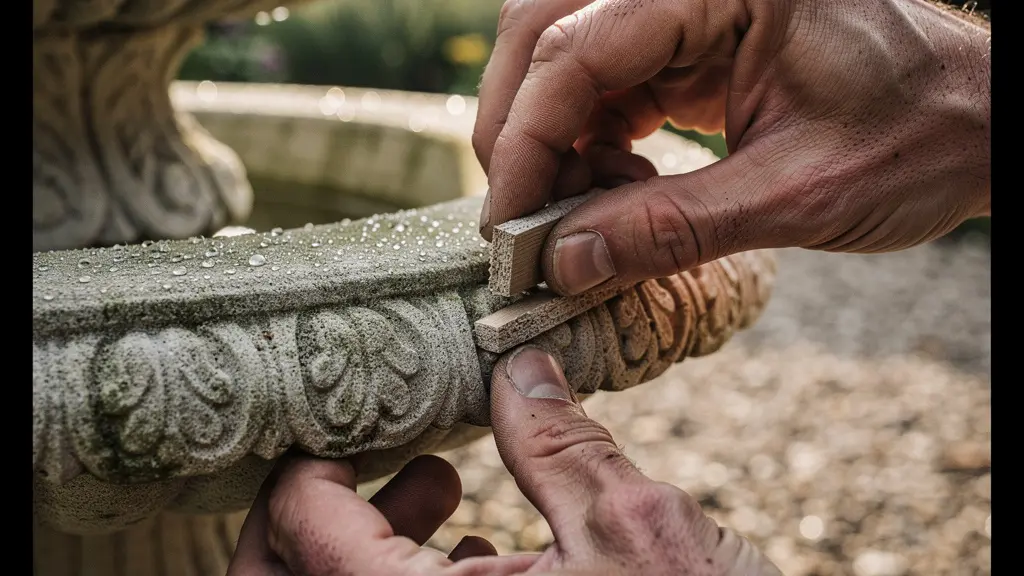
As seen in the technique above, the process requires constant verification. Use a long carpenter’s level across the lip of the first tier, rotating it 90 degrees at a time to check for level in all directions. Identify the low points and use a thin pry bar to gently lift the edge just enough to slide in a hard plastic or composite shim. These shims are designed for immense loads, with some capable of supporting up to 2,000 pounds each. Repeat this process, adding or adjusting shims, until the tier is perfectly level. This must be done for each successive tier to ensure the water cascades correctly and the structure is free from internal stress.
Solar vs Mains Pump: Is Solar Powerful Enough for a 3-Tier Fountain?
The pump is the heart of your fountain, and the choice between a solar-powered and a mains-powered unit has significant implications for performance, especially in regions with variable weather. For a large, multi-tiered fountain, a mains-powered pump is almost always the superior choice for reliability and power. It provides consistent water flow regardless of sunlight, which is essential for maintaining the intended aesthetic and sound of a cascading fountain. A solar pump’s performance, by contrast, is directly tied to the intensity of the sun.
While modern solar technology has improved, it faces inherent limitations that are critical to understand in a four-season climate. As the Pond Informer Editorial Team notes in their guide, with a solar pump, “The pump runs only in direct sunlight and won’t operate at night or on cloudy days.” This inconsistency can be a major drawback for a garden’s centerpiece feature. For large, three-tiered fountains, most consumer-grade solar pumps lack the required “head height”—the vertical distance they can push water—to reach the top tier effectively.
The differences become even more stark when considering winter durability and maintenance, as this comparative analysis shows.
| Feature | Solar Pump | Mains Pump |
|---|---|---|
| Winter Performance | Operates at slow speed on cloudy days but still generates enough energy despite light clouds | Consistent power regardless of weather |
| Freezing Protection | Must be kept indoors when it freezes | Can use freeze-stat or thermostatic outlet for automatic shutoff |
| Operational Lifespan | 2 to 5 years based on usage and maintenance | 5-10 years with proper maintenance |
| Head Height Capability | Designed for ponds maximum 1000 gallons, insufficient for larger fountains as main pump | Suitable for any size fountain with proper GPH and head height rating |
The data from a recent analysis of solar pond pumps is clear: for a significant, multi-tiered stone fountain, a mains pump offers the power, consistency, and easier integration with freeze-protection systems necessary for a northern climate. A solar pump may be suitable for a small, single-tier feature, but it cannot be relied upon as the core of a large, durable fountain system.
The Hard Water Problem That Clogs Stone Pores and Pumps
While the dramatic force of freezing gets most of the attention, a more subtle, long-term threat to your fountain’s health is hard water. Hard water is rich in dissolved minerals like calcium and magnesium. As this water evaporates from your fountain’s surfaces, it leaves behind these minerals as a chalky, white residue known as efflorescence or scale. This buildup is not just an aesthetic nuisance; it is a geological process that actively degrades your fountain.
This mineral scale can clog the pump, reducing water flow and eventually causing it to burn out. More insidiously, it clogs the microscopic pores of the stone itself. Whether cast stone or natural stone, all stone has a degree of porosity. When these pores on the surface become sealed with mineral deposits, it creates a barrier. This barrier can trap moisture within the material matrix of the stone. When temperatures drop below freezing, this trapped water expands, exerting immense internal hydrostatic pressure. This is a primary mechanism behind spalling (flaking) and cracking.
In essence, hard water scale acts like a faulty seal, preventing the stone from breathing and drying out properly. This makes an already porous material even more vulnerable to freeze-thaw damage. In fact, studies on similar cementitious materials show that freeze-thaw cycles are a leading cause of degradation. Using distilled water or a water softening agent in your fountain is a crucial, often overlooked, maintenance step. It prevents mineral buildup, protects the pump, and, most importantly, keeps the stone’s pores open, allowing it to fully dry out before a freeze—a critical factor in its long-term survival.
When to Scrub Algae: The Maintenance Routine to Keep Stone Pristine?
Algae and moss growth on a stone fountain can be seen as a charming sign of age, adding a touch of natural patina. However, from a structural perspective, excessive biological growth is a warning sign. Algae thrives in perpetually damp environments. Its presence indicates that parts of your fountain are not drying out properly, which, in a cold climate, is a major red flag for potential freeze-thaw damage. A routine cleaning schedule is therefore not just about aesthetics, but about proactive structural maintenance.
The goal is to keep the stone’s surface clean and its pores clear without using harsh chemicals or abrasive tools that could damage the material. A soft-bristle brush and clean water are your primary tools. Avoid pressure washers, which can erode the surface of cast stone and force water deep into the material matrix. For stubborn algae, use a cleaner specifically formulated for stone fountains.
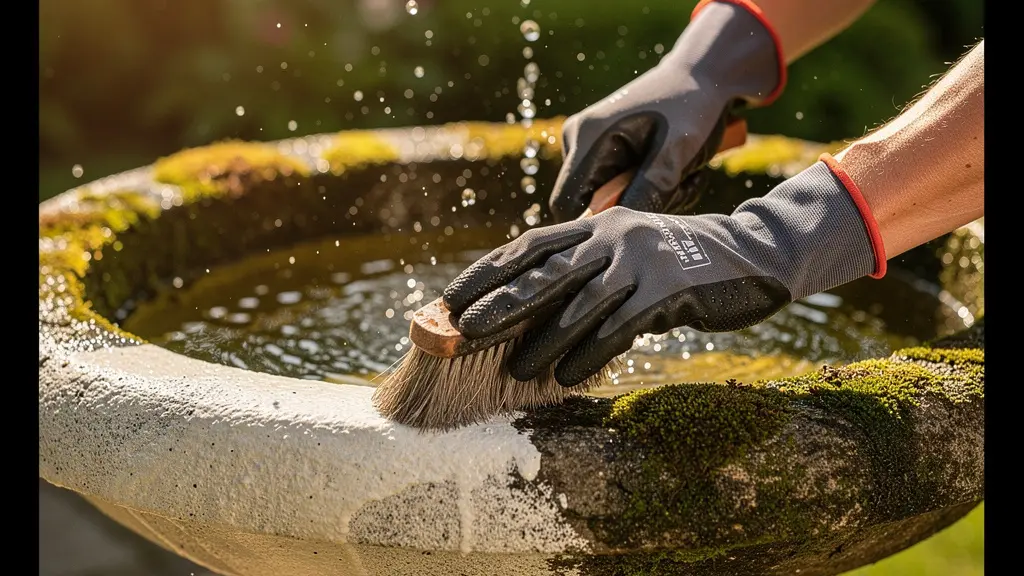
A consistent maintenance routine is the best defense. This should include:
- Weekly: Rinse the fountain with a garden hose to remove loose debris and prevent buildup. Check the water level and top up as needed with softened or distilled water.
- Monthly: Perform a more thorough cleaning with a soft brush to gently scrub away any emerging algae, paying close attention to crevices and water lines.
- Annually: Apply a high-quality penetrating sealer. A breathable sealer is crucial, as it allows any moisture already inside the stone to escape while preventing new water from soaking in. This should be done in a dry period well before the first frost.
This proactive approach ensures your fountain remains not just visually pristine, but also structurally sound and prepared to face the winter.
Natural Stone vs Porcelain: Which Stays Cooler Under Direct Summer Sun?
While the primary focus for a northern climate is winter durability, the question of summer performance does arise. When comparing natural stone to porcelain, natural stone generally stays cooler to the touch under direct sun. Its greater thermal mass allows it to absorb and dissipate heat more slowly than the denser, less porous surface of porcelain. However, this is a minor comfort consideration compared to the critical issue of freeze-thaw resilience.
Here, the internal structure—the material matrix—is everything. Natural stone (like granite or travertine) is a crystalline structure formed under immense geological heat and pressure. Its pores are part of an interlocking, ancient matrix. Cast stone is a concrete product: a mixture of aggregates (crushed stone, sand) and a cement binder. While high-quality cast stone is extremely dense, its durability is dependent on the quality of the mix and the manufacturing process. Its weakness remains the potential for water to infiltrate and compromise the bond between the aggregate and the cement.
Manufacturers of both materials often claim to meet industry standards for durability. However, these standards can be misleading. For instance, an important analysis highlights that while cast stone products may pass a 100-cycle freeze/thaw test, real-world conditions are far more punishing. A fountain can experience a full freeze-thaw cycle in a single day as temperatures rise above freezing in the sun and plummet at night. This rapid thermal shock places immense stress on the material. Ultimately, natural stone’s solid, monolithic structure gives it a long-term advantage in resisting this repetitive stress, provided it is not a highly porous variety like certain sandstones or limestones. The debate is less about which material is “better” and more about understanding which material structure is best suited to resist the specific pressures of your climate.
Recirculating vs Piped: Which Is Easier to Install for Beginners?
For beginners, a self-contained, recirculating fountain system is unequivocally easier to install than a piped-in system. Recirculating fountains operate as a closed loop: a submersible pump sits in the main basin or an underground reservoir, pushing water up through the fountain, where it then cascades back down to be collected and reused. This requires no external plumbing, only a power source for the pump. A piped system, conversely, is connected to a main water line and often includes an auto-fill mechanism and a drain, requiring trenching and professional plumbing skills.
This difference in complexity extends directly to winterization, a critical task for any fountain owner in a cold climate. A recirculating system is vastly simpler to prepare for winter. A piped system, with its underground water lines, presents a much higher risk of catastrophic failure if not drained perfectly. The plumbing itself is vulnerable to freezing and bursting underground, a repair that requires excavation.
As landscape expert Steve Packer of Moana Nursery wisely states, it’s essential to “Remember that winterizing is essentially water-proofing, as it’s not the cold that will damage your pieces but the freezing and thawing process of trapped water.”
Remember that winterizing is essentially water-proofing, as it’s not the cold that will damage your pieces but the freezing and thawing process of trapped water.
– Steve Packer, Moana Nursery Garden Centers
The following comparison, based on winterization guidance from professional fountain installers, clearly illustrates the advantages of a recirculating system for ease of maintenance in freezing climates.
| Aspect | Recirculating System | Piped System |
|---|---|---|
| Winterization Ease | Disconnect pump, pump out 50% of water from reservoir, bring pump inside. | Must drain all underground pipes below frost line. |
| Failure Risk | Simple pump swap if failed. | Burst underground pipes require excavation. |
| Installation | Self-contained, no plumbing required. | Requires underground pipe installation. |
| Auto-Fill Winterization | Not typically included. | Shut off water at source, remove auto-fill fitting and store inside. |
Key Takeaways
- Fountain durability in winter is a result of a complete system—foundation, material, and maintenance—not just a single material choice.
- A reinforced concrete foundation is the most critical element for protecting any heavy fountain from the destructive power of frost heave.
- The ultimate goal of winterization is the total elimination of trapped water, as it’s the expansion of ice, not the cold itself, that causes damage.
When to Drain Your Fountain: The First Frost Warning?
The single most important action to protect your stone fountain is to winterize it before the first hard freeze. A “hard freeze” is typically defined as a period when temperatures drop to 28°F (-2°C) or lower for several hours. At this point, any standing water in your fountain’s basins, pipes, or pores will freeze solid. As it freezes, water expands by approximately 9%, acting like a slow-motion explosion inside your fountain and exerting immense hydrostatic pressure that will inevitably lead to cracks.
Do not wait for the first snowfall. The moment your local forecast predicts overnight lows approaching the freezing mark, it is time to act. The process of winterization must be thorough, with the goal of making the fountain completely dry and waterproof.
Case Study: The Minnesota Polar Vortex Incident
A homeowner in Minnesota with a three-tiered cast stone fountain experienced a sudden polar vortex, with temperatures dropping to -15°F overnight. By morning, the fountain had become a solid ice sculpture. The owner acted quickly, turning off the pump, and then spent several hours gradually thawing the ice with lukewarm water and a nearby space heater. Once water began to flow, they used a wet/dry vacuum to drain every basin completely. Finally, they wrapped the entire dry fountain in thick blankets until a proper cover could be delivered. Thanks to this rapid and careful intervention, the fountain survived without any cracks, though the pump sustained minor damage and was replaced in the spring. This serves as a powerful testament to the fact that it is trapped, frozen water—not just cold—that destroys a fountain.
Following a meticulous process is essential to ensure no moisture is left behind. This is your final and most important defense in the systemic approach to fountain durability.
Action Plan: Your Pre-Frost Fountain Audit
- Drainage Points: Identify and list all components that can hold water, including every basin, internal pipe, and the pump housing itself.
- Component Inventory: Collect all removable parts—especially the pump, any electrical connectors, and auto-fill fittings—and prepare them for secure indoor storage.
- Structural Cohesion Audit: Meticulously inspect the entire fountain surface for existing micro-cracks or weak spots that could be compromised by freezing temperatures.
- Moisture Vulnerability Assessment: Locate all surfaces or bowls that can trap rainwater or snow. Plan to either flip them upside down or completely fill them with an absorbent material like burlap to wick away moisture.
- Protective Integration Plan: Select a properly-sized, waterproof fountain cover. Ensure it can be cinched tightly around the base to create a complete seal against both ground moisture and precipitation.
To ensure your garden centerpiece endures for generations, the next step is to evaluate your specific site conditions and choose a system—foundation, material, and plumbing—that works in harmony. Begin planning your durable fountain installation today.
Frequently Asked Questions About Cast Stone vs Natural Stone Fountains: Which Survives Freeze-Thaw Cycles Best?
How often should I seal my cast stone fountain?
You should seal your cast stone fountain at least once a year to protect it from moisture, staining, and freeze-thaw damage. In areas with harsh weather conditions, sealing it more frequently may be necessary to maintain a protective barrier.
How can I prevent algae growth in my cast stone fountain?
Regular cleaning and using filtered or softened water are the best ways to prevent algae growth. If algae persists, you can use specialized and safe algae removers designed for stone surfaces that will not damage the material.
What should I do if my cast stone fountain develops cracks?
Small, hairline cracks can often be repaired using an epoxy or mortar repair kit specifically designed for cast stone or concrete. For larger, structural cracks, it is highly advisable to consult a professional stone mason to ensure the fountain’s integrity is properly restored.